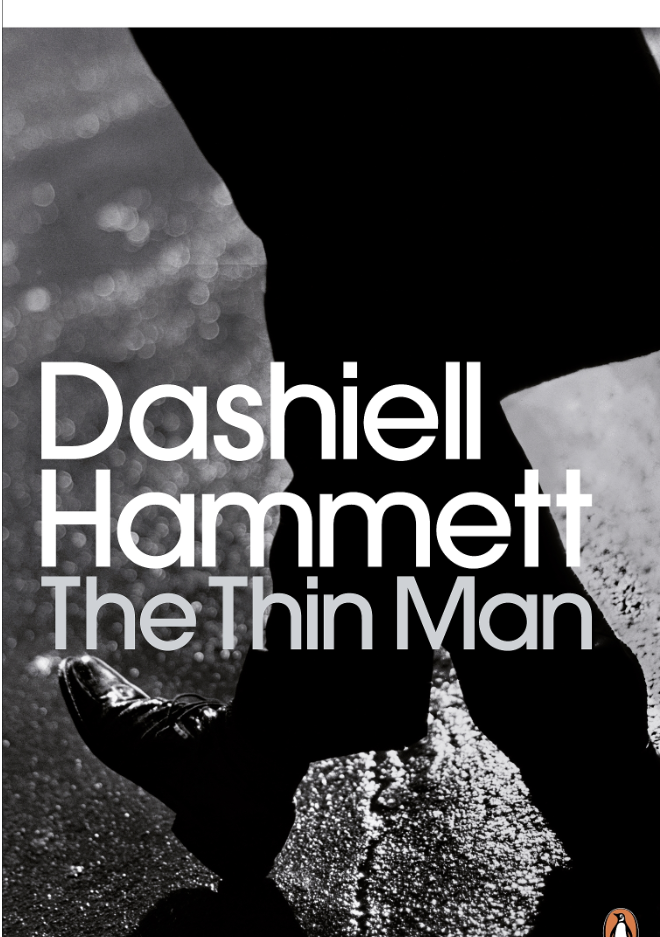
Dashiell Hammett: The Thin Man (1934)

The Thin Man

While I’ve devoured all of Chandler’s books, I’ve hardly read any Hammett. Way back when I started this blog, I read and reviewed The Glass Key – book and movie – and while I liked it, I never returned to him until now. Although I had both The Maltese Falcon and The Thin Man on my piles, I picked the latter. I’m pretty sure they are not in the same league and it wasn’t s as hard-boiled or noir as I expected. On the contrary. It has even some elements of a screwball comedy.

It’s the Christmas season and our hero, Nick Charles, is back in New York with his young wife Nora and their schnauzer Asta. Nick used to be a PI in New York before he met Nora and followed her to San Francisco where they share a business.

While waiting in a speakeasy for his wife who is Christmas shopping, a young woman walks up to him and introduces herself as Dorothy Wynant. Nick used to know her father and her when she was a kid. Dorothy hopes he’s got her’ father’s address but he hasn’t. He hasn’t heard from Wynant in years. Shortly after this encounter, Nick hears that Wynant’s secretary and former lover Julia Wolf has been found dead, shot four times, and that Wynant is missing. Interestingly, the dying Julia has been found by Wynant’s ex-wife, the manipulative, bitchy Mimi. Everyone, including the police, is convinced that Wynant shot Julia, only Nick doubts this.

While the readers are kept guessing who shot Julia, I can’t say that the crime-solving is the most interesting element in this story. What I enjoyed the most is the description of the couple Nick and Nora and the way they spend their days and nights. Most of the story takes place in their hotel room and a huge number of people drifts in and out. Friends, acquaintances, police men, criminals. Every one is constantly downing a drink. The last thing Nick does before he goes to bed – drink, the first thing he does when he gets up – he pours himself another drink. Nora and the others aren’t much better.

Nora might not be the best developed character but she’s fun. She’s the opposite of a nagging housewife. No matter what Nick does or what happens to him, she never gives him a hard time, never freaks out. She’s almost twenty years younger than her husband and very fascinated by his old life. When he’s dragged into the investigation of Julia’s murder, she joins him eagerly and tries to help him find out who killed her.

The tone and humour throughout the book, especially in the dialogue is very dry. Not as dark as in other novels of the era but refreshingly brittle.

I only found out after finishing this novel that Hammett wrote it for the women’s magazine Redbook where it was serialised in 1934. That may explain why it’s not as dark and why there are so many female main characters. There’s Nora, Nick’s wife, the hysterical Dorothy, Mimi, her bitchy mother and Dorothy’s aunt. The male characters are rather pale in comparison.

The THin Man is certainly not Hammett’s best but it’s fun.

Has anyone seen the movie?

Dashiell Hammett: The Glass Key (1931) and Heisler’s The Glass Key (1942)

Ned Beaumont is a tall, thin, moustache-wearing, TB-ridden, drinking, gambling, hanger-on to the political boss of a corrupt Eastern city. Nevertheless, like every Hammett hero (and like Hammett himself), he has an unbreakable, if idiosyncratic moral code. Ned’s boss wants to better himself with a thoroughbred senator’s daughter; but does he want it badly enough to commit murder? If he’s innocent, who wants him in the frame? Beaumont must find out.

I have read everything Raymond Chandler has written. He used to be one my favourite authors. This might be the reason why I neglected Hammett for so long. Maybe I thought he would be too similar and that this would influence my reading.

The Glass Key was my introduction to Dashiell Hammett and although it did remind me a bit of Chandler, they are still quite different. Hammett is at the same time sparser and coarser.

At the heart of The Glass Key lies the question “Who has killed Taylor Henry?”. Taylor Henry is the son of the influential politician Ralph Henry. In an attempt to appear cleaner than he is, the corrupt politician Paul Madvig tries to associate himself with Henry. And he is in love with Henry’s daughter Janet. When Taylor is found dead, rumors start to circulate that he might have been killed by Paul. None of these people are really main characters, the central figure and exemplary tough-guy, is Ned Beaumont. He is a sort of assistant to Paul Madvig and tries, like a PI, to investigate the murder. He visits bars and clubs and people. Gets beaten up and is held captive. Women literally throw themselves at him. This all leaves him quite unfazed. No matter how much you beat that guy up, how often you threaten him, how many times you flatter him or try to seduce him, you will not get much of a reaction but a very short reply. This is as tough as tough-guys go.

The interest, at least for me, did not lie in the solving of the murder. I couldn’t care less. The appeal of this book, is the character of Ned Beaumont, this monosyllabic guy who doesn’t even flinch when he is beaten to a pulp. The other appeal is the world and the atmosphere this novel depicts.

The world of The Glass Key is a world of corruption, prohibition, easy women, hard men, bars and secret joints, bribery and violence.

And of course one has to mention the dialogue. You couldn’t find any more sparse and caustic dialogue in any novel.

Ned Beaumont advanced into the room where Lee and the Kid were.

The Kid asked: “How’s the belly?”

Ned Beaumont did not say anything.

Bernie Despain exclaimed: “Jesus! For a guy that says he came up here to talk you’ve done less of it than anybody I’ve ever heard of.”

“I want to talk to you,” Ned Beaumont said. “Do we have to have all these people around?”

“I do,” Despain replied. “You don’t. You can get away from them just by walking out and going about your own business.”

“I’ve got business here. “

After having finished the book I realized that I had the movie. It is part of a collection of Film noir movies that I had ordered before Christmas. I immediately watched it and liked it a lot.

The story is told differently. More chronological and Janet Henry’s (Veronica Lake) role is much more important. A few names have been changed. There is a club owner who is Irish in the book. He is Italian in the movie which was probably more in line with the depiction of wise guys as they populated the film noir. What I truly liked about the movie is Veronica Lake. Since I have seen L.A. Confidential (one of my favourite movies) in which Kim Basinger is compared to Veronica Lake I always wanted to see the real one. I think she is really special.

Don’t ask me whether I prefer the novel or the movie. I enjoyed reading and watching at the almost same time. It was as if the characters had stepped out of the pages at the end of the book and come alive.

I am really pleased I found the trailer which is not usual for every old movie.