Whatever Happened to My 20 Books of Summer?

Goodness did I fail spectacularly at Cathy’s 20 Books of Summer. My intentions were good, my choices were excellent, and, for a while, I read one book after the other until I realized my pile had one major flaw – there were no crime novels. And once I strayed from the path, it was hard getting back to it. That said, I read seven and a half of the books on my pile before going off course.

Olivier Adam’s Passer l’hiver is a collection of short stories that hasn’t been translated which is too bad. They were outstanding. Melancholy, poignant and so evocative. They show people at their loneliest but mange not to be depressing.

Hilary Mantel’s Learning to Talk is another short story collection and my first introduction to Hilary Mantel. I liked it very much. Especially the first story in the book which reminded me a little of Joyce’s Araby.

Jenny Erpenbeck‘s Kairos. What to say about this? The writing is impressive. If it hadn’t been so great, I wouldn’t have finished it. It’s actually interesting that before this got The International Booker, it wasn’t praised much in Germany. Maybe because of the very toxic nature of the relationship of the two main characters? Or simply because the depiction of the former DDR is anything but convincing.

Willa Cather‘s A Lost Lady. Now this is a novel that will make my best of the year. I liked it so much.

Elizabeth Taylor’s The Wedding Group. I have read a lot of Elizabeth Taylor’s novels and didn’t think I’d ever read one that I didn’t find convincing. Unfortunately, The Wedding Group is not her best. There are things to admire here but overall, it felt disjointed.

Kaye Gibbons‘ Charms for the Easy Life. This is a historical novel, set after WWII. It’s very well written and entertaining but not a favourite.

Kate Zambreno‘s The Light Room is a memoir and I liked it a great deal. She describes the year after her second child is born, which is right at the beginning of Corona. The title The Light Room is an allusion to the Japanese novel Territory of Light, which I’ve read earlier this year. They both have a lot to say about motherhood.

Patricia Lockwood‘ Nobody is Talking About This was praised by so many people, but I found it annoying. It’s uncanny how well she describes Twitter or X but for some reason, it wasn’t for me.

I’m not too bothered that I didn’t manage to finish reading my pile, I’m more annoyed that I didn’t review them. Or any other of the books I read and really enjoyed this summer like Hollinghurst’s The Line of Beauty which has been on my shelves since 2005. Definitely another novel that will make my Top 10 this year.

20 Books of Summer

I just realized, I’m late to Cathy’s 20 Books of Summer. It’s my first time participating and I had no idea it didn’t start at the beginning of summer but at the beginning of June.

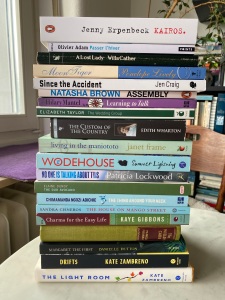
I was always tempted to participate but for some reason never could come up with a list of books. The other day, I was looking at a pile of unread books  on one of the shelves of my newest bookcase and noticed that there were almost 20 very tempting books. I added a few more to have at least one German and one French title, plus one memoir.

Normally, I don’t like to plan my reading but recently decision fatigue has kept me from actually reading and so, having a smaller pile to choose from, sounded like a great idea. It’s a bit like the capsule wardrobes that many people with too many clothes resort to.

Most of the books are rather slim with the exception of Erpenbeck’s Kairos and Edith Wharton’s The Custom of the Country. I’ve already read one book, Willa Cather’s A Lost Lady and am about halfway through Kate Zambreno’s The Light Room.

There are three books of short stories:

Olivier Adam’s – Passer l’hiver

Hilary Mantel’s – Learning to Talk

Chimamanda Ngozi Adichie’s The Thing Around Your Neck

The rest are all novels:

Jenny Erpenbecck – Kairos

Edith Wharton – The Custom of the Country

Willa Cather – A Lost Lady

Elizabeth Taylor – The Wedding Group

P. G Wodehouse – Summer Lightning

Pamela Frankau – The Willow Cabin

Janet Frame – Living in the Maniototo

Penelope Lively – Moon Tiger

Sandra Cisneros – The House on Mango Street

Kaye Gibbons – Charms for the Easy Life

Elaine Dundy – The Dud Avocado

Patricia Lockwood – Nobody is Talking About This

Natasha Brown – Assembly

Jen Craig – Since the Accident

Danielle Dutton – Margaret the First

Kate Zambreno – Drifts

One memoir

Kate Zambreno – The Light Room

I’m very pleased with my choices. There are so many books on this pile that I had wanted to read for ages like The Custom of the Country and Moon Tiger and A Lost Lady that I think, I might actually manage to stick to them.

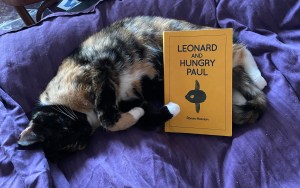
Leonard and Hungry Paul by Rónán Hession #ReadIndies – Bluemoose Books

I’ve always liked the idea of #ReadIndies but was never able to participate. This year, the hosts, Kaggsy and Lizzy, are focusing on micro publishers, publishers, with five employees or less. That said, one doesn’t have to choose from those. Any independent publisher counts. I had far too many choices and finally decided to opt for a micro publisher because I have far less titles from those. Rónán Hession’s novel Leonard and Hungry Paul, a book I’ve been meaning to read for ages, has been published by Bluemoose Books.

Leonard and Hungry Paul tells the story of two unusual friends. At the beginning of the novel, Leonard who is in his thirties, loses his mother with whom he has been living until now. He feels a great loss as his life is very uneventful. He works as an encyclopaedia ghost writer and other than Hungry Paul, he has no friends or relatives. Hungry Paul, too, still lives with his parents. He doesn’t seem to work much other than helping at the post office. Unlike Leonard, he has other relatives, one of which, his sister, is getting married soon.

In the evenings, Hungry Paul loves to play board games with Leonard or, if he doesn’t come around, with his parents. Their lives are full of small rituals that they enjoy enormously. They are also both interested in almost everything  and can discuss many topics at length. The death of Leonard’s mother and Grace’s wedding seem to put things into motion because suddenly there are so many changes in both of their lives.

Leonard and Hungry Paul is a gentle, joyful book about two outsiders and loners who seem to know much more about finding happiness in life than more conventional people. Especially Hungry Paul, whom his sister calls “the sage” sounds often like a Buddhist teacher and Paul is no less wise.

A book like this could very easily have been too saccharine or bland but it isn’t. The style is so witty and humorous, it’s an absolute joy to read.

Here are just a few examples to give you an idea.

Leonard was not exactly sure, but there must have come a point when their relationship (with his mother) grew from a purely filial one into one of partnership. Though an adult son living with his widowed mother is a situation about which society has yet to adopt a formal position, it is clearly seen in second-best terms.


Had he had the courage Leonard would have spoken up and said that his mother looked after everyone in her life as though they were her garden birds: that is to say, with unconditional pleasure and generosity.


The two friends then settled into one of the long pauses that characterised their comfort in each other’s company. They could sit quietly for extended periods without the need to hurry back to whatever it was they were doing, allowing the silence to melt away in its own time. However, on this occasion, Hungry Paul’s extemporising on astrophysics had struck a melancholy note inside Leonard. In the week since his mother had passed on, Leonard had noticed a distinct shrinking of his own personal universe. His evenings were less occupied, his social options had become more limited, and his mind seemed diverted inwards towards a vague, dreamy melancholy.


Hungry Paul had been blessed with a mental stillness which had become his natural state over the years. His mind worked perfectly fine and he had all the faculties of a healthy, if slightly unorthodox, man of his age. He just had no interest in, or capacity for, mental chatter. He had no internal narrator. When he saw a dog, he just saw a dog, without his mind adding that it should be on a lead or that its tongue was hanging out like a rasher.

I really enjoyed this story of a friendship between two unusual characters and the wonderful, witty way in which it has been written.

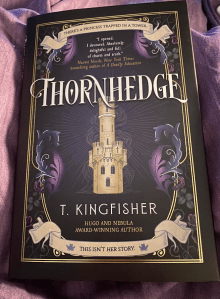
Thornhedge by T. Kingfisher (2023)

My first encounter with fairy tale retellings dates back to my teenage years when I discovered Angela Carter’s The Bloody Chamber. The book and the idea made a huge impression and I have loved reading and writing fairy tale retellings ever since. Among many things, I’m fascinated by the range. I once read a whole book with nothing but retellings of Little Red Riding Hood and didn’t get bored for a minute. I also love modern retellings like those in Cassandra Parkins collection New World Fairy Tales. Among those which are retold most often are Cinderella, Snow White, Little Red Riding Hood, and, of course Sleeping Beauty. As you may have guessed, Thornhedge is a retelling of Sleeping Beauty. A very original one, I might add.

T. Kingfisher is the pen name of the highly prolific children’s book author Ursula Vernon. Under her pen name she writes mostly fantasy for an adult audience. I saw a few reviews of Thornhedge here and there and the authors were all raving so I had to read it.

The main character, Toadling, has been guarding the thick thorny hedge which hides a huge castle for hundreds of years. The reader isn’t sure at first what Toadling is. A fairy, a toad, a witch, a bewitched human? It’s clear she has something to do with the hedge, the castle, and the sleeper in castle that goes beyond being its guardian. Toadling is a very nervous character. She’s afraid people might see the hedge, afraid people might remember it, and very afraid of knights who might remember it and try to get access to the sleeper.

As the centuries go by, fewer and fewer people approach the castle. It seems like a plague has decimated the population of the earth. But then, one day, a knight from a foreign country appears and unlike many others, he seems to know exactly what he’s looking for. Toadling must prevent this at all costs. Even if that means showing herself and befriending the stranger.

What follows is such a beautiful story. We find out who Toadling is and why she’s not only guarding the castle but extremely worried the sleeper might wake up.

Thornhedge is a beautiful story of belonging, loneliness, love, and loyalty. It’s very short, novella-length. If you like fairy tale retellings, fantasy and original tales and love stories, you might enjoy this as much as I did.

Where Have All the Bloggers Gone?

Since I returned to blogging, I’m trying to solve the mystery of the vanished bloggers. Where have they gone? Why did they stop blogging? Are they OK? Will they come back? I’m not the only one who’s been asking this question. Not too long ago I saw a thread on Twitter in which people were asking this exact question – Why did so many bloggers who were once extremely enthusiastic about blogging suddenly stop?

During my prolonged absence from blogging, which included not reading blogs, I wasn’t aware that I was not the only one who stopped. I was one of many to stop but, as it seems, the only one of those who stopped for a longer period, who has come back.

To find out, how many of those I used to visit were still around, I had to go through my blogroll. I went through the links one by one and what I found was rather sad. I expected to find a few inactive blogs and maybe the one or the other that had stopped for good, but I certainly didn’t expect to find that the majority of the blogs on my blogroll consisted of blogs that had been inactive for at least four years, that many had been deleted and several stopped recently. Many stopped in 2020. I think we can all guess why.

I’m not entirely sure what to do with my blogroll. Since I’m one of those bloggers who stopped for quite a long time but always had the intention of coming back, I’m a little reluctant to remove inactive blogs unless their link is broken. And even then, I’m not deleting them, I will just make them invisible to the public. I like to still be reminded of my former blogging friends. I also have always revisited favorite blogs, even if they haven’t written anything new in a long time.

The question remains – why did they stop? I do know in some cases. Occasionally for health or mental health reasons. Some stopped because they didn’t have the time anymore and a few because they didn’t enjoy it any longer. Some, like me, just wanted to take a break and found out that it’s remarkably difficult to come back to something you used to do regularly. I’m not entirely sure why this is the case, but that’s how it was for me. Being active on social media made it easier to come back. I was still in contact with many bloggers. Quite a few of those who have stopped blogging, have also disappeared from social media.

Should any of those who have vanished see this – know that we are still thinking of you and miss you.

I’d like to know how those who are still active handle their blogroll. Do you remove blogs? How long do you wait until you decide to remove them? I remember someone in the past mentioning they went through their links every year and any blog that wasn’t active in that year was removed. That’s too harsh for me but maybe three years should be a limit.

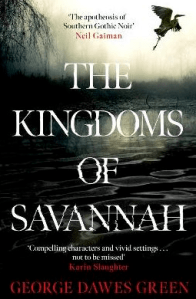
The Kingdoms of Savannah (2022) by George Dawes Green

I read quite a lot of crime but since I don’t do any reading statistics, I have to guess the percentage. Maybe 40%. Given that that’s a relatively high number, it’s rather frustrating that I end up not liking three out of four crime novels or thrillers I read. I’m sure you can imagine how pleased I was to finally find one that I didn’t only like but absolutely loved. The Kingdoms of Savannah is such an amazing novel. Neil Gaiman called it a Southern Gothic Noir and I’d say that’s spot on.

Set in Savannah, the novel tells the story of a murder and a disappearance. Luke and Stony like to have a drink at one of Savannah’s most popular bars, the Bo Peep’s. Stony loves to watch the beautiful bartender Jaq and Luke, well, he likes to hang out with Stony and have a few drinks too many. They are both homeless and most of the time not able to pay for their drinks. Jaq is very fond of them and doesn’t mind. Like most nights, they drink and talk a lot and Jaq, who is doing a documentary for an MFA application, is filming them. After their last beer, they leave together. Outside of the bar, Luke is stabbed and Stony disappears.

Luke’s body is found in a burned-down empty house that belongs to a notorious real estate shark, Archie Guzman. Guzman is promptly arrested for murder, but he swears he didn’t do it. He hires an unlikely private detective, Morgana Musgrove, the head of one of the richest and most influential families of Savannah. Morgana will accept but only if her homeless son Ransom helps her.

Jaq, who happens to be Morgana’s granddaughter, is less than thrilled that Morgana wants to help Guzman. Guzman pretends that Luke was high on drugs, but Jaq knows he didn’t do drugs. Besides, what happened to Stony? Nobody seems to think that her disappearance is linked to the murder. Soon, a police detective, Morgana, and Jaq are all trying to solve the riddle of Luke’s murder and Stony’s disappearance.

The solution, it appears, lies in the kingdoms of Savannah which Stony mentioned all the time, even on the video Jaq shot on the night of her disappearance. Unfortunately, nobody knows what and where they are. Or if they are even real. I won’t say more, as this is not a terribly long novel and some of the twists and the unexpected ending could easily be spoiled. I will just say this – many crime novels have less than satisfying endings. Not this one.

The Kingdoms of Savannah offers so much. A great atmosphere, colourful characters, a setting that comes to life, a suspenseful plot and some very big themes. The most important theme is the role slavery played in Savannah’s history. Themes that are just as important and often linked to slavery are the power of certain families, corruption, and social injustice. So many of the people in this novel are homeless. Many of them, like Ransom, Morgana’s son, live in camps that the police empties and destroys regularly. Reading about this and Savannah’s history made me uncomfortable a few times. Tourists come to Savannah to visit the beautiful houses and gardens, to go on ghost tours. But how many think about Savannah’s history as a city of slave owners? Or how many know that hidden from view, there’s a huge homeless population living a precarious life?

I hope I was able to convey how great this novel is. If you like a Southern Setting, the atmosphere of a noir, and crime novels that have far more to offer than a suspenseful story, then this is for you.


Convenience Store Woman by Sayaka Murata

Just like last year, my first, but hopefully not last, review of the year is a contribution to Bellezza’s Japanese Literature Challenge 17.

I mentioned it last year too, I’m always looking forward to Bellezza’s event. The only difference this year – I had no clue what to pick. My Japanese TBR has grown a lot during the last couple of years and I simply had too many choices. I finally picked Convenience Store Woman because it was the one, I’ve seen reviewed the most in the last couple of months and I wanted to find out whether it really was that good.

The first-person narrator, Keiko Furukuma is a 36-year-old woman who has been working at a convenience store since she turned eighteen. She is someone who never fit in. She doesn’t understand the rules and expectations of society which leaves her confused and unmoored. The day she discovers the convenience store and starts to work there, everything changes. She loves the store, loves working at the store, loves the store’s workings, and has almost literally become a part of the store. It has entered her body and mind. And it makes her happy when it works flawlessly. The beautiful machine her life has become thanks to her dedication to the store, stops abruptly when her sister and old friends start to ask repeatedly why she’s still doing the kind of work that normally students or housewives do part time. Keiko doesn’t really know how to be a real person, as she says, but she is aware that her family and friends do not accept her way of life. To keep them off her back, she lies about her health. If she had a husband, then maybe, they would leave her be. So maybe she should look for a husband? Too bad that she’s not really interested in men. This is a very short book, so I’m not going to add much more about the story.

The book focuses very much on the present but there are a few stories from Keiko’s past which show us that she really is rather peculiar. As a small child, they find a dead bird on a playground and while all the other children cry, Keiko wants to take it home and eat it. There are also small instances of violence. Maybe this wouldn’t be so peculiar if Keiko were able to understand that some things that she did aren’t acceptable, but she doesn’t. Japanese literature is full of quirky characters and most of the time I find them endearing. Not Keiko though.

I found this book very interesting and thought-provoking. I know many readers read it as a piece of feminist fiction, but I feel it’s more than that. In the book, men who are like Keiko face the same pressures. There might be less pressure to get married and have children but the expectations to get a “real job” might be even greater.

It is never said, but while reading this book one gets the impression that Keiko is neurodivergent. That means, there’s even more societal pressure because anything she might do or say alienates people. She knows this but she doesn’t know why and not how to be different. The people around her think she must be unhappy with her life but the only thing that makes her unhappy is their pressure. The way she describes work at the shop made me think of those monks who rake Zen gardens to perfection. Making them look tidy and neat is a meditative endeavour. Keiko’s efforts to keep everything clean, tidy, and running smoothly, is more obsessive than meditative but there is a similar satisfaction in a job well done. I loved reading about the shop, about the way weather and seasons affect sales and many of the other things that are important like how to promote certain foods or display goods in an advantageous way.

What I liked most about the book is how it shows us the arrogance of society in general towards those who do these kinds of tasks. Some people enjoy this kind of work very much and that should count for something, but it doesn’t. Maybe the pressures are a bit extremer in Japan, but Western society also judges people who don’t want to have a career or a family. We still have a long way to go to accept diversity in lifestyle.