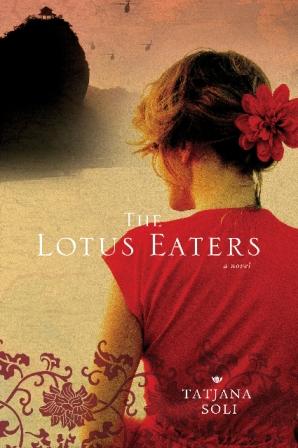
Tatjana Soli: The Lotus Eaters (2010) Literature and War Readalong October 2011

Soli’s debut revolves around three characters whose lives are affected by the Vietnam War. Helen Adams comes to Vietnam in the hopes of documenting the combat that took her brother from her. She immediately attracts the attention of the male journalists in the region, and quickly falls into an affair with the grizzled but darkly charismatic war photographer Sam Darrow. As Helen starts to make her own way as a photographer in Vietnam, drawing as much attention for her gender as for her work, Darrow sends her his Vietnamese assistant, Linh, a reluctant soldier who deserted the SVA in the wake of his wife’s death. While Linh wants nothing more than to escape the war, Darrow and Helen are consumed by it, unable to leave until the inevitable tragedy strikes. The strength here is in Soli’s vivid, beautiful depiction of war-torn Vietnam, from the dangers of the field, where death can be a single step away, to the emptiness of the Saigon streets in the final days of the American evacuation.

For one reason or the other I had a hard time getting into this novel. I struggled for almost 100 pages but all of a sudden I was hooked, fascinated and almost entranced. And I wanted to talk about it. I don’t always feel the urge to talk about what I’m reading but with this book, I felt it because the topics Soli chose are still as conflicting and important today, during any war, as they were at the time, in Vietnam.

The book starts in 1975 with the fall of Saigon and then switches back to 1963 and the moment when the young photojournalist Helen Adams arrives in Vietnam to cover the war. Helen is keen, eager and ambitious and a sensation as she is one of the first women photographers to want to cover a war.

Helen’s character is complex and interesting and through her we see the fascination and problems of this dangerous profession. Helen’s character is based on the stories of real photographers, one of them Dickey Chapelle, one of the first female war photographers who was killed in action.

There aren’t many professions that I find as problematic as war photographer and the novel does a fantastic job at letting us look into their world.

Helen knows from the start that if she wants to become a famous photographer, shoot interesting pictures, she must follow the men into combat. This is not only dangerous, it’s also voyeuristic because the photographers take pictures of everything. Dying soldiers, executed Vietnamese, piles of bodies, screaming children, in short, people during their final moments. They often wonder whether they are more than just vultures, whether it is justified to do what they are doing. On the other hand they get addicted to the high they experience in the heat of the action and the exhilaration that follows an incredible shot that will go on the cover of a magazine and will be seen by the whole word.

Helen and the others constantly oscillate between two states of mind, the selfish drive and the urge to help and reveal to the world what is going on. It seems as if this was a very addictive job and when the novel nears the end and at the same time the end of the war, there is a feeling in the air as if a party was over.

The danger cannot be underestimated. Not only the soldiers, whom Helen gets to like, are killed, many fellow photographers lose their lives as well. One could say the better the picture, the more dangerous the situation was for everyone involved and especially for the subjects.

An older woman from the group, a mother or aunt, screamed and ran forward toward the alcove, and one of the soldiers shot her. Captured on film. The curse of photojournalism was that a good picture necessitated the subject getting hurt or killed.

I was wondering why I always find it much more problematic when someone shoots a photo of a wounded or dying person but have far less of a problem when a reporter only tells or writes about it. Maybe because the dying people lose their privacy. In order to get a good shot, the photographer needs to focus on the pain, to invade the space of the other.

A the heart of The Lotus Eaters is a complex love story or rather the story of a love triangle. I was far less interested in that aspect of the book and that’s maybe why I didn’t like the beginning so much as it focuses a lot on that story line.

Soli manages to give a good feeling for the war. She captures how the war and its perception changed over time, shows how different its meaning was for those abroad, the Americans and Europeans who lived in Vietnam,  as well as for the Vietnamese people. In the beginning the presence of the French can still be felt.

The Americans called it “the Vietnam war”, and the Vietnamese called it “the American war” to differentiate it from “the French war” that had come before it, although they referred to both wars as “the Wars of Independence”. Most Americans found it highly insulting to be mentioned in the same breath with the colonial French.

The descriptions of the city, the country and the jungle are vivid and evocative. For that alone the book is worth reading. I equally liked how she managed to show what it meant for women to cover war. There are no women soldiers and when the female photographers follow a group into combat, they are the only women present which was problematic as well. There were sexual tensions and the fact that the men felt responsible for the women, furthermore they didn’t want to be seen injured or wounded by women.

When Helen goes back to the US for a while, in the late 60s, she tries to make people understand why she does this job. Helen explores her reasons very often and at one point she has to admit it is also because she excels at what she is doing.

“I just went as a lark. It turned into something else. What do you do if you have a hazardous talent, like riding over waterfalls in a barrel? A talent dangerous to your health?” After the question came out of her mouth, she felt embarrassed.

I’m glad I read The Lotus Eaters.  It has many beautiful passages and is very thought-provoking. It gives an in-depth view of one of the most dangerous professions without giving any easy answers. It’s up to the reader whether he thinks they are purely adrenaline addicted vultures or whether they are doing a heroic and admirable job.

I often wonder whether we need those pictures. Do we need to see the horror in detail, up close? Does it help stop wars? In one instance Helen says that every good war picture is an anti-war picture. Is that true and does it justify what they are doing?

I’m curious to hear what others thought.

Other reviews:
Anna (Diary of an Eccentric)


Danielle (A Work in Progress)

Serena (Savy Verse & Wit)

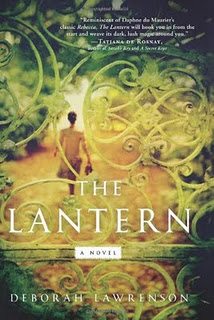
Deborah Lawrenson’s The Lantern – Group Read Week III (Part 5)

The Lantern by Deborah Lawrenson ebook

This is the last week of Carl’s R.I.P. VI group read of Deborah Lawrenson’s The Lantern. This week’s questions have been provided by Heather. Here is the link to the other posts.

Looking back on the novel, I would say this was a very mixed bag for me. I was really curious to read the end for many reasons. I wanted to know how it all tied up and I also thought that I could only say whether I really liked the book once I finished it.

Those who have not read the book at all, shouldn’t read the answers. They contain spoilers.

1. Now that it’s all said and done; what did you think of the book? Did you see the ending coming?

It was a mixed bag. I liked some parts a lot but after having finished I must say, I didn’t like the end at all. The story of the bones was too predictable, the missing girls a bit of a plump red herring and Rachel’s end was far from realistic.

2. What do you think of the characters? Lawrenson took us on a twisty little ride there, I had trouble deciding who was good and who wasn’t for a while there! What do you think of Dom? Of Sabine? Rachel?

I still think Dom was an insufferable character and what he says about Rachel’s death doesn’t even have to be true. Rachel was a troubled mind but we never really know why she became the way she is.

3. Pierre was such a conflicted character. In the end, do you think he killed Marthe and Annette, or did the fall to their deaths because of their blindness?

I’m pretty sure, he killed them. It goes well will all the other cruelties he committed.

4. The book is being compared to Rebecca and Daphne du Maurier’s writing. Do you think the book lives up to that description?

I didn’t see Rebecca in it at all. It’s decidedly not in the same league.

5. Did you have any problems with the book? Narration? Plot? The back and forth between two different characters and times?

I had a huge problem with the police procedurals and the cancer story. They just didn’t sound realistic. This book overflows with descriptions and details but all we get is the word “cancer”. That’s too easy. To feel at least a little bit realistic, we should have heard what type of cancer. Colon cancer, pancreatic cancer, non-small cell lung cancer, leukemia, glioblastoma… What did she have? I think you get the drift. If you can’t call a tree a tree but tell your readers it’s a fig, it’s a pine, it’s a …. then you should be a bit more explicit than that when it comes to an illness like cancer, especially when the person dies of it. This was not believable for me and spoilt the ending of the book.

6. Do you think Lawrenson tied both stories together well in the end? Is there anything she could/should have done differently?

The best part is Bénédicte’s story. I like that ending very well but, as said before the solution to the “serial killer” and Rachel’s end felt wrong, like a cheap trick.

7. One problem I had with the novel is the reliability of the narrators. Do you think any of them were telling the truth? Which ones?

I think Bénédicte and Eve are probably the only truthful ones. Dom’s story could be true or not.

Deborah Lawrenson’s The Lantern – Group Read Week II (Parts 3 and 4)

The Lantern by Deborah Lawrenson ebook

This is the second week of Carl’s R.I.P. VI group read of Deborah Lawrenson’s The Lantern. This week’s questions have been sent by Kailana. Here is the link to the other posts.

This week we read part 3 and 4 of the book. I’m still in two minds about the novel as a whole. There are passages I like and others I don’t but overall I enjoyed parts 3 and 4 much more than parts 1 and 2. They were more mysterious and creepier and I really wanted to know how the book ends that’s why I already finished it but I will not spoil it for those who haven’t read part 5 yet.

Those who have not read the book at all, shouldn’t read the answers. It wasn’t possible to avoid spoilers.

1. The title of this book is The Lantern, and a lantern makes an appearance in both of the stories. In Benedicte’s past, it had a meaning, but what do you think the lantern signifies in her future and in Eve’s story?

For me the lantern is one of the most creepy elements, together with the slender figure Eve sees several times at a distance but who disapears every time she gets closer. The discovery of the bones in the pool was quite creepy as well. At one point I thought it might be Dom who was carrying the lantern and trying to confuse and scare Eve.

2. Carl mentioned scents in last weeks questions, but they have been addressed even more in these sections. What significance do you think scents have in this story overall?

Scents are powerful triggers for memory. A scent can open up a door to a long forgotten past. That seems to be the function of the scents in the novel. For Bénédicte the scents and especially the perfume Lavande de Nuit are tied to Marthe, for Eve, I think, they will forever be her link to the first summer with Dom. And, finally, they capture the essence of the South of France, this very essence that Marthe tried to recreate with her perfume.

3. What do you think of the combining storyline of Marthe? She connects Benedicte, Eve, and Rachel. What do you think will be revealed about this connection in the next sections?

Marthe’s story is the one that fascinates me the most. The other characters in the story seem to feel the same. They are all equally fascinated by her. Her disappearance echoes Rachel’s story.

4. Now that things are beginning to move along, what do you think of the characters? Are any standing out for you? Do you particularly like any? Dislike any?

Of course I totally dislike Pierre. Dom is still without any interest to me. Eve is not very fascinating either but I’m interested in Bénédicte, Marthe and, more surprisingly in Rachel. I also start to feel pity for Rachel. I wonder if Dom ever really understood her. It seems she had issues but usually this type of issues does have an origin. Nobody becomes this obnoxious and dishonest without a reason.

5. What do you think really happened to Marthe and Annette? What do you think the significance of the bones in the pool are to the story? Especially now that it has been revealed that Rachel is also dead.

I was pretty sure they had been killed by Pierre but I didn’t see a connection with Rachel.

6. Do you have any other things you think are significant to talk about? Are there any other predictions to be made for the last two sections of the book?

I’d rather not answer this as I already finished the book.

7. Lastly, what do you think of this book overall? Other than for the read-along, why are you reading it? Is it meeting your expectations?

It’s different from what I expected. I thought I would like the story Eve – Dom – Rachel best but now I realize I’m far more interested in the triangle Marthe – Bénédicte – Pierre. During parts 3 and 4 it met my expectations. I didn’t mind the descriptions anymore and, as I said before, I really wanted to find out the ending and rushed right through the final pages.

Deborah Lawrenson’s The Lantern – Group Read Week I (Parts 1 and 2)

The Lantern by Deborah Lawrenson ebook

This is the first week of Carl’s R.I.P. VI group read of Deborah Lawrenson’s The Lantern. This week’s questions have been sent by Carl. Here is the link to his post. We have been reading part one and two of the book. It’s safe to read the answers below as they do not contain spoilers. It’s too early in the book. But some of the answers can give you a good impression of whether you want to read the book or not.

The blurb calls The Lantern a novel in the vein of Rebecca. Eve, a young woman, falls in love with a complete stranger. When he asks her to come and live with her in an old beautiful house in the South of France, she abandons her life in London and follows him. The house and its surroundings are enchanting and so seems their life at first. But when Eve begins to ask questions about Dom’s first wife and discovers strange things in the old house, it all starts to change.

1.  This may seem like an obvious opening question, but what do you think of The Lantern thus far?

I am in two minds about it. There are passages that I like for their detailed descriptions and others that I do not like for the exact same reason. Sometimes water is just water. But in The Lantern you will always find a fancy description. Blue-green icy sea water. They do not eat fruit, they eat mulberries and figs and cantaloupes and probably they will taste spicy, caramel-sweet and refreshingly juicy. There is no noun that isn’t accompanied by an adjective. I find this tiring at times. I feel as if I had entered a stuffy old boudoir with too much furniture and knickknacks in it. But then again, at other times, she captures the scents, the aromas, the colors, the light and the flora of the South of France so well, that I enjoy it.

The story is interesting so far and I’m curious to find out what is going to happen next but I’m not overly keen on the characters.

2. The book appears to be following the experiences of two different women, alternating back and forth between their stories.  Are you more fond of our main protagonist’s story or of Benedicte’s or are you enjoying them both equally?

They are both interesting and I want to find out, why the book skips back and forth. One moment we are in the past with Bénédicte, then we are back with Eve. Bénédicte is the more interesting of the two because she is more mysterious. I also think that the parts that are dedicated to her are less fraught with details.

3.  The Lantern is a book filled with descriptions of scents.  How are you liking (or disliking) that aspect of the book?  How do you feel about the lavish description of scents? How are the short chapters working for you?

I like the short chapters. I also enjoy the descriptions of scent but all in all, as I said in my first answer, I think it is overdone. There is too much of it. It has an appeal but at the same time it’s overpowering. The strength of the novel is at the same time its weakness.

4.  How would you describe the atmosphere of Parts 1 and 2 of The Lantern?

Part 1 seemed almost playful, a few hints that things may not be as they seem, but there is a lot of hope, a joyous atmosphere. In part 2 there are more and more strange things going on, there are omens and signs and much more chapters focus on the past.

5.  Has anything surprised you to this point?  Anything stand out?

I’m surprised by the descriptions, how appealing and artificial they are at the same time. I’m also surprised that the story goes back and forth in time and changes between the point of view of the two women.

6.  What are your feelings about Dom in these first two sections of the story?

I simply cannot stand the guy and have no clue why any woman would follow someone who makes a secret out of his past. I wouldn’t trust him at all.

Bonus question:  Did anyone else hear “Last night I dreamt I went to Manderley again” ringing in their ears through the first sections of the book

I read that it had a lot in common with Rebecca. Maybe the storyline is similar but the writing is so completely different that I didn’t really think of du Maurier’s book.


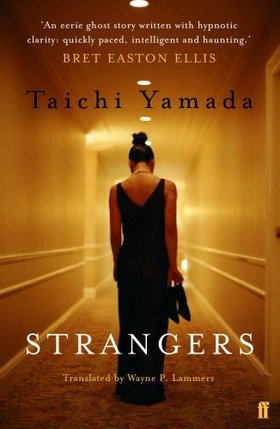
Taichi Yamada: Strangers – Ijin-tachi to no Natsu (1987)

A disconcerting, yet deeply satisfying novel: a wonderful study of grief and isolation, a moving expression of our longing for things we have lost and are unable to have again.

I’ve read about Strangers last year on Novroz’ blog (here is the review) and wanted to read it ever since. It’s a ghost story and as such a perfect choice for Carl’s R.I.P. challenge. But it is also so much more than just a ghost story. It’s a truly wonderful book with a haunting atmosphere, a melancholy depiction of solitude and loneliness with a surprisingly creepy ending.

I often think that the problem some people have with ghost stories is that they take them literally and if they do not believe in the possibility of an afterlife, they do not want to read them. But ghost stories can also be read as purely symbolical. Loneliness, longing and grief can affect a person deeply. Lonely children often start to talk with imaginary friends and also older people can start to talk to themselves which is actually rather a conversation with someone who is not present than a discussion with oneself.

I used to live in a huge apartment building for a while and remember that it could feel strange being awake at night when everyone else was obviously sleeping. All the lights were turned off, there were no noises. Coming home at night and seeing the building from afar, like a big ocean liner, with all the lights on, was also quite special.

Strangers starts in a building just like that. A huge apartment building on Tokyo’s noisy Route 8 where constant traffic keeps you awake and the density of the exhaust fumes forbids the opening of the windows. Most of the apartments are offices. Harada, a fortysomething TV script writer, has stranded here after his divorce. At first he can hardly sleep. The traffic noise is overpowering but after a few weeks he gets used to it. One night, despite the noise outside, he feels an intense loneliness. It seems as if he was the only person in this big building.  He finds out that there is only one other person, a woman, staying at the house at night. Everyone else leaves the place and lives somewhere else.

One night the woman, Kei, knocks on his door and wants to drink a bottle of champagne with Harada but he refuses. He regrets it and invites her a few days later. She is a beautiful woman but with a terrible burn mark where her breasts should be. While they start dating, Harada visits Asakusa, the downtown district in which he used to live with his parents. His parents died when he was very young. He never returned to the place but all of a sudden something attracts him magically. Many of the houses have been destroyed and replaced by modern ugly buildings. While walking around Harada meets a man who looks exactly like his dead father at the time of his death. He follows him to his house and there is his mother, she too is still young and looking exactly like she did before she died.

Harada knows that he shouldn’t return to see his parents but he cannot help himself. He has to go back again and again. His friends start to tell him that he is looking bad. Kei wants him to stop seeing them. He can’t and we understand why.

Something closely akin to the wonderful sense of security I’d felt at such times as a child had descended on me that night in Asakusa. I coul recall no such moments in all the years since my parents had died.

Yamada managed to write a ghost story that is at the same time an eerie tale and a realistic portrayal of loneliness, grief and the search for a meaning in life. Harada is at a turning point in his life. He has a hard time finding jobs, his wife got most of his money after the divorce, his son doesn’t want to see him, most women are not interested in a man like him. Falling in love with Kei seems not so much a choice as inevitable. They are both scarred in different ways. Meeting his dead parents is what infuses his days with meaning and warmth until he starts to pay a prize for it.

What did it amount to, anyway, this life I led? Busying myself with random tasks that popped up one after another, enjoying the moments of excitement each little sir brought before it receded into the distance, yet accumulating no lasting store of wisdom from any of it.

Strangers is an excellent ghost story and a melancholic depiction of the loneliness that living in a big city like Tokyo can bring. I really loved this book. I could hardly put it down and at the same time I didn’t want it to end.

Tim O’Brien: The Things They Carried (1990) Literature and War Readalong September 2011

A sequence of stories about the Vietnam War, this book also has the unity of a novel, with recurring characters and interwoven strands of plot and theme. It aims to summarize America’s involvement in Vietnam, and her coming to terms with that experience in the years that followed.

I expected The Things They Carried to be a very good book. A very good book about the war in Vietnam. What I found is not only an outstanding book about the war in Vietnam but also about the art of storytelling. I’m really impressed. I don’t normally rely so heavily on quotes but in this case, I think, the author is the best person to give an accurate impression of his excellent writing.

But this too is true: stories can save us. I’m forty-three years old, and a writer now and even still, right here, I keep dreaming Linda alive. And Ted Lavender, and Kiowa, and Curt Lemon, and a slim young man I killed, and several others whose bodies I once lifted and dumped into a truck. They’re all dead. But in a story which is a kind of dreaming, the dead sometimes smile and sit up and return to the world. (…) The thing about a story is that you dream it as you tell it, hoping that others might then dream along with you, and in this way memory and imagination and language combine to make spirits in the head.

The Things They Carried is told in interwoven stories. They are linked through the characters who return in most of them and through the common themes of war and storytelling. Each of the tales shows another way of telling a story or looks at an episode from another angle. Some are explicitly written by a writer for his readers only, they have never been told before. Some describe how the soldiers tell each other stories of what happened while they were separated or how they keep on retelling the same stories over and over again. Telling these stories gives meaning and is also liberating and healing. Those who cannot tell stories, those who are shut up by what they saw, those are bad off.

What is so fascinating about this book is that you can just read it like a series of linked episodes or you can read each episode as an attempt to tell the story another way.

One of the most powerful chapters is certainly the first, the one that gave the book its title. Through the enumeration of the things the soldiers carry, we get to know the soldiers, we sense that some of them will die and some will be wounded. As we learn later many of the young men O’Brien served with and who are introduced too us in this first chapter, die. Some through enemy fire, some in accidents. Some deaths are heroic, others are ridiculous, like Kiowa’s who got shot and then suffocated in a field full of shit. What impressed me in this story is the description of the stress, the weight they had to lift, the endless walking.

They moved like mules. By daylight they took sniper fire, at night they were mortared, but it was not battle, it was just the endless march, village to village, without purpose, nothing won or lost.

We learn a lot about the feeling of having been in a war and in this particular war. We hear about the state of mind of the soldiers and what war did to them. There are some chapters that made me feel uncomfortable like the one of a young soldier’s girlfriend who stayed with them a few weeks, joined the Green Berets and ultimately disappeared in the night, swallowed by the war. She got addicted to the feeling of danger and the heightened sense of being alive that went with it. This is fascinating and also unsettling.

I have read other accounts of men who went to war, I know my own father’s stories but they sound different which leads me to the conclusion that some experiences were typical for the soldier in Vietnam.

The average age in our platoon, I’d guess, was nineteen or twenty, and as a consequence things often took on a curiously playful atmosphere, like a sporting event, at some exotic reform school. The competition could be lethal, yet there was a childlike exuberance to it all, lots of pranks and horseplay.

At the end of the book you have the whole story of Tim O’Brien’s time in Vietnam. From the day when he got the letter that informed him that he was drafted, to the first days in Vietnam, all through the weeks that passed, all the things that happened, the friends he found, the friends he lost and how he ended up feeling like an outcast because he was sent away from his company after he was wounded and had to do some light duty in another camp. Maybe not all of this is true, as O’Brien writes, but a lot of what is made up is closer to what really happened than that what is just the plain unadorned truth.

Here is my favourite quote:

A true war story is never moral. It does not instruct, nor encourage virtue, nor suggest models of proper human behavior, nor restrain men from doing the things they have always done. If a story seems moral, do not believe it. If at the end of a war story you feel uplifted, or you feel that some small bit of rectitude has been salvaged from the larger waste, then you have been made the victim of a very old and terrible lie. There is no rectitude whatsoever. There is no virtue. As a first rule of thumb, therefore, you can tell a true war story by its absolute and uncompromising allegiance to obscenity and evil.

The Things They Carried is fascinating and powerful. Writing at its very best.

I hope others have read it as well and liked it as much. I would also like to hear how it compares to Matterhorn.

Other reviews

Anna (Diary of an Eccentric)

Danielle (A Work in Progress)

Silver Season

Beryl Bainbridge: The Dressmaker (1973)

Wartime Liverpool is a place of ration books and jobs in munitions factories. Rita, living with her two aunts Nellie and Margo, is emotionally naive and withdrawn. When she meets Ira, a GI, at a neighbour’s party she falls in love almost as much with the idea of life as a GI bride as with the man himself. But Nellie and Margo are not so blind …

Guy’s recent review of the Girl in the Polka Dot Dress (you can find it here) put me in the mood to read Beryl Bainbridge who had been on my radar and reading pile for a while. Initially I didn’t even want to buy The Dressmaker as the cover looked like some soppy romance. I couldn’t have been more wrong. This is a fantastic book. It’s so fantastic that I don’t know how to describe her writing. One would have to quote her extensively to convey a good feeling for her art.

While I was reading the book I was alternatingly thinking three things: “Why did I not discover her earlier?”, I” want to write like her”, “How did she do that?”

The Dressmaker is set in wartime Liverpool, a place and time that interests me a lot. Young Rita lives with her two aunts, Marge and Nellie. Her mother died and her father, whom she calls Uncle Jack, a butcher,  was unable to cope and raise a girl on his own. That’s the reason why she finished living with her two spinsterly sisters. Nellie, who is a dressmaker, is a joyless woman. She only lives for the day when she can finally follow her own mother to the grave. She is very domineering and her cheerless ways crush her sister as much as her niece. She has turned polishing and looking after her mother’s furniture into a cult. The lifeless objects mean more to her than her fellow human beings. Marge is quite different. She was married but her husband died, she also seems to have affairs that Jack and Nellie try to crush as soon as they start. Still she is lively and tries to enjoy life as much as the other two allow it. Rita is  a very naive young girl, very cheerless as well and full of sentimental, romantic and unrealistic ideas. When she meets Ira, a young GI, she has all sorts of pictures and dreams in her mind but none matches reality.

Interestingly the novel starts at the end but we do not know that really until we finish the book.

Afterwards she went through into the little front room, the tape measure still dangling about her neck, and allowed herself a glass of port. And in the dark she wiped at the surface of the polished sideboard with the edge of her flowered pinny in case the bottle had left a ring.

Nothing is like it seems in this novel. That may not be an unusual premiss but what is unusual is the way Bainbridge provides information. She can describe a scene leaving out an important detail that she will give much later. This makes you feel as if you were discovering all sorts of things while reading. She would never give you the whole picture of any situation or a person right away. Reading her is like being sprayed with cool water every few minutes. It will keep you attentive, awake and alert the whole time.

Just like situations and characters are only understood completely after we have read most of the novel, the story and its ending are only fully grasped at the end.

Besides this very wonderful and unusual story telling, she touches on so many themes. It’s so accurate how she portrays the way those young GI’s were received in England, enthusiastic by the women and with a lot of jealousy by the men as they were “overpaid, oversexed and over here”, as they said. Economically they were so much better off than the British, it must have been quite painful for many men. There is a lot of prejudice but at the same time they are also idealized. The way young Rita felt was quite typical too.

She was mad for the way he said “dawg”, like he was a movie star, larger than life.

Of course he isn’t anyone famous or important and  doesn’t even come from a rich family as Rita assumes or hopes. Without being aware of it, Rita would probably have fallen for any man who would have given her the idea of escaping her oppressing situation. She is not only living in a cheerless but in a highly dysfunctional environment and under the surface a lot of things are smoldering. Repressed sexuality and joy are but a few results of the upbringing Nellie, Marge and Jack had to endure as children and are now passing on to their daughter and niece.

Bainbridge offers accomplished writing paired with an engrossing story that culminates in a surprising ending. If you haven’t read her, I can only urge you to rush and get one of her novels. If you have read her, I’m sure, you know what I’m talking about. I very rarely feel the urge to read all of someone’s novels. It does happen though. It just did.

After Guy’s suggestion I already ordered another one, An Awfully Big Adventure. Do you have any other recommendations?