Tracy Chevalier: Remarkable Creatures (2009)

On the windswept, fossil-strewn beaches of the English coast, Mary Anning learns that she has a unique gift: “the eye” to spot fossils no one else can see. When she uncovers an unusual fossilized skeleton in the cliffs near her home, she sets the religious authorities on edge, the townspeople to gossip, and the scientific world alight. After struggling through cold storms, landslips, and other natural threats, her challenges only grow when she falls in love with an impossible man.

l often say I don’t like historical (genre) novels but I will not say this anymore. I may not pick them up frequently but when I do I often enjoy them. Even more so when they open a door to a world that fascinates me and of which I didn’t know a lot. Tracy Chevalier’s book Remarkable Creatures was exactly one of those books.

In the early 19th century the little working-class girl Mary Anning helps her family make a living with “curies” – curiosities – she finds on the beaches of Lyme Regis. Uneducated as she is, she doesn’t know a lot about fossils, she only knows that the rich people who come to stay at Lyme Regis give her money for her finds. Elizabeth Philpot who has moved to Lyme Regis with her two sisters is equally attracted by fossils. She is an unmarried woman who due to her unpleasing looks and the lack of money has no chance of ever finding a husband. When she meets Mary she is immediately aware that the girl has a gift. Where others see only stones and rubble, little Mary spots fossils. The two become friends and Elizabeth mentors the girl and helps her to sell her finds to a good price. When Mary makes a revolutionary discovery, the fossilized skeleton of an Ichthyosaurus, it is Elizabeth who fights for Mary’s right to be rewarded and acknowledged as the finder.

The book tells the life story of these two women in alternating first person narratives. It desribes their struggles, their failure at finding love and their fight for recognition. This is a time in which the idea of evolution, the fact that there once have been species that are now extinct, is thought to be blasphemous and heretic. And it’s even more problematic to acknowledge that women could contribute to science. Mary Anning’s discoveries are “remarkable” to some and shocking to many others.

This idea was too radical for most to contemplate. Even I, who considered myself open-minded, was a little shocked to be thinking it, for it implied that God did not plan out what He would do with all of the animals He created. If He was willing to sit back and let creatures die out, what did that mean for us? Were we going to die out too? Looking at that skull with its huge, ringed eyes, I felt as if I were standing on the edge of a cliff.

I was completely captivated by this story. The descriptions are so well done. Tracy Chevalier has a gift to bring the past to life. I already noticed that when I read Girl With a Pearl Earring. The period detail seems extremely well done. I have always been fascinated by fossils and delighted when I found some but I never bothered to read much about them. I had never heard of Mary Anning before and loved to be introduced to this amazing woman and her story.

I expected something slightly different though. I thought this would be a novel about a friendship which it is to a certain extent only not the type I had in mind. I’m obviously used to modern-day friendships with the emphasis on discussion and soul-baring. There is none of this in this book. Their friendship is expressed in silent company, not conversation. More than anything else, these two women form a little support group. Both have not been treated kindly by society and could be called outcasts. Elizabeth maybe less than Mary but still to some extent as well. Both are trapped by their respective class and their gender and if it hadn’t been for the fossils and their attachment to each other, they would have lived sad and lonely lives.

The melancholy mood and the evocative descriptions of the setting, the beaches of Lyme Regis, the weather, the danger of being killed in a landslip fascinated me even more than the story of these two women. The cover of the book captures some of this very well. A lonely rather rough-looking beach and two figures completely absorbed by what they see.

I’ve read that others found the book to be flat or lacking. It wasn’t any of this for me. I liked it a great deal and would highly recommend it to those who like Tracy Chevalier’s books.

Have you read this or other books by Tracy Chevalier? Which is your favourite?

Here is the link to Tracy Chevalier’s blog and a video in which you can see the beaches and listen to her talk about the creation of the book and why she chose to tell this story. It’s quite fascinating.

The book is part of a readalong hosted by Emma (Book Around the Corner). Unfortunately the book didn’t work for her. You can find her impressions here.

Muriel Spark: Territorial Rights (1979)

I have been looking forward to Muriel Spark Week hosted by Simon from Stuck in a Book  and Harriet from Harriet Devine’s Blog. I liked both of the Muriel Spark novels I’ve read so far,  The Girls of Slender Means and The Prime of Miss Jean Brodie. It was about time to read another one. Territorial Rights had been on my piles for a while and that’s why I decided to read it.

Sadly this book did not work for me and if it hadn’t been for Muriel Spark Week  – and if I was not a notorious book-finisher – this would have been a DNF for me. But first things first.

Territorial Right is set in Venice and as a Venice novel it is remarkably well done. I was there, I saw the streets, the canals, the piazzas, the palazzi, the churches, the street cafés and the back gardens. I enjoyed the descriptions a lot.

Now take this setting and throw in a motley crew of people, all magically coming to Venice at the same time. They know each other either from Paris, England or Bulgaria. They do not only know each other but they are all connected and even fleeing from each other only to bump into each other in Venice. Hmmmm. Add a dark secret that is hidden by two elderly women owning one of the local pensions, murmur of political machinations, drug dealers, an unfaithful husband, an elderly  woman wo likes young men, a Bulgarian artist in exile who jumps in the canal because she finds out she has been in bed with a Jew, a rich art dealer who is in love with a young man who disappears while his father abandons his lover for his sons ex-lover…

All is resolved in the end. Nothing was as it seemd at first. We find out what was hidden in the garden and get to know the past and the future of each character. Does it sound quirky? It sure was.

I think there is a lot going on in this novel that mirrors unresolved conflicts in Spark’s life and I’m sure from what little I have read after finishing the book that it would be interesting to analyze it in the light of this. Little incidents like the girl jumping into the canal to clean herself after having had sex with a Jew are meaningful when you know Muriel Spark had a falling out with her son because he was an Orthodox Jew and she a devout Catholic (as read on Wikipedia).

Since this is a very well written book, I can see how it could appeal to someone else. It’s a must for those who love novels set in Venice.

I hope others have been more successful in their book choices. Despite not having liked this, I will certainly read another of her novels soon.

Has anyone read Territorial Rights? Did you like it?

Suzanne Collins: The Hunger Games (2008)

I bought The Hunger Games long before even part II and III were out but never read it. Too much hype. Not that there is less of it now but I’d like to watch the movie and figured, I should read the book before. I finished it in barely two sittings and even spent one night dreaming of it.

I went through a few different phases while reading it and finally I had to admit that a lot of the problems I had with the book were entirely mine and resulted in some misconceptions. Sometimes we expect something from a book or a movie that isn’t there. I’m not the only one, I saw this reflected in a few of the reviews I’ve read so far. This isn’t a poetical fantasy story, nor a subtle YA coming-of-age novel. The Hunger Games is a dystopian adventure/action story. Following the logic of adventure and action movies and books, there isn’t a lot of introspection. Switching from Virginia Woolf’s world of characters with a rich inner life, I felt a bit lost at first but once I saw the book like a new take on an old theme, namely gladiators in a dystopian setting, I started to enjoy the ride.

A modern-day gladiator novel is pretty much what The Hunger Games is. When you’ve learned Latin in school you are familiar with the expression “Panem et Circenses” meaning “Bread and Games/Circuses”. The story plays in a distant future, in America, in the country of Panem. There are a lot of other elements taken from roman history: the Capitol, some of the names like Octavia, …

The 24 tributes of the 12 districts of Panem, 12 boys and 12 girls are sent into an arena where they fight against each other until there is only one survivor left. The games are not only shown on TV but they must be watched. The questions the book could have asked but only brushes is “Would you kill to survive?” and “How does it affect you to be forced to witness killing on a regular basis?” or “Are these killings murder?”.  The book can lead to this type of discussion but it doesn’t really look into those questions at all.

Katniss, the main character, volunteers in order to save her sister. She prays that her best friend Gale isn’t going to be sent in with her. Since there can only be one survivor it would mean she might have to kill her best friend. The boy chosen instead, Peeta, isn’t a much better choice as he saved her life once. She can only hope that either she or Peeta will be killed by someone else before the last fight.

The arena is a vast landscape with forests and lakes, bushes and caves. The game masters can change the weather, they can send wild animals, ice and storm, fire and frost. This adds to the difficulties. Only those who are skilled in all sorts of survival techniques, those who know how to hunt and hide will make it.

It is a quick read and I was captivated, not so much because I wanted to find out who will survive, no, there was no suspense in that department. It’s pretty clear from the start but it isn’t clear how they will survive. And I was interested to see whether Katniss would have to kill someone as well. And if and how it would affect her.

The Hunger Games is a page-turner, exploiting and re-inventing the gladiator theme, with some surprising ideas thrown in but I still have a few reservations.

Did there have to be a love story and did it have to play such an important role? I’m not going into details as that would be a major spoiler.

And the writing? That was a problem. I’m not a native English speaker and can be more tolerant occasionally but nothing could make me miss the fact that it’s not very well written. There is a constant use of present tense, hardly any subordinate clauses, a very limited vocabulary and a lot of repetition. I’d like to emphasize here that this isn’t typical for YA novels or dystopian novels. I’ve read several that were very well written.

As I haven’t read Battle Royale, I can’t compare but the violence in The Hunger Games is minor. Nothing very shocking. It’s more the thought that they are so easily ready to kill each other that is shocking.

I think, if you know what to expect, you will enjoy this novel as it is fast-paced, captivating and I personally liked the main characters. Just don’t expect anything poetical or introspective. The emphasis is on action not on ideas or feelings.

Will I read the next one? I have already started.

If you would like to read other reviews here is the link to Iris’ very interesting post. She has included a huge number of other reviews.

The Winner of the Muriel Spark E-Book Giveaway – The Hothouse by the East River

One week has passed and it’s time to announce the winner of the Muriel Spark e-book giveaway The Hothouse by the East River courtesy of Open Road Media.

I drew the winner via random.org list generator.

The lucky winner is Nadine (Carpediemblogger)

Enjoy!

This e-book is one of eight of Muriel Spark’s novels that have just been released.

There is still enough time to read something for Simon’s (Stuck in A Book) and Harriet’s (Harriet Devine’s Blog) Muriel Spark Week from April 23 – 29.

Muriel Spark E-Book Giveaway – The Hothouse by the East River

The poll has decided and the second e-book I’m giving away courtesy of Open Road Media is Muriel Sparks The Hothouse by the East River.

This book is one of eight of Muriel Spark’s novels that have just been released.

Here is what is said about the book

Touched by madness and haunted by a secret past, Paul and Elsa’s relationship reveals that there can be no normality for people who witnessed the worst of war

In 1970s New York, Paul and Elsa are like many other well-off middle-aged couples, worrying over their apartment and psychoanalyst bills by day, and meeting friends at restaurants by night. But this is not an ordinary couple with ordinary neuroses, as becomes clear when Paul convinces himself that Elsa’s shadow always points in the wrong direction. As Paul and Elsa’s involvement in World War II espionage begins to surface, the glitz and glamor of their lives is revealed to be nothing more than illusion.

The Hothouse by the East River is a delirious satire of superficial urban life in the shadow of one of modern history’s great horrors.

This ebook features an illustrated biography of Muriel Spark including rare photos and never-before-seen documents from the author’s archive at the National Library of Scotland.


If you win this giveaway you are still in time to join Muriel Spark week, hosted by Simon (Stuck in A Book) and Harriet (Harriet Devine’s Blog), which is taking place from April 23 – 29

*******

If you would like to win this e-book, just leave a comment. The giveaway  winner will be announced next Tuesday, April 10 2012.

Literature and War Readalong April 30 2012: Coventry by Helen Humphreys

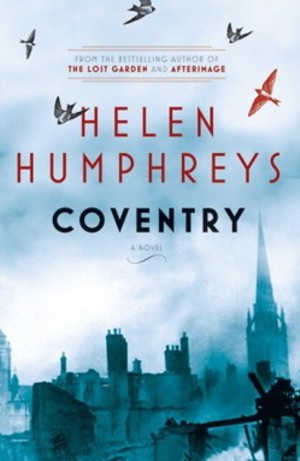
With last month’s book we have left WWI behind us and move on to WWII. The first of the WWII books is Helen Humphreys’ novel Coventry. I thought this would be my first novel by this author but I have read another one before, The Lost Garden, a wonderfully lyrical coming-of-age story which I liked a lot. With this in mind I’m keen on reading Coventry. Helen Humphreys is British but she lives in Ontario, Canada. Helen Humphreys has won several prizes, she is the author of 4 novels, one book of narrative non-fiction and four collections of poetry. I have a weakness for poets who write novels or novelists who write poetry because the writing is usually far above the average.

On the back cover of the novel it says that Coventry is “a memorial to the terrible losses of wartime, and a celebration of remembrance, determination and resilience.” The book tells the story of two women and moves back and forth between 1919 and the night of the 14 November 1940.

Here are the first sentences

The swallow arcs and dives above the cathedral. Harriet March watches it flicker through the darkness ahead of her as she walks along the cobblestones towards the church. The bird moves in the night air with all the swiftness of sudden feeling, and Harriet stops at the base of the ladder, tracking the flight of the lone swallow as it shivers up the length of the church spire.

*******

The discussion starts on Monday, 30 April 2012.

Further information on the Literature and War Readalong 2012, including all the book blurbs, can be found here.

Muriel Spark E-Book Giveaway Winner and Poll


It’s time to announce the giveaway winner of the e-book The Prime of Miss Jean Brodie by Muriel Spark courtesy of Open Road Integrated Media.

I drew the winner via random.org list generator.

The book goes to Marcus (Cinesprit).

Happy Reading Marcus!

******

The poll which I added to the last post is now at the bottom of this one.

You can still vote until the next giveaway will be announced.