Jane Austen: Persuasion (1818)

Persuasion

After having read Mansfield Park and liking it so much (as you can see here) I decided to read Persuasion, which has been mentioned by so many in the comments as their favorite Jane Austen novel. The two books couldn’t be more different. I found Persuasion much more mature, more subtle, less witty, more elegant and a bit melancholic. It’s a perfect novel, there is nothing superfluous in it; the story and the characters are rounded and the way their emotions are shown is believable and very touching. There is a lot of sadness and heartache in this novel, but, since it’s an Austen novel, the good characters are rewarded. Despite of all of this, I’m not sure I prefer it to Pride and Prejudice or Mansfield Park. The earlier novels have some imperfections, but they also show an exuberance and wit, which I enjoy. From the point of view of the love story, I think Persuasion is my favourite and I like Anne Elliot and Captain Wentworth as much or even more as Elizabeth Bennet and Mr Darcy, but I missed some of the irony and playfulness of the earlier novels. On the other hand Persuasion is very subtle and I love the more urban settings, Lyme Regis and Bath, which add to its appeal.

Anne Elliot is one of three sisters who lost their mother at an early age and grew up with a silly and vain father who, on top of that, is a spendthrift. The most important things to him and his eldest daughter, Elizabeth, who is his female counterpart, are looks and titles. Being a baronet is of the utmost importance to him. The gentle and sensible Anne suffers a great deal through their coldness and superficiality and if it wasn’t for her mother’s old friend Lady Russell, who has become her mentor, she’d be bad off in a family of self-centred, pompous fools. Her younger sister Mary is not much better and at that a hypochondriac. When the novel starts the Elliots are forced to leave Kellynch Hall and find cheaper lodgings in Bath because Sir Elliot and Elizabeth have been spending far too much. The estate will be let to Admiral Croft and his wife. Mrs Croft is the sister of Captain Wentworth, the man Anne Elliot once loved and – persuaded by Lady Russell – refused to marry because he had no money and no status yet.

Eight years later Captain Wentworth is still as handsome and likable as he used to be, but he’s also very rich. Anne who has refused every suitor, soon regrets bitterly that she refused him. Captain Wentworth on his side is still hurt and resentful. He hasn’t forgotten Anne but cannot forgive her.

Persuasion is often called a “novel of second chances”, and that’s what the love story is all about, but Austen novels are always about much more than just love and marriage. Money and the criticism of a superficial society which attached too much worth to it are central themes. In Persuasion we find a similar situation as in Pride and Prejudice: a rich man with no male heir. The way this is handled is central to the society and the times in which Jane Austen lived but, thankfully, so different from now. Should Sir Elliot die, the estate would go to a distant male relative and not to one of his daughters. It seems as if the property was tied to the name only and not so much to the family. Someone who may never even have seen a house, may be living in it, while those who spent there all their lives have to move out.This is so incomprehensible for us, feels so incredibly unjust that whole series, like Downton Abbey, illustrating this practice, are sure to generate our interest.

A large part of the second story line in Persuasion focusses on this aspect. There is an heir, but he is proud and arrogant, and it is very painful for everyone to imagine he will be living in Kellynch Hall. However, since Sir Elliot is still a good-looking man, it’s not impossible that he remarries. If a younger wife would give birth to a son, the whole situation would look entirely different. While the love story is central the “hunt” for the estate and the ensuing complications are no less important.

I’ve read all of Jane Austen’s longer novels now and it’s quite fascinating to look back, to compare, find similarities, spot differences. I’m currently reading Claire Tomalin’s Jane Austen biography and it adds another layer. So much that is mentioned in Tomalin’s book can be found in the novels. I noticed that Jane Austen never describes London, but I didn’t know she’d never been there.

Nowadays I tend to jump from one author to the next, but it has a special appeal to read everything of one writer because the books are always linked and when you’ve read them all, you can see, that despite the differences, the individual books together form a whole. In Jane Austen’s case, reading all of her books, showed all of her novels are full of vivid portraits and character sketches, full of well-observed behaviour and show the many facets of romantic attachment. But while there are similarities in the themes, there is a huge difference in mood.

Literature and War Readalong September 30 2013: There’s No Home by Alexander Baron

There Is No Time

I discovered Alexander Baron’s There’s No Home  thanks to Guy who read an article about this forgotten author a while back.

Reading the beginning of the afterword I’m astonished he was forgotten. John L. Williams writes the following.

Alexander Baron was, arguably, the great British novelist of the Second World War, and for a while he was also the most popular. The three books in which he covered the conflict  –There’s No Home, From the City, From the Plough, and The Human Kind– received glowing reviews and sold in vast numbers on their first appearance on the bookstands and in book club editions.

That these titles have receded from view, rather than becoming established classics – on a par with, say, the wartime books of Evelyn Waugh, Graham Green e or Olivia Manning – seems as mysterious as it is unjust. Perhaps it is due with Baron’s concern with the infantryman’s point of view, rather than the officer class. Or perhaps it is that Baron’s style is so effortlessly simple and unsensational that it is easy to overlook the virtuosity of the writing.

This certainly puts me in the mood to pick up the book and discover this author for myself.

Here are the first sentences

This is not a story of war but of one of those brief interludes in war when the almost-forgotten rhythms of normal living are permitted to emerge again, and when it seeps back into the consciousness of human b wings – painfully, sometimes heartbreakingly – that they are, after all human.

*******

The discussion starts on Monday, 30 September 2013.

Further information on the Literature and War Readalong 2013, including all the book blurbs, can be found here.

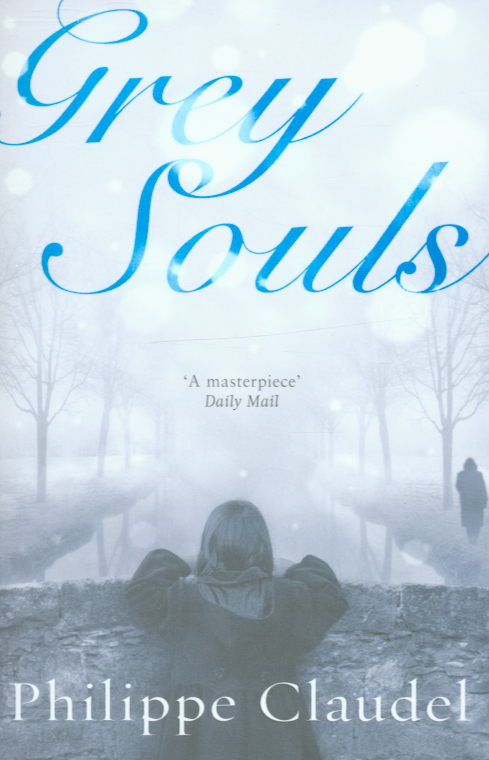
Literature and War Readalong August 30 2013: Grey Souls by Philippe Claudel

Grey Souls

I wanted to read Philippe Claudel since years and looking for a WWI novel I came across his Grey SoulsLes âmes grises. Like most of his other books the novel has been translated into 25 languages and was generally liked by readers and critics. From what I know so far, the war is not predominant in the novel. It’s more like the starting point to a crime which is solved much later. From some of the reviews I got that it’s quite heavy and brooding.

Here is the blurb

This is ostensibly a detective story, about a crime that is committed in 1917, and solved 20 years later. The location is a small town in Northern France. The war is still being fought in the trenches, within sight and sound of the town, but the men of the town have been spared the slaughter because they are needed in the local factory. One freezing cold morning in the dead of winter, a beautiful ten year old girl, one of three daughters of the local innkeeper, is found strangled and dumped in the canal. Suspicion falls on two deserters who are picked up near the town. Their interrogation and sentencing is brutal and swift.

Twenty years later, the narrator, a local policeman, puts together what actually happened. On the night the deserters were arrested and interrogated, he was sitting by the bedside of his dying wife. He believes that justice was not done and wants to set the record straight. But the death of the child was not the only crime committed in the town during those weeks.

The first sentences:

I don’t really know where to start. It’s quite difficult. All this time that has gone by, which words will never bring back, the faces too, and the smiles, the wounds. Still I need to try to say it. Say what’s been bothering me for twenty years. The remorse and the big questions. I have to cut open the mystery with a knife, just like a belly, and sink my hands in, even if that’s not going to change a thing.

The book has been made into a movie but I don’t know whether it’s available in English

*******

The discussion starts on Friday, 30 August 2013.

Further information on the Literature and War Readalong 2013, including all the book blurbs, can be found here.

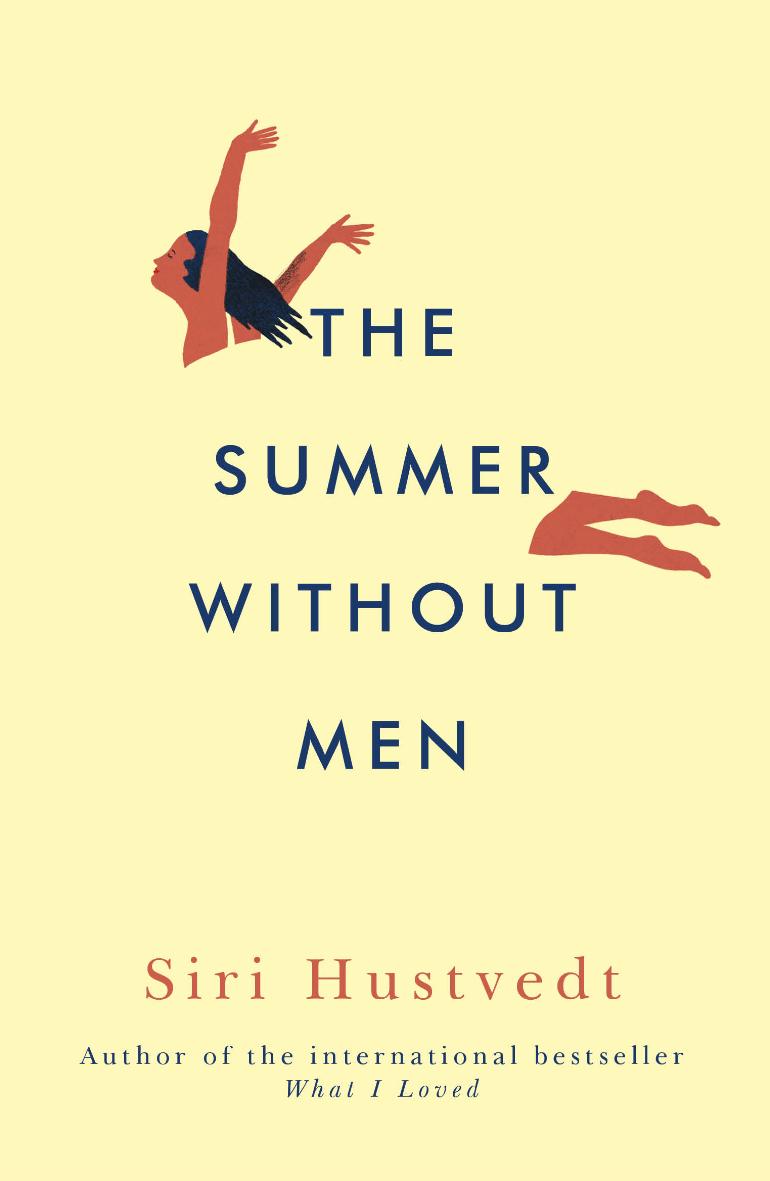
Siri Hustvedt: The Summer Without Men (2011)

The Summer Without Men

I’ve read three of Hustvedt’s novels so far, The Blindfold, The Enchantment of Lily Dahl, What I Loved, the memoir The Shaking Woman and some of the essays in A Plea for Eros. The novels are among my favourites, the essays are thought-provoking and so was her memoir. After finishing The Summer Without Men all I can do is wonder – What happened to Siri Hustvedt?

Not every writer is an academic, I’d say among the great it’s probably a minority and when you read a book like The Summer Without Men, it becomes apparent, that there may be a good reason. The intellectual baggage can enrich a book but it can also turn into a hindrance and in this case, what meager story Hustvedt had, she pumped up with theory. Derrida, Kierkegaard, Samuel Johnson, Jane Austen, and many more are mentioned and interpreted by Mia, the main protagonist. That could have been done well, but here it felt like a lecture. And to some extent it felt like she was talking down to the reader. Readers with no knowledge whatsoever of the theories and people behind them, will feel alienated, the others slightly bored as there are only snippets. The history of gender theory is an especially pertinent example. Everyone who’s ever been interested in that, will know as much as Mia but reading about it as if she’d just invented the wheel is jarring.

These were the theoretical parts of the novel. The novel has also a more story driven part. Funny enough however that read like pure chick lit for women over 50.

Mia, a 54-year-old poet is left by her husband a 65-year-old for a woman who is 20 years younger than Mia and French (yes it’s very original). Her reaction is intense. She has a psychotic episode and ends in a psychiatric hospital. That beginnning, I must say, was powerful and the pain, shock and horror behind it was palpable. After this Mia decides to spend her summer in Minnesota where her elderly mother lives in a nursing home. She meets the Swans, a group of elderly friends, Lola, her 20 something neighbour with two kids, and a group of pubescent girls who take a poetry course with her. If you think of the triad virgin-mother-crone then you are spot on as the whole story is meant to illustrate the various stages of womanhood. Some of this is arresting, some of it, notably the description of bullying among the very young, is touching, but overall it was nothing new.

Chosing a very intellectual protagonist would allow that theory is included, but that should have been done in a more subtle way. On top of that Mia often talks directly to the reader, which feels artificial.

It’s the first time, while reading this, that I noticed how bland Hustvedt’s writing is. Hustvedt uses only the most common words and the most simple sentence structures.  Her strength lies in her ideas, but they must be wrapped up better.

I wonder why this book has received such a lot of very good reviews by critics. Were they afraid they would come across as not savvy if they criticized it? I suspect so.

The end was a let down as well. In essence the book consists of parts which I’ve seen done better elsewhere. There are excellent YA books on bullying, amazing books about being a middle-aged woman like Lisa Moore’s February, and a few who look at old age, loss and grief.

As for the title, it’s not well-chosen. The Summer Without My Husband would have captured it far better.

I’ve still got Sorrows of an American here, but I think that is far better than this one. Hustvedt used to be a writer whose every book I bought without even thinking about it. That has changed radically.

Assia Djebar: Children of the New World – Les enfants du nouveau monde (1977) Literature and War Readalong July 2013

Children of The New World

Assia Djebar’s novel Children of the New World – Les enfants du nouveau monde is set during the Algerian War of Independence or Algerian Revolution which lasted from 1954 – 1962. If you are not familiar with this war wikipedia gives a short overview. It was a so-called decolonization war between France and Algeria. The war was fought in many different ways, guerrilla warfare, maquis fighting, terrorism and extensive use of torture on both sides.

The war in Algeria is still controversial in France. While it is meanwhile called “a war” and not only a “pacification intervention” – or whatever euphemism was chosen at the time – many of the aspects of the war are still not spoken about openly. One of them being the “interrogation techniques”.

It was a complex war that ripped apart the Algerian society. I think Assia Djebar showed this well in her novel. She chose to write Children of the New World as a series of vignettes, each with the name of a protagonist as title. Upon closer inspection we see that these are not individual stories but that each is a piece of a puzzle forming a kaleidoscopic canvas, which is apt and nails the Algerian society of the time. This was a society that resembles a broken pot, still held together at the seams, but the cracks showed and covered it like spiderwebs, ready to burst at any moment.

I have read the one or the other critique of this book stating it wasn’t really about the war, which puzzles me no end. The war is everywhere in this book, in every page. Every relationship is influenced or distorted by it. Neither love nor parenthood, nor friendship, nor anything else is free of the war’s influence.

We don’t see the fighting, that takes place outside of the city, in  the mountains, but the people see burning farms from afar, they see bombs fall and at the opening of the book, one falls on a house in the city, killing and old woman.

The book also shows how hostile this society was and how it was almost impossible to make a difference between enemies and allies. There were so many good and bad people on both sides. Not every Algerian was for the Algerian cause, not every French person was against it and many on both sides were against the use of torture and violence.

I have never read about any war in which torture was used this extensively. This becomes clear in the book too, although, mercifully, we find no descriptions, but we hear of people who don’t survive interrogations, of others who hear them scream in their own cells.

As said, the war is omnipresent in this book but Djebar transcends it and gives us more than just a society at war with itself and its oppressor. It shows a traditional society undergoing change and what this change means, notably for its women. I loved the many different descriptions of women’s lives. The diversity is amazing and in its best parts Djebar’s writing is as detailed as a documentary.

This was Assia Djebars third novel and it’s said that it’s not her best. I suppose that is correct as there are many structural problems. Djebar makes intense use of analepses , still I got the impression there were a lot of time-breaks that were not entirely wanted.

I’m curious and want to read another of her novels some day. She’s an interesting writer, with a raw unpolished force that I found quite refreshing.

For those of you interested in movies on the Algerian war – here’s a list that will also guide you to some of my reviews.

Other reviews

Danielle (A Work in Progress)


*******

Children of the New World – Les enfants du nouveau monde was the seventh book in the Literature and War Readalong 2013. The next is the WWI novel Grey Souls aka Les âmes grises by French writer Philippe Claudel . Discussion starts on Friday 30 August, 2013. Further information on the Literature and War Readalong, including the book blurbs can be found here.

Daniela Krien: Someday We’ll Tell Each Other Everything – Irgendwann werden wir uns alles erzählen (2011)

Someday

Daniela Krien’s debut novel Someday We’ll Tell Each Other Everything (German title: Irgendwann werden wir uns alles erzählen) was a success in Germany and has already been translated into 15 languages, one of which English. That’s why I thought I’d like to see for myself if it’s really that good. I’m not sure the book won me over as a whole, but I liked a lot of the elements and the end packs a real punch.

The narrator Maria is a young woman of 16 who is living with her boyfriend Johannes on his family’s farm. It’s 1990 and the Berlin wall has just fallen. The novel begins shortly before the reunification of Germany. What makes the story interesting is that it’s set in Eastern Germany and that we see the end of the former Democratic Republic through the eyes of the people who lived there. The author grew up in the country, in the former DDR, so she knows what she’s writing about.

It’s odd that Maria is living with her boyfriend’s family and not with her own but we learn later that the mother has been left and that Maria can’t stand her sadness anymore. It’s far livelier on the Brendel’s farm. But even though it’s livelier, there are tensions as well, and just like in her own family, there are family secrets.

Maria and Johannes are still going to school but Maria stays at home most of the time, hiding somewhere, reading Dostoevsky. She’s often sad as well, prone to mood swings, but she is a keen observer and a kind girl. She want’s to help and make her stay worthwhile for everyone.

Not far from the Brendel’s farm is the farm of the Henners. Henner is a forty-year old guy, a brute, as they say, a man whose wife couldn’t stand his company anymore and who has left him. He’s said to be violent and drinks like a fish. He comes to the Brendel farm occasionally because they have a small farm shop. Maria watches him and Marianne, Johannes’ mother. Marianne seems to have a bit of a crush on him. Maria herself is fascinated and before long, without thinking of the consequences, she’s having an affair with him.

Their love affair is one of those dark maelstrom passions. They try to fight it but to no avail. Maria feels extremely guilty, but at the same time she cannot let go. What they share is too deep. It’s passionate, violent, but it’s also more than that. Henner opens up, tells her his life story.

At first their affair is all about sex but later they are content to just read Dostoevsky and Trakl together. Henner even tries to get sober.

They way this is told is quite appealing. The beginning is strange but after a while, you feel sucked in and read more and more quickly.

I have never read a novel about the end of the former Democratic Republic from the point of view of someone who lived “over there”. I really liked how Daniela Krien captured this. Just imagine: one day the authorities decide that your country will not exist anymore. Even though it might be for the better, it would still be a shock. There are many small details which show that and they are well rendered.

I was surprised that Maria was allowed to live with her boyfriend’s parents and that they shared a room and a bed, but then I remembered that the attitude towards sexuality is said to have been much more liberal in the former Democratic Republic. I watched a talk show on German TV a few years ago with athletes from the ex-DDR and they mentioned that for them one of the strangest things was how sex was handled in Germany. They said they preferred partenrs who came from the former Democratic Republic because they were more liberated. Judging from this novel it certainly seems as if there had been quite a difference.

The title is a Dostoevsky quote taken from the Brothers Karamazov. The book contains a few quotes from Dostoevsky, others are taken from Hamsun. Henner repeatedly quotes Trakl’s poem Song in the Night. Trakl is an Austrian poet. His poems are beautiful but gloomy.

If you like dark love stories you’d like Someday We’ll Tell Each Other Everything. You might equally like it if you have an interest in country life or life in the former Democratic Republic of Germany. The style is quite simple, most sentences are short. It’s not subtle but it works. The whole story is carried by the narrative voice, which I found haunting. The end alone makes it worth to read the book.

Sarah Hall: The Carhullan Army (2007)

Carhullan

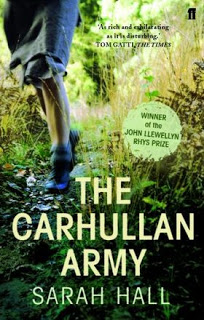
Set in the part of England once known as The Lake District and frequented by hordes of landscape hungry tourists, The Carhullan Army is narrated by a young woman who has adopted the name Sister. Britain after its union with the United States and numerous unsuccessful foreign wars, has found itself in the grip of a severe fuel crisis and the country is now under the control of a severe body known as The Authority. All fire-arms have been handed over to the Government and all women have been fitted with contraceptive devices; this Britain of the near-future is brutal and very-near desperate.Sister’s only hope — or so she thinks — lies in finding the Carhullan Army: a mythical band of women who lives a communal existence in the remote hills of Cumbria.

I came across Sarah Hall’s name many times in the past months. First I read a review of The Carhullan Army on Vishy’s blog (here) and immediately thought I’d love to read it. I later saw that Hall won the John Llewellyn Rhys Prize for The Carhullan Army, the Commonwealth Writer’s Prize for Hameswater and was shortlisted for the Man Booker for The Electric Michelangelo. Her short stories are said to be very good too.

The Carhullan Army is a dystopian novel. It has been called A Handmaid’s Tale for our times. I can’t confirm whether that’s the case as I haven’t read Atwood’s novel yet, but it’s certainly not a genre novel, it’s highly literary.

The Carhullan Army  is set in a bleak Britain, which is ruled by the so-called Authority. The system has collapsed due to a fuel crisis. People live like cattle, sharing small apartments. Some things are strictly regulated like work and reproduction, others are forbidden, like leaving the town. People are depressed, many use drugs. Relationships collapse, love dies. “Sister”, how the narrator calls herself, can’t take this anymore. She’s heard of Carhullan. Somewhere in the mountainous region of the Lake District lives a group of women autonomously. They have a leader, Jackie, a very charismatic figure, but other than that, they are free. Sister doesn’t know that much about the place, only that what she has heard. The rest is a mix of her imagination, her hopes, her dreams.

The place sounded utopian, martial or monastic, depending on which publication was interviewing, and what angle they wanted to push.

Sister is sure that her life will improve and that the women will welcome her, commend her for her courage to leave. But things don’t exactly go like that. The way Sister is “welcomed” is a huge disappointment, a shock even. It will take more than simple resilience to come to terms with this. But once she’s proven she isn’t a spy, nobody is following her and that she’s truly interested in living at Carhullan, she’s accepted.

Sister is a complex narrator but Jackie, the leader, is even far more complex. What Jackie has created at Carhullan is as amazing as it is scary. The women are able to provide for themselves. They plant, gather, and hunt, and – even far more important – they have an army. An army which has been trained by ex-soldier Jackie who is a severe drill instructor. She’s fierce and demanding, charismatic and unforgiving. Most women know that they might need to defend themselves some day and for many it is a special distinction and a great honor to be chosen for the army, others however think Jackie goes too far. Sister would love to be part of the army, but she has to wait a long time.

In Jackie Sarah Hall has created a multilayered personality. She combines the traits of a cult leader, of a fanatic, a saviour, a soldier and a hero. She never questions the use of violence, which, for me, was the most difficult part of the book. I never thought this was a utopian society, but I never thought they were that misguided either. Given the circumstances the development was quite logical but they were not free. Every single of Jackie’s decisions is an answer to the Authority and the end of the book makes this very clear. Sister idealizes Carhullan when she goes looking for it, the reader thinks it’s ideal at first, but towards the end we understand that Carhullan is part of the system as well. There would be no Carhullan, at least not the one we see here, if the society had not reached an endpoint.

Here’s Jackie talking to Sister:

“…. I just want to get to the bottom why these things go on. I’m a dark fucking tourist, Sister, I like going to these places. It’s interesting to me. I’m interested in what holds people back. And what doesn’t. And how far these things extend….”

I think this illustrates my point. Jackie is raw, she’s violent and she’s never free of questioning the system, she has an urge to explore it and in doing so stays tied to it.

The Carhullan Army explores many other themes, Lesbian love, autonomous living, the nature of cults and fanatics, totalitarianism and terrorism. Sarah Hall writes well, her sentences are limpid, simple, yet her vocabulary is rich and evocative.

The story is told like a confession, which has been recorded. Some of the files are recovered, some are corrupted. I thought tha approach worked well.

It’s a book that made me feel very uncomfortable. I found it had a bit of a Lord of the Flies vibe. The place Sarah Hall describes isn’t a gentle haven, it’s a rough world, in which people have to fight for their survival. The harsh landscape, the difficult situation has changed them. They swear, they fight. They do have camaraderie and loyalty, even love,  but it’s all very raw.

I am glad I’ve read The Carhullan Army. I think it’s excellent and thought-provoking but it’s depressing as well. I wouldn’t want to live in neither of the worlds Sarah Hall has created.

Have you read any of Sarah Hall’s novels or short stories?