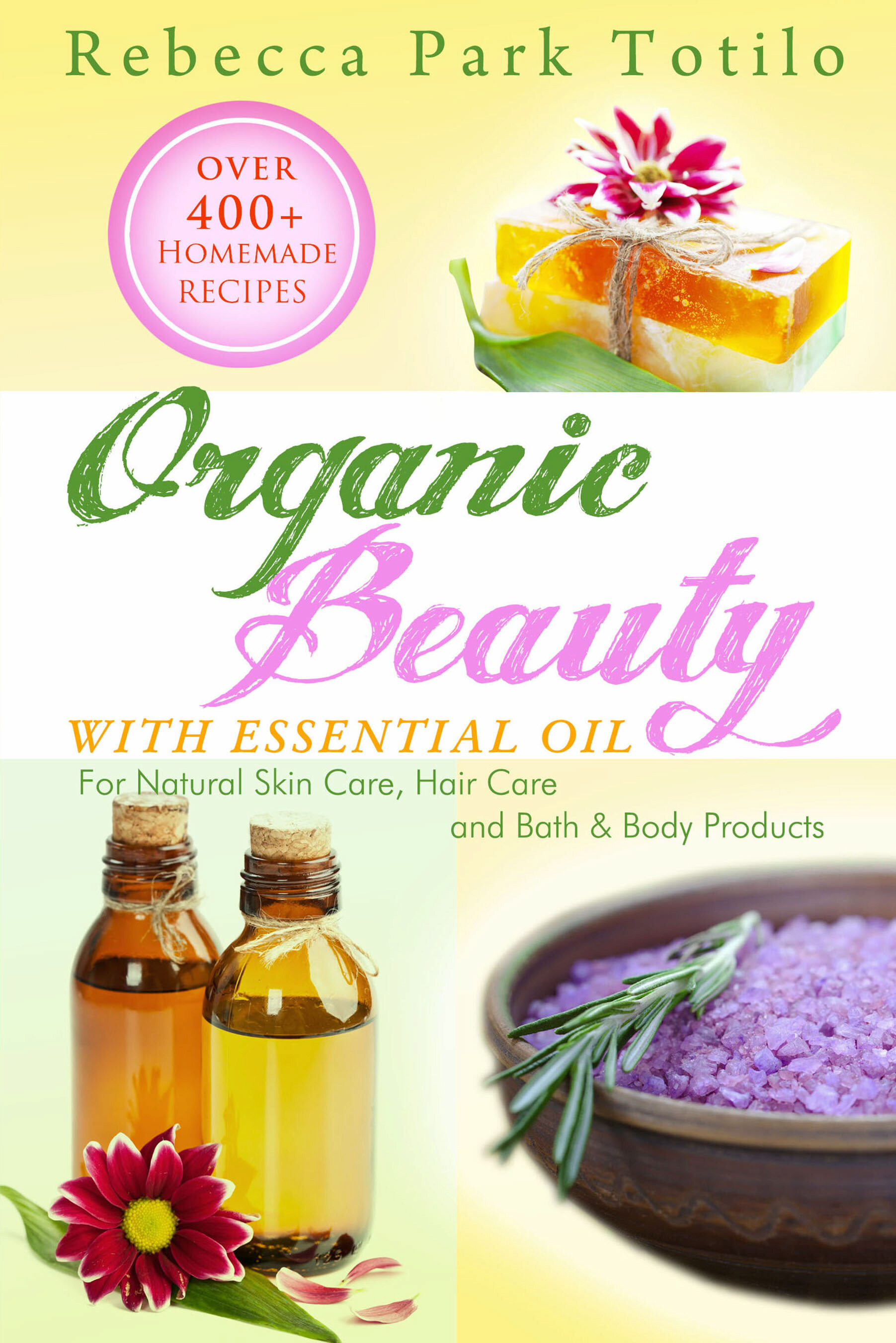
Rebecca Park Totilo: Organic Beauty With Essential Oil

Organic Beauty

I’ve always been interested in essential oils and also used them quite frequently in the past, still I would never have thought I’d enjoy reading this wonderful book so much. Rebecca put knowledge, passion and enthusiasm into this book, and wrote it in an accessible and engaging way. It’s a real pleasure to read.

The book opens with a detailed introduction to making your own beauty products with essential oils. It gives tips and advice on which are the best carrier oils, what oils are best for the skin, which will help set a specific mood and so on. You will also find instructions on how to store your oils, how to dilute and blend them. Rebecca also enumerates all the different products that you can do with the help of this book. At the end of the introduction you find a detailed description of  far over 70 essential oils, from Angelica to Ylang Ylang. Each section describes what the oil is for, how to use it and whether you have to be careful with it.

After the description comes the “recipe section”, which contains the following chapters: Bath Oils, Bath Bombs, Bath Salts, Bubble Baths, Bath Soaps, Milk Baths, Body Scrubs, Body Powders, Body Sprays, Body Lotions, Facial Scrubs, Facial Masks, Facial Creams, Facial Toners, Shampoos and Shower Gels, Toothpaste, Lip Balms and Glosses, Cuticle Oils, Hand Creams, Products for the Feet.

As you can see, the book is very rich.

I picked two recipes for you, to give you and idea

Energizing Bath Salt

WHAT YOU WILL NEED

2 cups Epsom Salt

1 cup Sea Salt

10 drops Natural Green Food Coloring

5 drops Natural Blue Food Coloring

6 drops Eucalyptus essential oil

10 drops Rosemary essential oil

15 drops Peppermint essential oil

WHAT TO DO

  1. In a large bowl, add salts and food coloring
  2. Add the essential oils, one drop at a time and mix well. Let it sit overnight.
  3. For the bath: Add 4 heaping tablespoons of bath salts to the running water for one full tub.

Sweet ‘N Sour Nail Growth Oil

WHAT YOU WILL NEED

20 drops Lavender essential oil

10 drops Lemon essential oil

2 tablespoons Sweet Almond Oil

Small dark glass bottle

WHAT TO DO

  1. In a bottle, add the almond oil and the essential oils.
  2. Tighten the cap and shake the bottle vigorously for one minute to blend.
  3. To use, massage the nail bed once a day to encourage healthy growth.

I hope this gave you a good impression. I think Rebecca did a great job. It’s an inspiring and colorful book with tons of recipes, ideas and tips. It’s great for people who are fed up with toxic beauty products, for everyone who likes to experiment and try out new things, but also for those who are simply interested to learn more about essential oils.

Here is Rebbecca’s page.

And some more information on the author:

“Rebecca Park Totilo’s flair and passion for life bursts into living color when she writes and speaks, as you will see in the visual way she presents herself.  She literally believes in the “show, don’t tell” principle in everything she does.  Becca has ministered to literally millions of people via television, radio and live appearances. She is an award-winning published author of over 40 books, including “Therapeutic Blending With Essential Oil”, “Heal With Essential Oil”, and “Through the Night With God.” Her credits include working as a contributor writer on two best-selling series (“Quiet Moments with God” and “Stories for the Teen’s Heart”) which sold over one million and five million copies respectively.  She is also a freelance writer for several national magazines include Christian Parenting Today, Discipleship Journal and Woman’s World.

Rebecca’s photography work has appeared in numerous national magazines such as Woman’s World, Sports Spectrum, Evangel, and Sharing the Victory.  But by far, her greatest accomplishment, if you asked her, is after a decade of rejection slips (with almost 150 in one year!), Rebecca hit it big in 1999, with over 13 books contracts, ranging from teaching curriculum to gift books and devotionals for adults.  Truly, its her grit determination that makes her inspirational writings draw such a mass market appeal.

Rebecca graduated from Virginia Commonwealth University in 1986 with a Bachelor’s of Science Degree in Information Systems. In addition, she attended Faith Bible Institute in Richmond, Virginia for instruction in ministry and University of the Nations in Hawaii. She is also trained as a Clinical Aromatherapist and is an international educator offering online courses on the art of perfume-making and how to blend with essential oils worldwide on her website http://rebeccatotilo.com. Rebecca owns a cute soap boutique, Aroma Hut, near the beach in Florida where she practices as an Clinical Aromatherapist.

Rebecca won the Writer of the Year in Non-Fiction (National Writer’s Association)
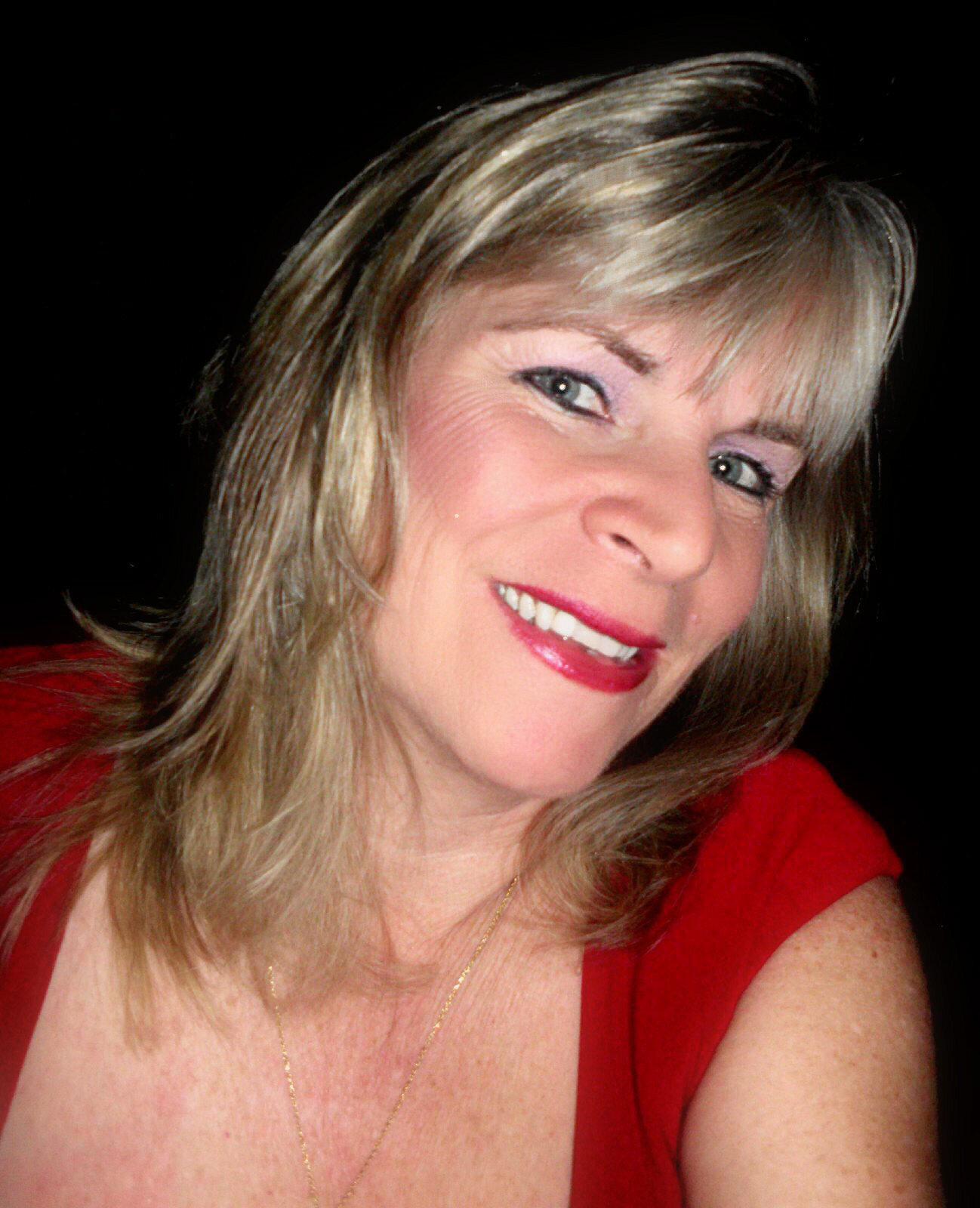
Rebecca Park Totilo

Thanks to Virtual Author Book Tours for letting me participate in this tour. I enjoyed it a great deal. If you’d like to enter for a giveaway, don’t miss the other tour dates, which you will find here.
vabt-highresolution

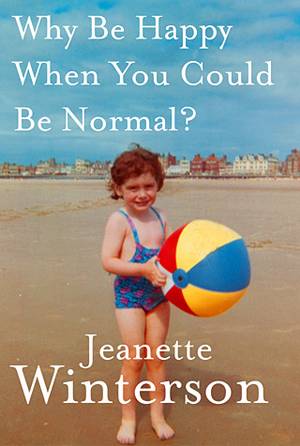
Jeanette Winterson: Why Be Happy When You Could Be Normal? (2011)

Why Be Happy

In 1985 Jeanette Winterson’s first novel, Oranges Are Not the Only Fruit, was published. It was Jeanette’s version of the story of a terraced house in Accrington, an adopted child, and the thwarted giantess Mrs Winterson. It was a cover story, a painful past written over and repainted. It was a story of survival.

This book is that story’s the silent twinIt is full of hurt and humour and a fierce love of life. It is about the pursuit of happiness, about lessons in love, the search for a mother and a journey into madness and out again. It is generous, honest and true.

Jeanette Winterson’s first novel Oranges Are Not the Only Fruit is largely inspired by her childhood. Her memoir Why Be Happy When You Could Be Normal? tells the other side of the story. That what was left out. It took me a long time to read this memoir. I started it four times, not because it’s not good, but because reading it was painful. The first part, until Jeanette leaves home at 16 and her mother asks her the question that has become the title of the book, is painful and disturbing for many reasons. The wit and the humor she uses to describe her awful childhood made me shudder. Shudder because I didn’t get it. I didn’t understand how you could live through so much pain and not go crazy, to write a book at 21 and become famous and leave it all behind. I was glad she proved to be so resilient, but it made me uneasy. I kept on thinking: When is it going to happen? When will she break down? Is that still in the future? I don’t think that you can survive a childhood like Winterson’s and not break down eventually. It’s just a matter of time.The second part of the book deals with what came much later. Jeanette Winterson’s descent into madness (her terms), her breakdown and attempted suicide in 2008. Reading that felt like entering a freshly aired room. I know this may sound weird, but the beginning made me choke. I couldn’t believe that she’d left it all behind and only when I read about the descent into madness, did I finally feel glad for her. Now she can move on.

Jeanette Winterson was adopted by the Wintersons when she was 6 months old. She was never told who her real parents were and her mother always said that the devil led them to the wrong crib, meaning she would have liked another child, a nicer child. This is such a typical statement from a woman like Mrs Winterson who is a depressed zealot and always utters half-truths in bible-inspired metaphor. Jeanette Winterson says that all of her books start with individual meaningful sentences and we see where that comes from. Her mother often only says one dark ominous sentence over and over again. Sometimes without any apparent connection to what just happens or what was just said. “Ask not for whom the bell tolls . . .”, “It’s a fault to heaven, a fault against the dead and a fault to nature . . . ” Uttered without any context or referring to very mundane things like the gas oven blowing up, these sentences are either creepy or hilarious.

Winterson grew up in the North of England, near Manchester and she loves this part of the country, lovingly tells us about its history, which is quite interesting. The Wintersons are not only religious fanatics but working class and her mother is so suspicious of books that she confiscates and burns all of those Jeanette has been hiding.

Punishment is frequent and comes in different forms. Either Jeanette is beaten or left outside all night and day, on the door step, even in winter.

When she falls in love with a girl, and Mrs W finds out, they perform an exorcism. Jeannette finally leaves at 16. She only returns once, when she’s studying in Oxford and things go very wrong. That’s the last time she sees her mother.

As you may have guessed, this isn’t an easy book to write about. I marked so many passages and sentences that hardly any page is left white. Jeanette Winterson has a way with words that is amazing. Although I don’t always agree, I find the sentences, many of which are used in her novels, arresting.

In her novel Oranges Are Not the Only Fruit, Jeanette Winterson paints her mother like a giantess and in her memoir she says she was too large for her circumstances. I was puzzled that there was no explanation whatsoever why Mrs W was the way she was. Mean, fanatic, abusive, depressed and just plain crazy. She had her dreams and her wishes, but smothered them. She lived as if she was wearing a very tight corset. The Wintersons were Pentecostals and the religion was like a mental corset.

If you like memoir, then you should read this. It’s disturbing, but it’s so amazingly well written and the first part has hilarious moments. Mrs Winterson is crazy, but she really is larger than life. She reminded me of some of Picasso’s paintings of grotesquely deformed women. We read about her with horror, but at the same time we almost wishes we had been there. I even felt compassion, there were small details that could almost make her endearing. At the end of the book, when Jeanette Winterson has found her birth mother and looks back on her childhood, she says she’s glad Mrs Winterson was her mother. Although she was crazy and abusive, she made her who she is, maybe without such an adoptive mother, there wouldn’t be a writer like Jeanette Winterson. I can understand that thinking very well.

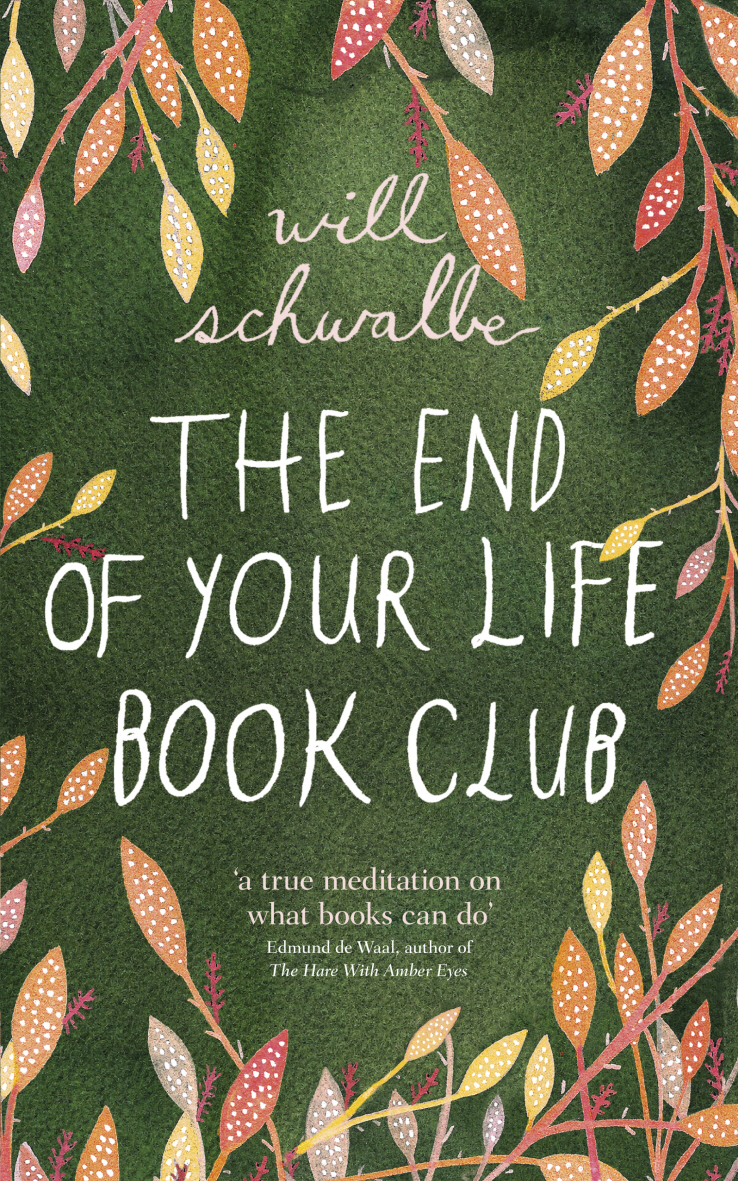
Will Schwalbe: The End of Your Life Book Club (2012) A Memoir

End of Your Life Book Club

Will Schwalbe’s memoir The End of Your Life Book Club is one of those books that needs a review because it’s hard to tell from the blurb what it is about. Sure, it’s about books and the love for books and a beautiful friendship between a mother and son, but more than that it’s about an amazing woman and her terminal illness. People who pick this up may think, like I did, that it was to a large extent about books, which isn’t the case. Books are mentioned on every other page, but the largest part is about Schwalbe’s mother, her life and her battle with pancreatic cancer.

Will Schwalbe and his mother always loved to read and discuss books, but when she is diagnosed with pancreatic cancer and has to undergo regular chemo therapy, they decide to use the time they spend together at the hospital discussing books they have both read and that’s how they start The End of Your Life Book Club. The beginning of each chapter is dedicated to the book they have been reading and the discussion they have. The book choices are varied and I loved reading about them. Continental DriftCrossing to Safety, The Painted Veil, Olive Kitteridge, The Girl with the Dragon Tattoo, Brooklyn,The Elegance of the Hedgehog are but a few books they read, discuss and enjoy.

After this usually brief paragraph about books, Schwalbe leads us directly to his main topic: his mother. His mother must have been a very courageous woman. She travelled from one hot spot to the next for the Women’s Refugee Committee. She helped refugees all over the world and put herself in great danger to do so. She was a fighter but at the same time she was a genuinely kind woman and to read about her and the love the people felt for her is quite beautiful.

What will not be everyone’s cup of tea is the detailed description of the therapies, the side effects and the battle to just live a few months longer. Pancreatic cancer is mostly terminal and most people don’t have much more than a few months after the diagnosis. Schwalbe’s mother was lucky, she lived a full two years. Years that she lived to the fullest, not missing any opportunity to enjoy life and do good. This is quite admirable. I liked her belief that you should never look away from what is bad in our world but always strive to do good.

I feel heartless writing this but the book did not work for me. I have no problem to read about terminal illness. I read the memoir written by Susan Sontag’s son and found it excellent. So that’s not the reason. And of course I love reading about books but in a way, I felt this memoir was too personal. There were too many details added that just didn’t mean anything to me, because it’s not my mother or someone I know. She ate this and liked it, she drank that and couldn’t swallow… She saw these friends and those grandchildren… There were just too many mundane and ordinary details that are only significant when you know a person. Since they wrote a blog about her illness to keep family and friends updated, I suspect, large portions of this book were based on those entries. This may be a reason why the writing was a bit bland.

I think this is a book which could be of great help if you have a friend or relative who has cancer, especially pancreatic cancer. It shows extremely well and in a lot of detail what can be done, what the side effects of some of the therapies are and when you have to decide to let go. As a book on cancer it’s great. As a book about one person’s mother, it’s too personal and as a book about books it is a let down. It says it’s about books and reading but they rather form a bracket around the rest.

Still I’ve discovered a few titles I didn’t know and would like to read:

Victor Lavalle’s Big Machine

Reynold Prices’s Feasting the Heart

Danyal Mueenuddin In Other Rooms, Other Wonders

There was also one book I know I will not be able to read and that is  Mariatu Kamara’s The Bite of the Mango (look it up and you’ll know why). Reading about it made me sick.

Have you read any of these?

Aharon Applefeld: The Story of a Life – Sippur chajim (1999) Literature and War Readalong August 2012

In his memoir The Story of a Life acclaimed author Aharon Applefeld tells the story of his childhood and how he came to be a writer. He starts by describing his earliest memories, the beauty he experienced, the love he received from his parents and grandparents. Most prominent in his memories is his last summer holiday as a child of five when he and his parents visited the grand parents in the Carpathians. Little Aharon’s parents are quiet people. They don’t talk a lot and Aharon learns early just to observe, be in the moment and absorb everything around him, the light, the scents, nature. These sensory memories will haunt him all his life. But this idyllic summer is the last peaceful moment of his childhood. Hitler comes to power, war breaks out. At first the family lives in a ghetto, later on they are transported to the camps. Both his parents are killed, his mother right at the beginning of the war. After having lost his father as well, Aharon escapes into the forest where he lives for years until he joins others. Together they first walk from the Ukraine to Italy and from there to Palestine, their new home.

The memoir is a book of a rare beauty. It taps into the deepest recesses of the soul where vague and sensory memories are stored. Because he was a child and a taciturn child at that, he is lacking words for what has happened to him. This makes this memoir so amazing, it’s like watching someone feel around, probe and slowly approach the right words to convey what it was like. Fleeting memories and strong impressions are mixed. Some people, some stories stand out but a lot is just like shadows on the wall.

The loss of his mother tongue leads to further fragmentation. In his family they spoke three different languages, on his long escape to Italy and from there to Palestine, there are more languages spoken and when he finally arrives in Palestine he has to let go of all of them and learn a new one, Hebrew. This is all painful.

I’ve read all sorts of WWII accounts and novels but they never focussed on orphaned children. It’s hard to imagine what it means to lose your parents, your home, your mother tongue. And Palestine wasn’t as welcoming as one would think. Especially not when you felt you wanted to talk about what happened and later to write about it.

Applefeld had to overcome an incredible amount of obstacles before becoming the writer he is today. He had to dig out his memories from where they were buried, find the right words, find the right language. He had to fight hostility too. Every single one of his books is an attempt to capture what happened to him and how it felt.

The Story of a Life is in part exactly that, the story of one man’s life, but more than that it’s a meditation on language and how to put into words, make palpable what is just a fleeting sensory impression. No wonder the cold, the wind, the rain are things which catapult him back to the war years. The war, he writes, is stored in his body, his bones. Because he was so little at the time, lacking the ability to fully comprehend and put into words what happened, the memoir and most of his novels, it seems, are more like a search, a quest almost for what once was, an attempt at conjuring up what was lost.

This is a book I can highly recommend even to those who are tired of reading about WWII and the Holocaust. It is a rich, inspiring and very meditative book about life and how to tell one’s story.

Other reviews

Danielle (A Work in Progress)

Judith (Reader in the Wilderness)


*******

The Story of A Life was the eighth book in the Literature and War Readalong 2012. The next one will be Richard Bausch: Peace. Discussion starts on Friday 28 September, 2012.

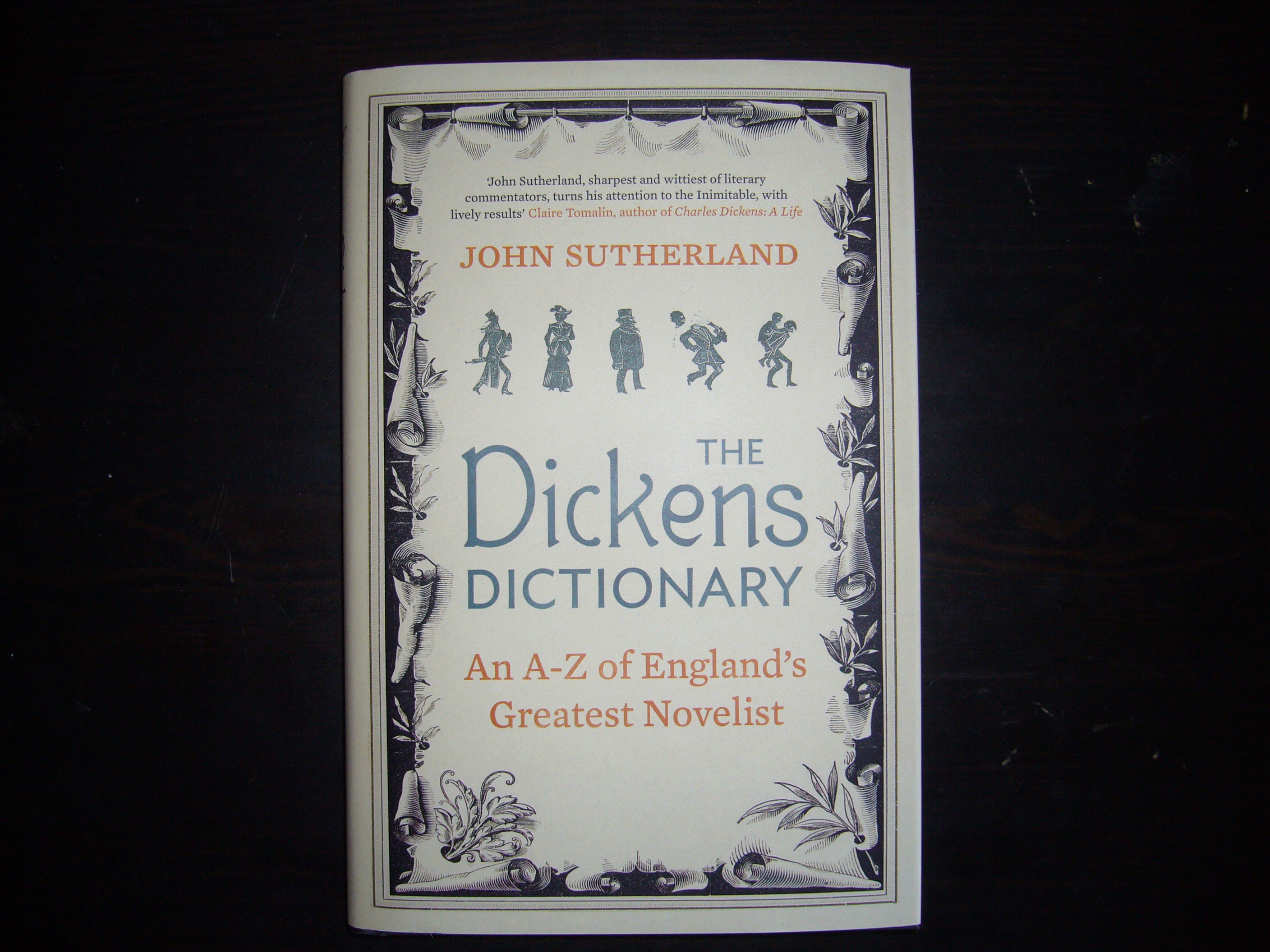
John Sutherland: The Dickens Dictionary (2012)

Although I’m one of those who has been tiptoeing around Dickens’ work for a while now without reading anything else but A Christmas Carol and part I of David Copperfield, I’m still interested in the author and the work. I also have a feeling I’m familiar with his novels without having read them because I saw the one or the other movie based on his books and because creations of great artists seem to acquire a life of their own and seem to go on living outside of the confined space of the book covers. People mention them, talk about them as if they were real people.

When I discovered The Dickens Dictionary on Mel U’s blog (here is the post) I knew I had to get it right away and since it arrived yesterday afternoon I spent many moments with it.

The author John Sutherland is a recently retired professor who has taught and published on Victorian novels. Browsing his book and reading the one and the other of the 100 collected entries, you discover not only a world of information but a book written by someone who is passionate about the subject and knows how to write about it in a way that will make you feel the urge to grab the next Dickens novel at hand. Sutherland’s aim was

When I think of Dickens I do not see a literary monument but an Old Curiosity Shop, stuffed with surprising things: what the Germans call a Wunderkammer – a chamber of wonders.

This book, taking as it’s starting point 100 words with a particular Dickensian flavour and relevance, is a tour round the curiosities, from the persistent smudged fingerprint picked up in the blacking factory in which Dickens suffered as a little boy to the nightmares he suffered from his unwise visit at feeding time to the snake-room of London Zoo.

The 100 entries cover such different subjects as Bastards, Blue Death, Candles, Cats, Child Abuse, Dead Babies, Dogs, Fog, Hands, Incest, Merrikins, Onions, Pies, Pubs, Smells, Thames…. They are all entirely fascinating.

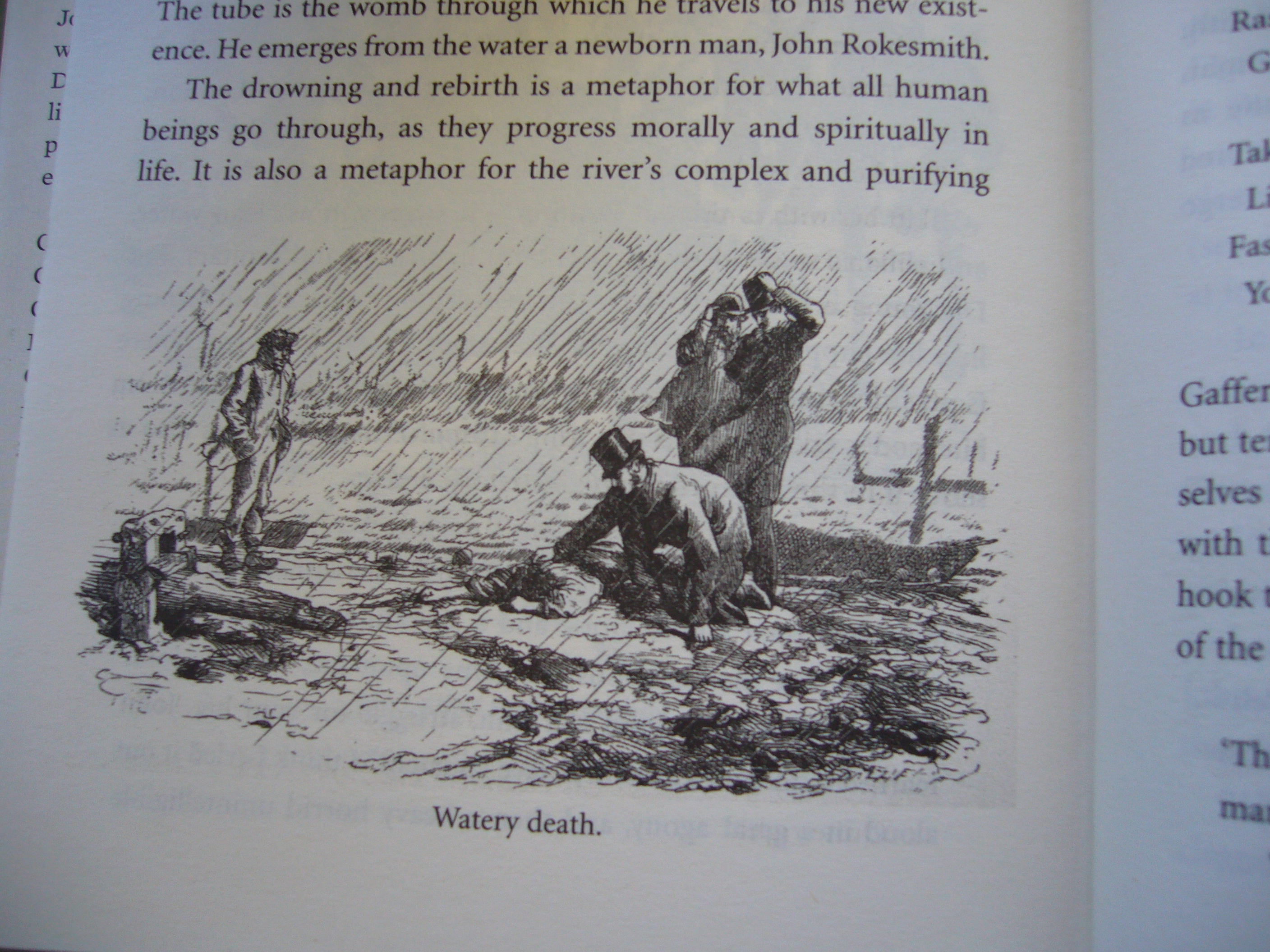
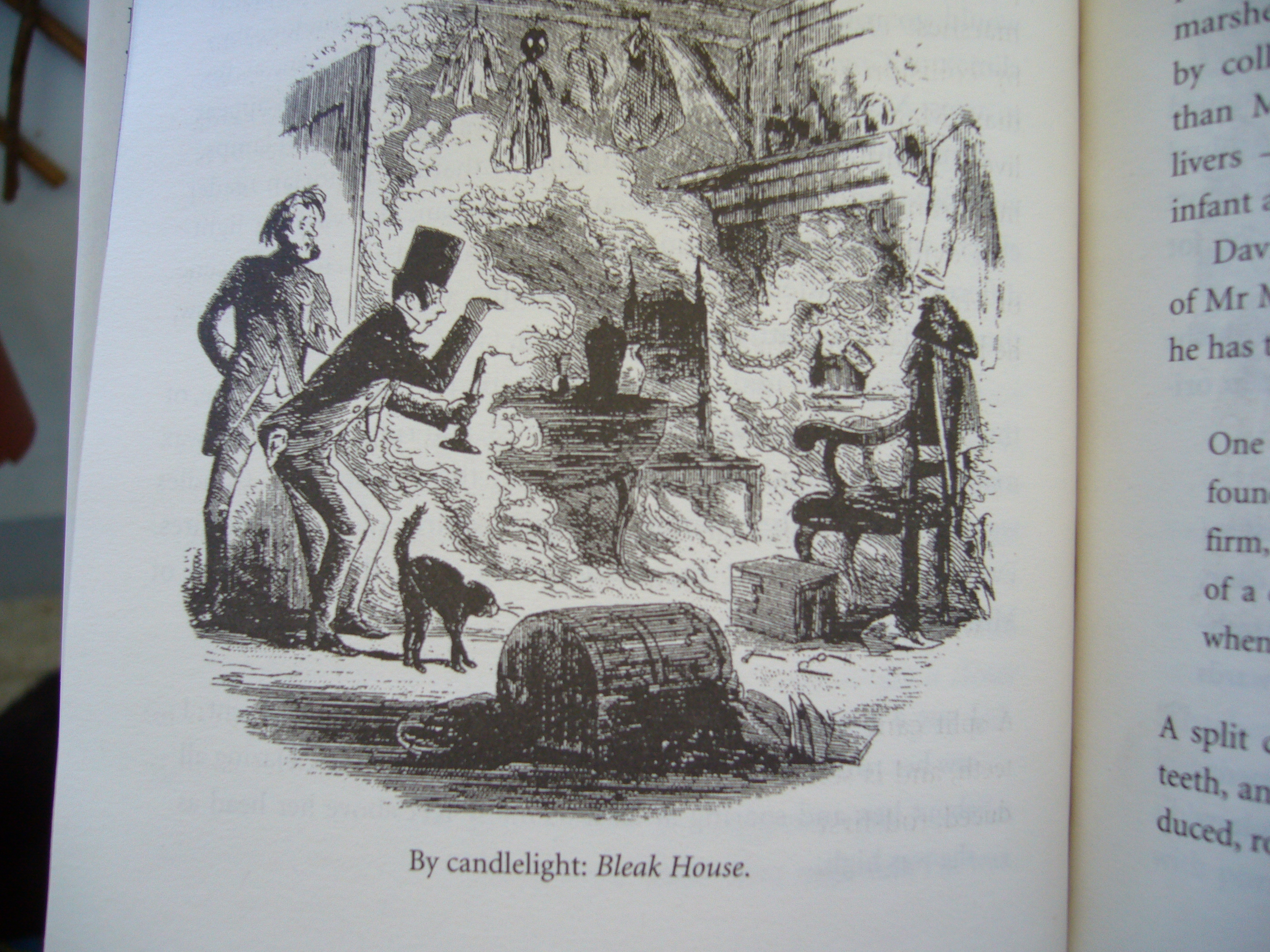
What certainly adds to the appeal of this book are the many illustrations.  There is one on almost every other page.

I also liked the many quotes Sutherland included which give a good feeling for the work. Since I have still not decided which will finally be my first Dickens, this book will help me make up my mind.

To give you an idea of the entries I chose the one called Blue Death.The title refers to the Cholera epidemic of 1848-49 during which 52,000 Londoners died. The entry explains where it came from – India 1817 – and how Dickens and most people thought it was miasmic. He referred to it in Bleak House in his description of Tom-All-Alones’s. His rival Thackeray contracted the Cholera and might have died if Dickens hadn’t sent his own physician.

The Dickens Dictionary is a great introduction to Dickens, it contains quotes and references of the various novels, anecdotes from Dickens life, historical facts of Victorian London and a whole range of other “curiosities”.

As I said, I still don’t know which should be my first Dickens. Which one would you recommend?

Nina Sankovitch: Tolstoy and the Purple Chair (2011) A Memoir

Tolstoy and the Purple Chair is a memoir I’ve been eying for a while until I finally bought it. The subtitle – My Year Of Magical Reading – obviously an allusion to Joan Didion’s memoir – annoyed me a bit but I liked the idea behind the book.

After the early death of her beloved sister, Nina tries for several years to overcome her grief and feelings of guilt when she finally comes up with a cunning idea. Reading has always been important for her and her family. Reading instructs and entertains but it can console and give hope as well. That’s how she decided that she would read one novel per day for a whole year and write about it on her blog Read All Day.

Tolstoy and the Purple Chair tells the story of that year, interweaving it with memories and stories of her family and herself. Not all the 365 books she has read in one year are described or mentioned but she writes in detail about a few which were especially meaningful. She summarizes them briefly and writes why they were important, what memories they triggered, how they helped her heal.

The list of all the 365 books can be found at the end of Tolstoy and the Purple Chair and on her blog. They don’t follow any specific order. One book led to the next and many were recommendations from family and friends and later from readers of the blog.

While I expected slightly more, I still liked reading the book. I liked her infectious enthusiasm. Each book is a world to discover and she tackles the ambitious goal with a lot of energy and passion.

Some of the books are so important because they help her explore her story or the story of her family. Harry Mulisch’s The Assault is one of them and so is Schlink’s Self’s Deception. But there are many more.

Crime novels are among her and her family’s favourite books, each member loves another writer. Nina thinks that what she loves best about them is the fact that they re-establish order. Things make sense in crime novels.

The parts in the book I enjoyed the most weren’t only those about books but those in which she describes the many little joys life has to offer. A meal with friends, a sunset, a newly planted tree, a lilac bush and the many cherished memories of her sister that make it easier to let go of her grief.

As was to be expected with a book like this I ended up with a list of books I’d like to read now.

Muriel Barbery’s The Elegance of the Hedgehog – L’élégance du hérisson

Nadine Gordimer’s Burger’s Daughter

Harry Mulisch’s The Assault

Adam Phillips and Barbara Taylor’s On Kindness

Kevin Canty Where the Money Goes

Chris Cleave Little Bee

Chimamanda Ngozi Adichie The Thing Around Your Neck

While I wouldn’t say it’s an absolute must-read, it’s a nice way to spend a few hours. I liked her voice and her stories. Just be prepared, if you don’t have as much time at hand, you might end up being a bit envious.

I have a fondness for this type of project. It doesn’t even have to be reading a book per day. There are some other 365 and similar projects like that I enjoyed reading about. Many are based on blogs or turn into blogs like the famous Julie and Julia.

Have you read about any interesting projects or self-experiments like this? And what about the books on my list, have you read any of them?

Alexandra Johnson: A Brief History of Diaries – From Pepys to Blogs (2011)

I regularly find interesting non-fiction (and fiction) book reviews on Tom’s blog A Common Reader. I don’t always get to read the books right away which is a pity. There were two exceptions recently however,  A Brief History of Diaries that I have just finished (here is Tom’s review) and David Bellos’ Is That a Fish in Your Ear? which I’m still reading (Tom’s review is here).

A Brief History of Diaries is exactly what the title indicates, a short but nevertheless interesting overview of the tradition of journal keeping. Alexandra Johnson won the PEN award for Hidden Writer which I bought earlier this year and will be reading very soon as well.

I’m very interested in this topic as I’ve been keeping a diary since the age of 11. I don’t know how many thousand pages I’ve written because I do not read them very often anymore. This has reasons which would fill a few posts but I’d like to leave the stage to Johnson’s book for the time being.

The book is divided into 5 chapters. The first is dedicated to the innovators, the very first people who kept a diary. The apothecary Luca Landucci is among them. If you’d like to read an eyewitness account of the burning of Savonarola, this is the place to go. John Dee and Samuel Pepys can be found in this chapter as well. I think if you would like to know more about 17th century London, including the great fire, Pepys is the source to consult.

Chapter 2 is one I’m personally less interested in, its focus are the Travel and Explorer Diaries. I’m familiar with Ibn Battuta’s diary because it’s an early source for cultural anthropologists. Johnson included in this chapter Western pioneer travel diaries which sound very interesting.

Chapter 3 gives an overview of the diaries of artists and writers. I found many I would like to read or at least browse. Sonya Tolstoy, about whom Johnson writes extensively in Hidden Writer, is mentioned as well as Katherine Mansfield, Virginia Woolf, Sylvia Plath and May Sarton. The appeal of these diaries is to see how some sketches, little incidents, ideas are later incorporated into novels. We can follow the seed and watch it grow into a plant.

Chapter 4 is dedicated to war diaries. Those of the poets of WWI are mentioned (Sassoon, Owen, Graves) as well as the two famous WWII diaries by Anne Frank and Etty Hillesum. I wasn’t aware that there are two Anne Frank diaries. It’s interesting because the two diaries show the emergence of a writer. The first is just the diary of a child noting all that happens but later, she rewrote the diary. Her father seems to have thought it best to publish the early original first. The full unabridged version was only published in 1997. A war diary I’d never heard of before but which I would love to read is Mary Chestnut’s Civil War diary.

Chapter 5 is about digital diaries. I do not consider my blog like a diary at all and I would never use an online diary. I’m a fan of handwriting and have always been. I choose my pens and ink carefully. Choosing a new diary is a big ritual. So I was far less interested in this chapter and it’s also very brief.

This book is, as it states in the title, only an introduction, but it’s very well done and the bibliography at the end of the book is valuable.

I like reading diaries and have quite a collection. There are quite a few I haven’t read yet but I am looking forward to reading them. A major reading project next year, should actually be dedicated to diaries and memoirs. I’d like to read the diaries of May Sarton soon but I also got one by Cesare Pavese and just bought the first volume of the Journal of the brothers Goncourt. Of those I have read so far the one I liked the most was the one by Katherine Mansfield and those by German writer Brigitte Reimann.

Do you like reading diaries? Which were the diaries you liked the most?