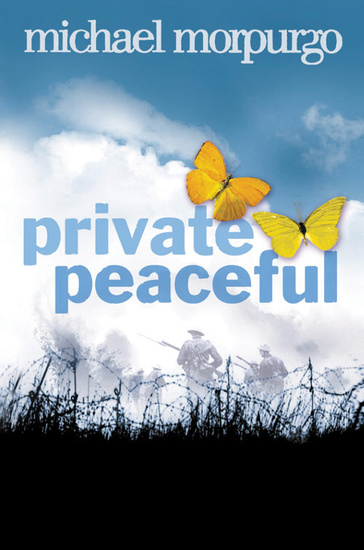
Michael Morpurgo: Private Peaceful (2003) Literature and War Readalong May 2014

Private Peaceful

British author Michael Morpurgo is one of the most appreciated writers for Children. He was the UK Children’s Laureate from 2003 to 2005 and Writer in Residence at the Savoy Hotel in 2007. He won many prizes for his fiction.

Tommo Peaceful is the narrator of Private Peaceful. He begins his story at five past ten in the evening, after everyone else has left him. He awaits the next day with anxiety but he doesn’t want any company or distraction. He wants to spend the night thinking about his life. The chapters are all given a specific time and each intro to the chapter describes briefly Tommo’s surroundings and his state of mind. After the intro Tommo tells us in flashbacks his story, from the idyllic childhood in the English countryside to the trenches of WWI.

Tommo is one of three boys. At the age of nine his father dies in an accident and Tommo feels responsible for his death. Although he and his older brother Charlie are very close, he never mentions what happened in the woods, the day their father dies. They have an older brother Big Joe who had Meningitis as a child. He can’t go to school and is easily agitated but they are still very fond of him.

Their father’s death marks a transition from a carefree life to a life of some hardship. They are at the mercy of the Colonel in whose cottage they live. The cottage is tied to a function and after the death of the father, who was the forester, they would have to leave. The Colonel’s estate is big and many people and families work for him and so Tommo’s mother is offered a position at the big house, and they can stay in the cottage.

The years go by and there is happiness and heartache in equal measures. When WWI breaks out, they don’t think they are affected. Tommo is only 16 and Charlie, who is two years older, doesn’t think of volunteering but in the end they are forced. Although Tommo is too young, he doesn’t want to abandon Charlie and pretends he’s older. Finally they are shipped to France together. From there they move on to Belgium and stay near Ypres for the following months.

They don’t see any action at first but eventually they come under heavy fire. From then on we get an impression of everything that was typical or important during WWI: trench warfare, mustard gas, rats, rain, mud, high numbers of casualties among men and horses, arbitrariness of orders, sadism of the high command, absurdity of it all . . . While it’s usually key to show but not tell, Morpurgo often tells but doesn’t show. He stays away from graphic descriptions or anything that you could call gruesome. We still get the horror because we see how it affects Tommo. Most of the time, we just don’t get to see what he sees. I think that’s a great way to go in a Children’s book.

What works particularly well in the book is the contrast between the childhood and teenage years and the war scenes. Morpurgo takes a lot of time to introduce us to his characters and to make us care for them. While some of the secondary characters are a bit stereotypical, the main characters Charlie and Tommo are well-developed. Their relationship is very close and they would give everything for each other.

As I wrote in the introduction to this month, I was particularly interested to see how a Children’s author would handle a WWI book from the point of view of a soldier. I think Michael Morpurgo did an admirable job. I’m sure, children will get a good impression for the particularities of WWI. And they will care for the characters and feel deeply about the end. For an adult reader who has read some very similar books for adults – Strange Meeting and How Many Miles to Babylon come to mind – it was not exactly a huge revelation, but in spite of that, I found the twist at the end harrowing.

Other reviews

Danielle (A Work in Progress)

 Judith (Reader in the Wilderness)

*******

Private Peaceful is the fifth book in the Literature and War Readalong 2014. The next book is the WWI novel Fear – La Peur by Gabriel Chevallier. Discussion starts on Friday 27 June, 2014. Further information on the Literature and War Readalong 2014, including the book blurbs can be found here.

Pat Barker: Toby’s Room (2012) Literature and War Readalong April 2014

Toby's Room

I’ve been procrastinating all morning. Every time I sat down to write this review I had something very urgent to do. Read the afterword of Fire and Hemlock, read the news on the Ukraine, get a cup of tea, look for cat number 2, read more news on the Ukraine, read the guardian review of Toby’s Room, urgently hunt for a book voucher, read the NY Times review of Toby’s Room, call my best friend in Odessa. I think you get the drift. Anything but writing the review.

Why?  Because I’m far from happy about this book and because I’m going to say what the critics didn’t say: it’s a mixed bag and despite a lot of good elements – mainly the choice of topic – it’s pretty much a failure or – even worse – a dishonest attempt. Still, it would be a great book club pick, as its strengths are topics and characters. That’s why I think it was a good choice for our readalong and if a few people read it, the discussion should be interesting.

So what’s Toby’s Room about? Thanks to the Guardian review, I was made aware that the title is an allusion to Virginia Woolf’s Jacob’s Room, the novel which she wrote after her brother Thoby died in WWI. It’s not surprising then that Virginia Woolf has a cameo appearance in Toby’s Room. I’ve read Jacob’s Room too long ago to make the connection, but I’m tempted to revisit it.

Elinor and her brother Toby are close, too close, one could say. One afternoon, in 1914 they spend a night together. This is deeply traumatizing for Elinor, although she’s not a victim in the whole encounter. Later when they are both in London, Elinor studying to become a painter, Toby to become a doctor, their relationship is strained.

In 1917 Toby’s reported “Missing, believed Killed”, which affects Elinor deeply. Until that day she tried to avoid thinking of the war but the death of her brother and the uncertainty of the circumstances, propel her right into it.

When Elinor finds a letter her brother wrote shortly before his death, mentioning Kit Neville, a famous painter, knows what happened to him, she barges in on Neville who’s at a hospital for soldiers with facial wounds. She disregards his state and unease and tries to force him to confess what happened. To no avail.

The second part of the novel sees Elinor join Tonks, her former teacher. Tonks is a painter and surgeon who helped a great deal in giving back some sort of face to those who had been severely disfigured. Part of his and Elinor’s work consists in drawing the wounded men before, during and after surgery. The gallery of this drawings can be visited online here (I managed to look at two).

Neville doesn’t confess to Elinor, he will confess to the far more sympathetic Paul, Elinor’s lover, whose story is told in Barker’s Life Class.

Pat Barker is famous for blending fact and fiction, for introducing us to important topics – I shy away from calling facial reconstruction “fascinating” as she herself does in her afterword – and for addressing the complexity of WWI. And she’s a very good plotter. The book reads like crime fiction. From the very beginning we are drawn along, running like donkeys after a carrot, to find out “Whatever happened to Toby?” I’m grateful for Pat Barker’s plotting skills, it made for quick reading, but when the juicy carrot I’d been hoping for proved to be a shriveled scrap, I felt let down. I didn’t buy the end. It wasn’t believable for me, but very much in line with the sensationalist beginning.

My biggest problem however was that she felt she had to start with an incest. Why was that necessary? I can relate to someone’s attachment to their brother, I didn’t need an incest to understand that they were very close and that their relationship was far from uncomplicated. This leads me to another problem I had with the book – heavy-handed foreshadowing.

Before I move on to the good parts, let me just say that I found Elinor a off-putting character. Not only did I despise her for blocking out the war, but for being so insensitive. In a way, the novel wants to tell us, it’s that character trait that made her useful. If she’d been more emotional, more sensitive, she wouldn’t have been able to draw the atrocities she saw. I don’t think that is true. I think there are people capable of deep empathy who can still do work like that.

What I liked about this novel, besides its suspenseful readability, was the choice of topics. I’d never heard of Tonks before and I found it interesting how the novel showed that the painters had to document everything in great detail but that they knew it would never be shown publicly. Some of the other painters mentioned painting landscapes as a metaphor. The war can be shown metaphorically but not realistically.

Neville isn’t a sympathetic character either but he’s a great character nonetheless. His story illustrates how hard it was for people to handle seeing facial mutilations. It was so hard that they often ceased to think about the person who was “behind” the disfigurement. They seemed to have lost their humanity with their faces and thus the repulsive reactions of the people were only occasionally questioned.

The more I read, the more I was wondering whether the fact that these injured men were sent to hospitals outside of cities was not so much for their own good as for the good of the population. These parts were done admirably well in the novel and the juxtaposition with scenes in which Elinor learns how to become a better painter through anatomy lessons and dissecting a corpse is great as well.

As a whole however I would say that this novel with its shifting POVs and sensationalist beginning and ending, is a failure. But a very thought-provoking failure.

I’m curious to hear the thoughts of others. Did you think the incest was a good choice? And what about the many different POVs and Elinor’s diary?

Other reviews

CarolineD

Danielle (A Work in Progress)

Maryom (Our Book Reviews)

The Mole

*******

Toby’s Room is the fourth book in the Literature and War Readalong 2014. The next book is the WWI novel  Private Peaceful by Michael Morpurgo. Discussion starts on Friday 30 May, 2014. Further information on the Literature and War Readalong 2014, including the book blurbs can be found here.
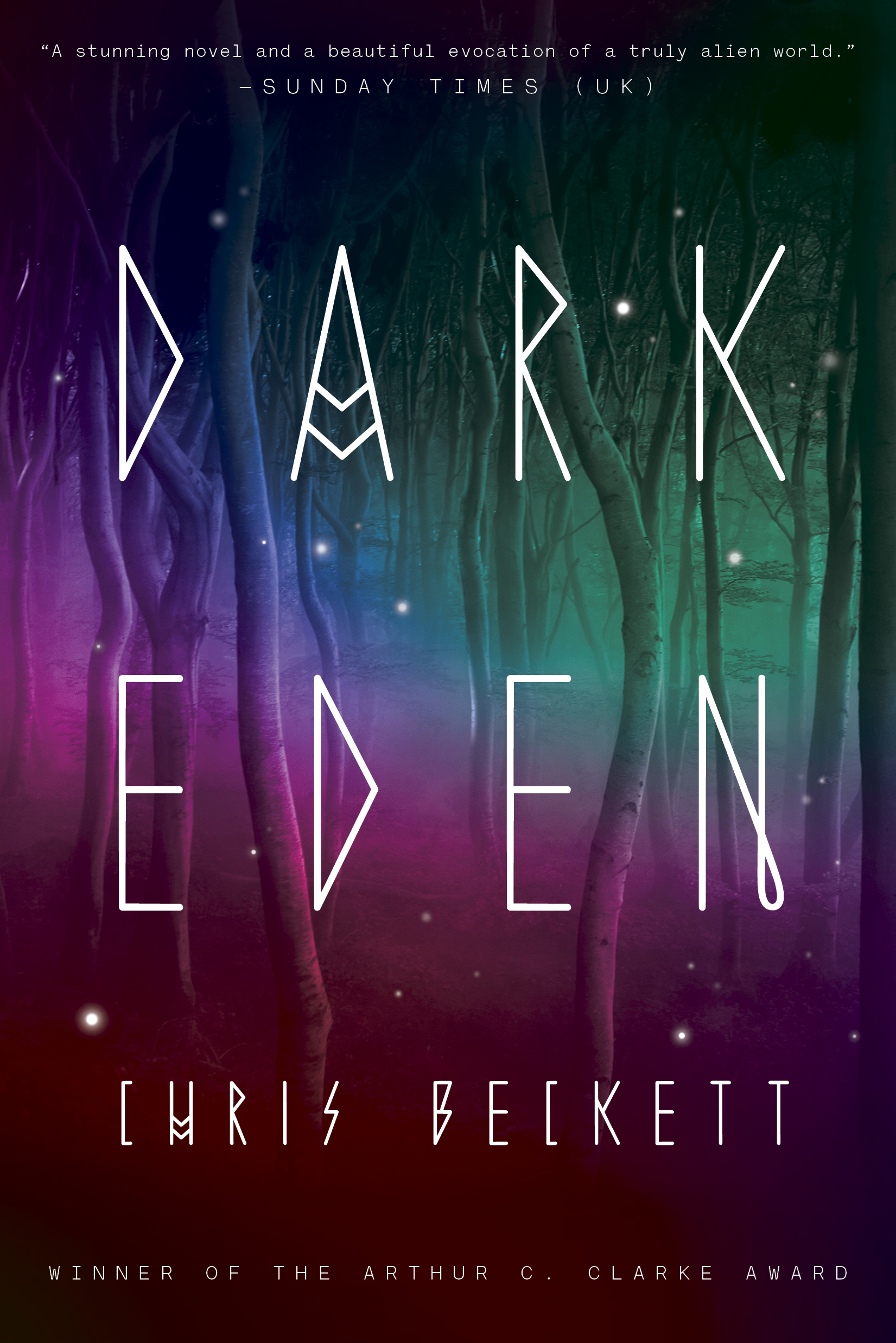
Chris Beckett: Dark Eden (2012)

DARK_EDEN

Chris Beckett’s novel Dark Eden was last year’s Arthur C. Clarke Award winner, which usually guarantees that a book is at the more literary end of the Sci-Fi spectrum. For once I can understand why a novel received an award. Dark Eden is nothing if not a tour de force. It’s as original as it is philosophical; in its themes as much as in its execution. Reading it wasn’t only a brainy experience, it was quite visceral as well. Beckett’s world felt so realistic, the everyday life of the people is described in all its strangeness and boring repetition, that I felt sucked in.

As a linguist and cultural anthropologist, I found the civilisation Beckett created extremely fascinating and thought-provoking. What would happen if a part of our high culture, a tiny fragment of our civilisation – two people to be precise – were abandoned on an alien planet, with nothing but their clothes, some paraphernalia and nothing else? This is what happens to Thommy and Angela, the ancestor’s of the people we meet in Dark Eden. The world they encounter is strange and dark. Light and warmth come from the lantern trees. Food abounds at first. The two humans can eat fruit and hunt the strange six-limbed animals of Dark Eden. Angela and Thommy procreate and once the story begins, the population of Dark Eden has risen to 532 people. Food is scarce by now. The perpetual darkness is hard on them. They have not ventured further because their creation myth traps them. After 160 years, or wombtimes as they call it, they are still waiting for a “veekle” from Earth to return and bring them back to their planet of origin. A planet that sounds like paradise to them. A planet where there is “lecky trickity” and daylight coming from a giant star.

Cultural anthropology studies – among other things – the development of civilisations from hunter-gatherers to (nomadic) herders to agriculturalists and more advanced civilisation. In Dark Eden this evolution is reversed at first and then starts to move through the aforementioned stages. The descendants of Angela and Thommy are hunter-gatherers, on the verge of becoming herders. And they have an oral tradition again; writing and schools have been abandoned a long time ago. Many of the words are written phonetically to illustrate that. “Rayed Yo”, “Veekle”, “Secret Ree”, “Wind Oh”. The sentence structure is simple and words like “very” don’t exist but instead of them, the narrators repeat words. “Very sad” becomes “sad sad” or even “sad sad sad”. I thought this was ingenious but – in all honesty – it got a bit on my nerves as well.

As we all know, a story needs conflict and the conflict arises in the form of a “newhair”. John Redlantern is only 20, but he questions the traditions who keep them trapped in this one place, waiting forever for an air ship that never comes. He dares the unspeakable. He challenges the elders and is finally cast out. What the elders didn’t expect – he’s struck a chord with many. Staying in one place means that food is getting scarcer and people are afraid of starving. When he leaves, a group of newhairs joins him.

John’s frustration has a lot to do with survival but is about something else als well. John’s suggestion to leave their dwelling place has something to do with leaving behind the past. Everything they do or think revolves around a distant time and place. They hope to be saved and brought back one day. They re-enact the story of Thommy and Angela again and again and, while waiting to be saved, they don’t really enjoy life or live freely.

What false hope can do to people is only one thought-provoking element, which is part of a profound analysis of meangless rituals and religion.

The structure of the novel is interesting as well. It has two main first person narrators and at least six minor narrators. That breaks up the monotony and gives Beckett the opportunity to show more than one view of the same story. The multiplicity of stories is another important theme in the book:

There are lots of different stories branching away all the time from every single thing that happens. As soon as a moment has gone, different versions of it start to be remembered and told about. And some of them carry on, and some die out, and you can’t know in advance which version will last and which won’t.

Dark Eden  describes a world in which sexuality is lived freely, in which nobody has ever murdered anyone and in which even the crippled and disfigured are treated like everyone else. But it’s not a peaceful society. Hatred and aggression simmer under the surface and can only be contained as long as absolutely nothing in the daily or yearly routine is changed. Once John questions tradition and sets in motion change, violence erupts.

The end is well done and logical. Pretty much what I had expected but that wasn’t disappointing. However, closing the book was a relief. The world Dark Eden describes is a wondrous place, filled with abundant vegetation and a strange and haunting fauna, but it’s bathed in perpetual darkness, and very suffocating.

Dark Eden is a novel that touches on many different topics – religion, family, tradition, overpopulation, hope, creation myths, languages etc. –  it’s philosophical and anthropological in scope and certainly testifies that Sci-Fi can still contribute a fresh and thought-provoking exploration of the human condition and our culture.

Thanks to Broadway Books for the review copy.

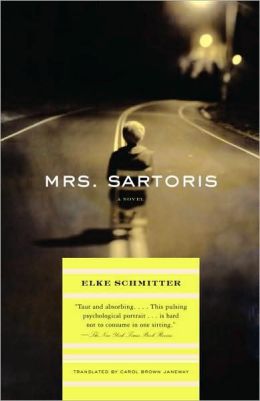
Elke Schmitter: Mrs Sartoris – Frau Sartoris (2000)

Mrs Sartoris

Part confessional, part thriller, Elke Schmitter’s explosive first novel is the story of Margaret. Jilted by a rich boyfriend when only eighteen, she finds herself many years later married, with a daughter, to Ernst, a war veteran with a penchant for routine and order. Living out her days in a small German village she is emotionally frozen, until one day she embarks on passionate affair with a married man. Planning to run away with him, she seems unaware that her plan is a fantasy that can never come true, and similarly unaware of the shocking repercussions that could result from chasing such a dream.

Why does someone commit a crime? Especially someone who isn’t really a criminal, but an ordinary person. Mrs Sartoris is an ordinary person, still, she kills someone. How that happened and who she killed is at the heart of this captivating and masterful novel.

Mrs Sartoris is a troubled woman. She drinks too much, is unhappy and once upon a time she spent a few months in a psychiatric hospital. She lives with her mother-in-law, her husband and her daughter in a small house. The only person in her life she’s truly attached to is her mother-in-law. She makes life bearable. There is no warmth between her and her husband and, as we will learn later, there are reasons for that.

The book opens with a cryptic short paragraph in which Mrs Sartoris, who tells the whole story, writes about an incident. What it is will be revealed very slowly. Small chapters on that incident change with chapters on her life. Her childhood and unhappy love story, her dreadfully boring and conventional married life, her affair with Michael.

Mrs Sartoris isn’t an entirely unreliable narrator but she’s highly deranged and depressed which clouds her judgement.

The story as such is interesting and suspenseful. And there is a twist at the end, which is very well done. But what makes this book truly masterful is the way it’s told. There are passages in the narration that I would call “litanies” in which Mrs Sartoris enumerates things. In one instance she talks about all the meaningless sentences she doesn’t want to say anymore. Reading them in rapid succession is eerie to say the least and makes the reader think how often one uses empty phrases just like that. How many meaningful conversations do we have day in and out? Another litany enumerates all the things Mrs Sartoris has never had in her life and this reveals so much bleak emptiness, it’s  chilling.

Mrs Sartoris has been compared to Mme Bovary. I don’t think I would have made the comparison if the blurb hadn’t told me to make it. Sure, there is an adultery, but other than that? Mrs Sartoris’ husband is as conventionally boring as Charles Bovary, Mrs Sartoris is lost in a dream world and her lover resembles Mme Bovary’s lover a tiny bit but that’s that. I would, if I had to, much rather compare it to Tim Parks’ Loving Roger.

Mrs Sartoris is the tightly woven story of a life, an analysis of a crime written in a chilling, and revealing style that will haunt readers for quite a while.

For another take on the novel here is Stu’s review.

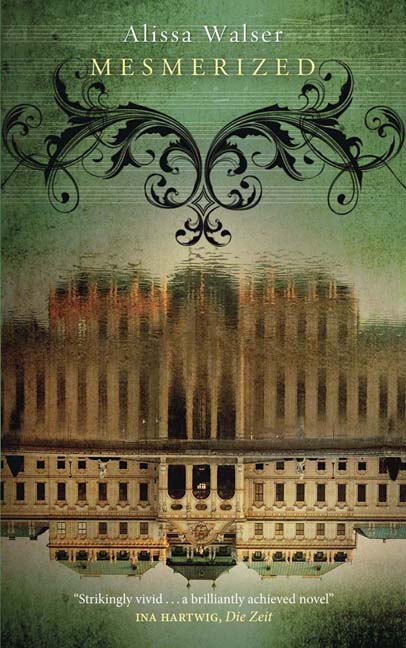
Alissa Walser: Mesmerized – Am Anfang war die Nacht Musik (2010)

untitled

I so wanted to love this book. I liked the premise, the first sentences were evocative and descriptive but then, a few pages later, I just couldn’t stand the style anymore. Admittedly, it’s artful but also quite lifeless and tedious. The whole book contains only indirect speech and a great majority of the sentences are only fragments. Very staccato and after a longer period of reading, very repetitive. I’ve read mostly positive reviews of this book on English blogs, but they were all based on the translation while I read the German original. Maybe it reads better in English? The German critics were either impressed with the style or they called it artificial.

The story as such, which is based on true events, is fascinating. It’s set in Vienna in 1777  and in Paris in 1784. Franz Anton Mesmer was one of the most famous doctors of his time. A controversial figure who invented a treatment method involving what he called “animal magnetism”, in which he applied magnets to his patients or applied some sort of energy therapy. Some of the cases were quite miraculous, the most famous being the cure of the blind musician Maria Theresia Paradis. Maria lost her sight at the age of five and it was never clear what caused it. Still she was an accomplished musician and protégée of the empress. Mesmer moves her away from her family and treats her in his hospital. After a few weeks the girl can see again. Unfortunately it affects her music. Seeing makes her less of an accomplished musician. Her parents and doctors come running and in the end, nobody really knows why, she loses her eyesight again and Mesmer is called a fraud. After these unhappy developments Mesmer flees to Paris where some see him as a charlatan, others think he’s a miraculous doctor.

The book clearly underlines that Mesmer has found a relationship between body and mind and in removing Maria from her family he indicates that the surroundings were toxic. Maria’s blindness has a lot in common with some of the hysterical symptoms Freud will describe later.

What I really liked in this book is how music and energy are paired. Nobody denies the effect of music, the wonder of it, despite the fact that you can neither touch nor see music, still most people around Mesmer, don’t believe in energy fields in the body. Mesmer is a musician as well and the bond he forms with Maria, a bond her parents and his wife equally fear and hate, is strong because they understand each other on a deeper level. They communicate through their love of music. His understanding of her personality is much more intuitive than rational and that may have been a reason why the therapy worked so well. Until the parents turned up and Maria was dragged in front of a critical public who was hoping she wasn’t cured.

There are tragic elements in the book. Many quacks tried to cure Maria before she was brought to Mesmer and some of the brutal treatments left scars on her. Even in 18th Century Austria there were a lot of physicians more interested in money than the cure of an ill person.

The translation of the title is a bit surprising. In German the book is called “In the beginning the night was music”, which is a very rich, lyrical and biblical sounding title.

If I had liked Alissa Walser’s style, which reminded me a bit of Elfriede Jelinek, I would have loved the book, but since I found it tiresome, I didn’t.

A few more positive reviews

TBM (50 Year Project) 

David (Follow the Thread)

Iris on Books

Here’s the author reading the beginning of the novel:

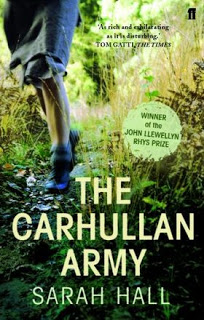
Sarah Hall: The Carhullan Army (2007)

Carhullan

Set in the part of England once known as The Lake District and frequented by hordes of landscape hungry tourists, The Carhullan Army is narrated by a young woman who has adopted the name Sister. Britain after its union with the United States and numerous unsuccessful foreign wars, has found itself in the grip of a severe fuel crisis and the country is now under the control of a severe body known as The Authority. All fire-arms have been handed over to the Government and all women have been fitted with contraceptive devices; this Britain of the near-future is brutal and very-near desperate.Sister’s only hope — or so she thinks — lies in finding the Carhullan Army: a mythical band of women who lives a communal existence in the remote hills of Cumbria.

I came across Sarah Hall’s name many times in the past months. First I read a review of The Carhullan Army on Vishy’s blog (here) and immediately thought I’d love to read it. I later saw that Hall won the John Llewellyn Rhys Prize for The Carhullan Army, the Commonwealth Writer’s Prize for Hameswater and was shortlisted for the Man Booker for The Electric Michelangelo. Her short stories are said to be very good too.

The Carhullan Army is a dystopian novel. It has been called A Handmaid’s Tale for our times. I can’t confirm whether that’s the case as I haven’t read Atwood’s novel yet, but it’s certainly not a genre novel, it’s highly literary.

The Carhullan Army  is set in a bleak Britain, which is ruled by the so-called Authority. The system has collapsed due to a fuel crisis. People live like cattle, sharing small apartments. Some things are strictly regulated like work and reproduction, others are forbidden, like leaving the town. People are depressed, many use drugs. Relationships collapse, love dies. “Sister”, how the narrator calls herself, can’t take this anymore. She’s heard of Carhullan. Somewhere in the mountainous region of the Lake District lives a group of women autonomously. They have a leader, Jackie, a very charismatic figure, but other than that, they are free. Sister doesn’t know that much about the place, only that what she has heard. The rest is a mix of her imagination, her hopes, her dreams.

The place sounded utopian, martial or monastic, depending on which publication was interviewing, and what angle they wanted to push.

Sister is sure that her life will improve and that the women will welcome her, commend her for her courage to leave. But things don’t exactly go like that. The way Sister is “welcomed” is a huge disappointment, a shock even. It will take more than simple resilience to come to terms with this. But once she’s proven she isn’t a spy, nobody is following her and that she’s truly interested in living at Carhullan, she’s accepted.

Sister is a complex narrator but Jackie, the leader, is even far more complex. What Jackie has created at Carhullan is as amazing as it is scary. The women are able to provide for themselves. They plant, gather, and hunt, and – even far more important – they have an army. An army which has been trained by ex-soldier Jackie who is a severe drill instructor. She’s fierce and demanding, charismatic and unforgiving. Most women know that they might need to defend themselves some day and for many it is a special distinction and a great honor to be chosen for the army, others however think Jackie goes too far. Sister would love to be part of the army, but she has to wait a long time.

In Jackie Sarah Hall has created a multilayered personality. She combines the traits of a cult leader, of a fanatic, a saviour, a soldier and a hero. She never questions the use of violence, which, for me, was the most difficult part of the book. I never thought this was a utopian society, but I never thought they were that misguided either. Given the circumstances the development was quite logical but they were not free. Every single of Jackie’s decisions is an answer to the Authority and the end of the book makes this very clear. Sister idealizes Carhullan when she goes looking for it, the reader thinks it’s ideal at first, but towards the end we understand that Carhullan is part of the system as well. There would be no Carhullan, at least not the one we see here, if the society had not reached an endpoint.

Here’s Jackie talking to Sister:

“…. I just want to get to the bottom why these things go on. I’m a dark fucking tourist, Sister, I like going to these places. It’s interesting to me. I’m interested in what holds people back. And what doesn’t. And how far these things extend….”

I think this illustrates my point. Jackie is raw, she’s violent and she’s never free of questioning the system, she has an urge to explore it and in doing so stays tied to it.

The Carhullan Army explores many other themes, Lesbian love, autonomous living, the nature of cults and fanatics, totalitarianism and terrorism. Sarah Hall writes well, her sentences are limpid, simple, yet her vocabulary is rich and evocative.

The story is told like a confession, which has been recorded. Some of the files are recovered, some are corrupted. I thought tha approach worked well.

It’s a book that made me feel very uncomfortable. I found it had a bit of a Lord of the Flies vibe. The place Sarah Hall describes isn’t a gentle haven, it’s a rough world, in which people have to fight for their survival. The harsh landscape, the difficult situation has changed them. They swear, they fight. They do have camaraderie and loyalty, even love,  but it’s all very raw.

I am glad I’ve read The Carhullan Army. I think it’s excellent and thought-provoking but it’s depressing as well. I wouldn’t want to live in neither of the worlds Sarah Hall has created.

Have you read any of Sarah Hall’s novels or short stories?

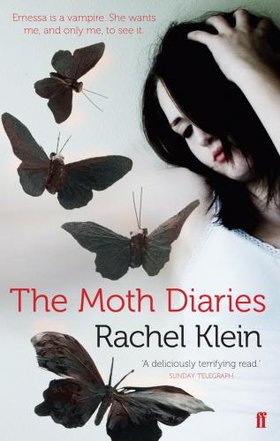
Rachel Klein: The Moth Diaries (2002)

The Moth Diaries

Did you like being an adolescent? Looking back I can’t say it was much fun. I would even say it was pretty awful. A whole lot of insecurities, suffering and drama. When I studied cultural anthropology some years later we read Margaret Mead’s Coming of Age in Samoa, which was her first publication. At the time when she wrote it, cultural anthropology was seen as a means to better understand Western culture and society. When she went to Samoa Mead’s wish was to investigate adolescence in another culture and to see how much of what girls in the US went through was rooted in the culture. Pretty much everything that is experienced as awful when growing up in the US or Europe was missing in Samoa. While her research was later criticized for being to idealizing, it still contains a lot of valuable information. Maybe Samoa wasn’t the idyllic paradise she saw in it but the young Samoan girls decidedly didn’t suffer like many girls did and still do in Western societies.

The Moth Diaries depicts adolescence in its most dysfunctional forms. Obsessions, anorexia, self-inflicted wounds, suicide. It is an intense and intriguing book, a painful story told by an unreliable narrator, in form of diary entries. The microcosm of a boarding school, set in an old Gothic looking building adds further depth to the story.

Her psychiatrist later tells the narrator that she suffered from “borderline personality disorder complicated by depression and psychosis”.  The prologue tells us that she has left this behind. But is she really cured, is she really better? What prize did she pay for that? And was everything she experienced and witnesses just the output of a vivid imagination?

The narrator’s father has committed suicide. Her mother cannot deal with an adolescent and sends her to boarding school where the narrator forms a close relationship with another girl, Lucy. Returning after a longer holiday break, the narrator must realize that her best friend is more interested in the new girl Ernessa. Ernessa is pale and mysterious, she never eats or sleeps and the narrator is convinced that she is a vampire.

What is interesting in the way this is told is how the book manages to show that when you are alone during an important phase of your life, isolated even, and you are surrounded by suffering that you don’t understand, you may end up interpreting facts in a fantastical way. Or, to say it differently, you may have a psychotic episode.

While books like Twilight and The Vampire Diaries, tell a normal college story spiced up with vampires, The Moth Diaries does exactly the opposite. What really goes on in this boarding school, the obsessive dieting that turns into self-inflicted starvation, the claustrophobic friendships that turn into erotic relationships, the mobbing, all this is much more painful than the vampires populating contemporary high school dramas could ever be. Whether or not Ernessa is a vampire, is ultimately not that important.

What made me feel particularly uncomfortable is how the grown-ups deal with the girls in this book. With the exception of one or two teachers, they are all dysfunctional and abusive.

The Moth Diaries is an eerie and uncanny depiction of adolescence with a very Gothic feel. It is full of  inconvenient emotions, told by a narrator who is confused but at the same time extremely wise and insightful. One could call The Moth Diaries a contemporary and female version of The Catcher in the Rye. I found it painfully poignant.

The Moth Diaries has been made into a movie. Has anyone seen it?

http://www.youtube.com/watch?v=rp_luBLwsN0