Rosamund Lupton: Sister (2010) A Great New British Thriller Writer

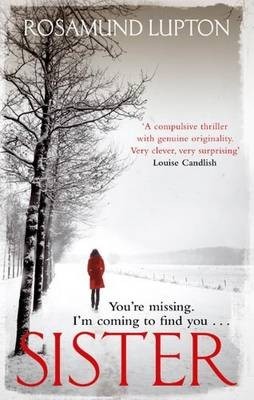
Nothing can break the bond between sisters …When Beatrice gets a frantic call in the middle of Sunday lunch to say that her younger sister, Tess, is missing, she boards the first flight home to London. But as she learns about the circumstances surrounding her sister’s disappearance, she is stunned to discover how little she actually knows of her sister’s life – and unprepared for the terrifying truths she must now face. The police, Beatrice’s fiance and even their mother accept they have lost Tess but Beatrice refuses to give up on her. So she embarks on a dangerous journey to discover the truth, no matter the cost.

That was a fast read. Even though this was a busy week and the novel had some 370 pages I read it in a few days. That certainly says something. I liked it a lot. The writing reminded me of Maggie O’Farrell. Should she ever choose to write a thriller, that’s what it could look like.

Sister is the story of  Tess and Beatrice, two sisters who are extremely close, even though the older one, Beatrice, lives in New York, while the younger, Tess, is still in London where she goes to an art school. When Beatrice gets the phone call from her mother saying her sister is missing she is highly alarmed and flies back to London immediately. When the sister is found dead and declared to be a suicide Bee – as her sister used to call her – is the only one who does not believe it was suicide. She is certain it was murder. And she won’t change her mind. No matter what the police, her mother or Tess’ psychiatrist say.

The story is told in part as if Beatrice was writing  a letter to her dead sister, telling her the whole story after the murderer has been found and arrested. In part she writes the letter, in part she tells the whole story to a lawyer. Consecutive flash backs. The story is also interspersed with dialogue between the sisters.  There are many red herrings as so many men who were in Tess’ life seem suspicious. The ending is quite a twist. That’s the only flaw I could find in this book. It seems a little bit artificial but then again it is not an improbable ending.

There are  many colorful characters in this novel. Art students, immigrants, doctors, scientists, policemen. The bond between those sisters is certainly the most important relationship in the book and it is very deep and moving. The story of their childhood is not an easy one which is another reason why they were so close. All through the novel Beatrice finds other people to relate to and some relationships like the one with her mother are completely transformed. Bee herself is also changed considerably. When the novel starts she is afraid of life, at the end she is ready to embrace and enjoy it.

Sister is Rosamund Lupton’s first book. The next should come out in 2011. I am already looking forward to reading it.

Thierry Dancourt: Hôtel de Lausanne (2008) French Prize For First Novel

Au cimetière du Trocadéro, un homme et une femme s’assoient sur un banc. Le vent souffle, elle n’arrive pas à allumer sa cigarette, ils entament la conversation. Elle s’appelle Christine, vit un peu hors du temps, entre un père obsédé par les mappemondes et un fiancé qui semble ne pas beaucoup compter. Lui, Daniel, parcourt le monde à la recherche d’objets anciens. Entre eux se noue une relation à part, clandestine, dans un Paris enneigé et brumeux. Du XVIe arrondissement à Casablanca, une galerie de portraits se dessine, mais une figure domine, entre ombre et lumière, celle, singulière et attachante, de Christine Stretter.

A man and a woman meet at the cemetery du Trocadéro in Paris. She tries to light a cigarette but the wind and the rain are too strong. They start to talk as if they had known each other forever. Christine lives outside of our daily world between a father obsessed with maps and  a fiancé who is never there. Daniel is an antiquarian and travels the world. They will start to meet in hotels all over Paris and in the province.

Dancourt won the French prize for first novel and I am pretty sure he will be translated. This little book is far too wonderful and will be highly appreciated by people everywhere as it is also an homage to the city of Paris. Without knowing it ( I looked it up later) I knew that Dancourt is not a Parisian. Parisians do not render their city so lovingly. Only people from abroad and the homesick ones who live in other countries would describe it with such great detail.

Reading this filled me with a terrible longing. Missing a city is not much better than missing a person. On the other hand, the Paris of this book has an otherworldly quality and charm that the struggle of daily life, commuting etc. destroys sooner or later. This is the Paris we love to dream about, the town we would love to live in if we did not have to go to work every day.

Hôtel de Lausanne tells also a very lovely story in the typical French manner of not revealing too much. The people in this novel keep their mystery until the very end. We can only assume why they do this or that, it is never explained or analyzed.

Christine is engaged when she meets Daniel and even though their relationship is very profound and magical she still gets married to her fiancé as she always wanted to get married very young (she is only 21). The funny thing, even though this feels wrong on a logical level, it feels right emotionally. One has never the feeling of reading a book about an adulterous woman. And one never questions her choice. I never even wondered why she wasn’t getting married to Daniel if they were so close.

I liked this aura of mystery that encloses the people and the many descriptions of Paris, its little cafés and bars. Those typical little cafés no tourist would ever go to but where the people living close by, the so-called  “habitués” will come every day, drink and eat and chat. Village-like coziness of big cities where you end up staying in your quartier unless you go to work. Christine and Daniel have their favourite places, where people know them and treat them like a couple and where they occasionally also meet someone who knew Christine’s mother. A haunting figure of whom we try to catch a glimpse as hard as Christine tries herself.

Hôtel de Lausanne is a very enchanting novel and I will certainly read more of Dancourt (his second novel Jardin d’hiver has just been published). As stated before I am pretty confident this will be translated. It simply has to.

Daniel Glattauer: Love Virtually (2011) aka Gut gegen Nordwind (2006) A German Novel in E-Mails

Love Virtually

“Write to me, Emmi. Writing is like kissing, but without lips. Writing is kissing with the mind.’

It begins by chance: Leo receives emails in error from an unknown woman called Emmi. Being polite he replies, and Emmi writes back. A few brief exchanges are all it takes to spark a mutual interest in each other, and soon Emmi and Leo are sharing their innermost secrets and longings. The erotic tension simmers, and it seems only a matter of time before they will meet in person. But they keep putting off the moment – the prospect both excites and unsettles them. And after all, Emmi is happily married. Will their feelings for each other survive the test of a real-life encounter?

And if so, what then?

Love Virtually is a funny, fast-paced and utterly absorbing novel, with plenty of twists and turns, about a love affair conducted entirely by email.

I have already read Love Virtually because the original came out in Germany in 2006. I even read it in hardback, a rare thing, as I was so curious to find out what the hype was all about. I must say, I have not often been this engrossed. You start it, you read and you do not stop before the end. After, let’s say, two –  three pages you will have forgotten that this is a novel, you will be sure that you are reading a real e-mail exchange between two people. That is quite an achievement. I am really  pleased to see that Glattauer’s book will be published in English in 2011.

Emmi writes accidentally to Leo and they keep on writing to each other because each one likes the tone of the other’s e-mails. And because they both imagine each other. Without knowing each other they develop crushes. There is only one little complication. Emmi is happily married. It seems only natural she does not want to meet Leo. What if he was anything like the man she imagines? Still she can’t stop writing. They tease and flirt and exchange their hidden dreams and wishes and get to know each other better and better. They also arrange a date without really meeting each other. They just both know that they are at the same restaurant at the same time. Later they compare their impressions and try to find out if they  did recognize each other.

Leo and Emmi are both  intellectuals. This is important to know, as that determines the nature of their exchange. Even though they tease and flirt, they philosophize and analyze a great deal too.

If you want to find out if they really meet you have to read the novel. Daniel Glattauer wrote a sequel (Alle sieben Wellen 2009) that has been published a while back. It is also very good but I would have preferred if he had stopped after Gut gegen Nordwind. The ending of Love Virtually is very special. The sequel spoils it.

I think the idea of having a crush on someone you only know by e-mail (I know the movie with Meg Ryan, but Love Virtually is very different) is interesting and Glattauer provides an in-depth analysis of this premiss. Love Virtually is highly entertaining but still deep. Personally I like epistolary novels a great deal. This is just a variation on the same theme.

A word on the English marketing of this book. Just have a look at the German cover. Don’t you think it looks much nicer? I can understand that the title was problematic. Gut gegen Nordwind would have to be translated as “Good against the North wind”. This is far more poetical than Love Virtually but does this mean anything outside of Germany? The North wind is a bit like the Californian Santa Ana winds, but cold, very cold. He does also carry a nervous energy and is a bit depressing. I must admit, I am not sure I would have bought the book with the title Love Virtually and such a cover. What do you think about the covers and the titles?

Susan Hill: The Small Hand (2010) A Ghost Story

Returning home from a visit to a client late one summer’s evening, antiquarian bookseller Adam Snow takes a wrong turning and stumbles across the derelict old White House. Compelled by curiosity, he approaches the door, and, standing before the entrance feels the unmistakable sensation of a small hand creeping into his own, ‘as if a child had taken hold of it’. Intrigued by the encounter, he determines to learn more, and discovers that the owner’s grandson had drowned tragically many years before. At first unperturbed by the odd experience, Snow begins to be plagued by haunting dreams, panic attacks, and more frequent visits from the small hand which become increasingly threatening and sinister …

I really bought The Small Hand with the R.I.P challenge in mind when I found it at a local bookstore. And because I love the cover and had wanted to read something  by Susan Hill anyway. I enjoyed it quite a lot. It is beautifully written but surprisingly old-fashioned in tone. It is quite an eerie and mysterious ghost story. What I appreciated is the fact that the mystery is solved in the end.

The Small Hand has quite a lot to offer. Adam Snow being a bookseller every book lover will feel a certain affinity right away. What sounds more enchanting than a job that involves travelling the world and looking for rare books? One of his trips brings Adam to the South of England. On his way back he gets lost and discovers an abandoned house with an overgrown garden. This is not exactly an original idea, especially not in a British novel as the British novel has a great tradition of descriptions of grand old  houses and mysterious gardens (from Great Expectations to The Secret Garden, Tom’s Midnight Garden to The Forgotten Garden and many more). The lack of originality did not disturb me one tiny bit as I love descriptions of old houses and descriptions of gardens that return to a state of wilderness. Susan Hill is very talented in describing nature with great detail. It is in this very garden that Adam feels for the first time the presence of the ghost of a little child.

Ghosts are normally bound to certain places but this one is not. It will haunt Adam all through the story and wherever he goes. Telling more would be a spoiler so I will stop here.

On one of his hunts for rare old books, a First Edition of Shakespeare in this case, Adam travels to a forlorn French monastery. This is another extremely well rendered description. And such an appealing one. I would love to spend a few weeks there myself.

I think this book could be quite scary for some readers especially if they have a history of recent panic attacks as this is the way Adam experiences the presence of the ghost or rather ghosts.

The Small Hand is a wonderfully old-fashioned and very British (a high compliment coming from a fervent Anglophile) Ghost Story creating a pleasant frisson. It is best read at this time of the year, preferably at night in bed.

I have already ordered The Woman in Black, another of Susan Hill’s Ghost Stories. What Susan Hill novels did you read and like?

Here’s another review of The Small Hand by Susan Hated Literature

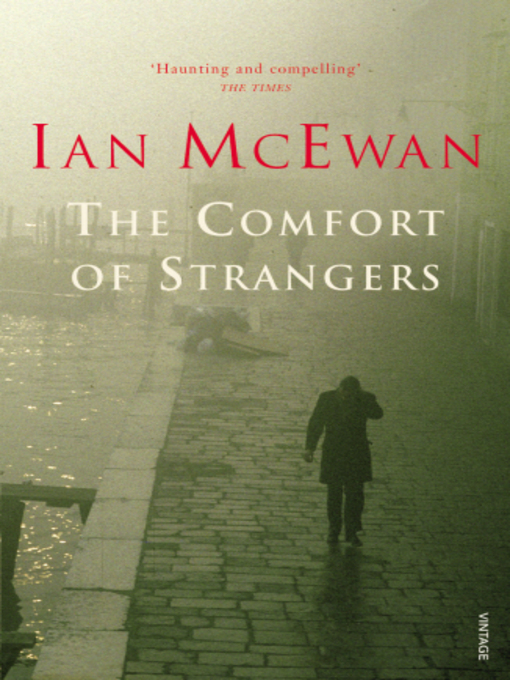
Ian McEwan: The Comfort of Strangers (1981)

As their holiday unfolds, Colin and Maria are locked into their own intimacy. They groom themselves meticulously, as though there waits someone who cares deeply about how they appear. Then, they meet a man with a disturbing story to tell and become drawn into a fantasy of violence and obsession.

I can’t forget The Comfort of Strangers. It keeps on haunting me.

This is not a novel, I liked. The world McEwan unleashes is too gloomy, too disgusting. Even though I didn’t like the novel  I am fascinated how obstinately  it stays in my mind, and even in my feelings.

I truly enjoyed Atonement. It did stay with me for a very long time as well. When you are engrossed in a novel that you enjoy you don’t pay so much attention to the skills of the author. You are just enchanted by the feelings he evokes in you. McEwan is one of the most renowned British writers and when reading a book like The Comfort of Strangers, that you do not even like but that still resonates in your mind, you know why he gets so much praise.

The Comfort of strangers narrates the stay of a young English couple in Venice. There is something sinister from the very beginning. The way McEwan describes the city gives the impression as if Venice was a lurking animal. The Venice he describes is neither idyllic nor romantic; on the very contrary. His description of those labyrinthine, narrow streets that make orientation difficult, of those alleys whose walls tower too high to permit an overwiew, is unsettling.  I was reminded of the movie Don’t Look Now. The young English couple is described as if they knew each other too well.  They don’t talk much, they drift and only barely escape deadly boredom. It is not exactly clear why but all of a sudden their  sexuality changes radically. They are suddenly drawn to more violent, sadomasochistic lovemaking.  On one of their nightly forays they meet a mysterious local man who takes them to his own restaurant where they drink far too much. On their way back to the hotel they get lost and wait on some doorstep till dawn approaches. As if out of nowhere the man reappears and takes them home where he introduces them to his wife. His wife seems to be an ailing invalid. They don’t know it, but from the moment they meet these two people they are doomed.

McEwan’s slim novel touches many topics: relationships, love, power, sadomasochism, people abroad, Venice,  disorientation, voyeurism. The list is almost endless. On top of that McEwan´s writing is scarce, concise, and very atmospherical and visual.

The Comfort of Strangers is not a pleasing novel, but one that shows you what good literature is capable of.

Are there any books that you did not like but still consider to be very fascinating?

J. Courtney Sullivan: Commencement (2009)

A sparkling debut novel: a tender story of friendship, a witty take on liberal arts colleges, and a fascinating portrait of the first generation of women who have all the opportunities in the world, but no clear idea about what to choose.

Assigned to the same dorm their first year at Smith College, Celia, Bree, Sally, and April couldn’t have less in common. Celia, a lapsed Catholic, arrives with her grandmother’s rosary beads in hand and a bottle of vodka in her suitcase; beautiful Bree pines for the fiancé she left behind in Savannah; Sally, pristinely dressed in Lilly Pulitzer, is reeling from the loss of her mother; and April, a radical, redheaded feminist wearing a “Riot: Don’t Diet” T-shirt, wants a room transfer immediately.

Celia, Bree, Sally and April are best friends even though they couldn’t be more different. During their time at Smith’s College they are inseparable. They help each other through minor and bigger disasters. Four years after graduating they meet again at Sally’s wedding. A stupid dispute drives them apart and they avoid each other for almost a year when April disappears.

Commencement is a novel of ideas. I don’t know why it has been called chick-lit. Because four young women are the protagonists? Quite unfair. It is as if this label proves the point the book wants to make. Even years after women’s lib began, we are still nowhere. A large part of Commencement is dedicated to topics like sex-trafficking, rape and child abuse. Despite the serious topics it tackles, it is an entertaining book with a lighthearted quality. But it is definitely a feminist novel in the vein of Marilyn French’s The Women’s Room and not chick-lit. I needed some time to get into it as each chapter is told by someone else. We hear that person’s story and get to know the others through her eyes. That wouldn’t be confusing, but they sound similar and their names are similar. Sullivan let’s her characters explore all the possibilities women have today. Getting married, staying single, having kids, having no kids, become lesbians, have various sexual partners, be monogamous. She looks into the mechanics of family and friendship. One girl’s parents are still in love, another has lost her mother, the third grew up with a single hippie mom and the fourth has a career mom. Regarding their professional choices Sullivan goes a similar way. They all chose something quite different. Sullivan who is a feminist deliberately chose to show every possible combination/choice. This could have gone wrong but it is well done. From page to page I liked those girls more. I wouldn’t go as far as comparing it to Mary Mc Carthy’s The Group but it is very good.  Ronnie, April’s boss, a militant feminist and audacious filmmaker is a very interesting character. Her ideals are such that she is blinded by them and becomes a true fanatic. A selfish zealot who does not shy away from endangering others for the cause. Another interesting aspect is that even though one girl loves another girl, she never considers herself to be a lesbian. The depiction of a women’s college is probably very realistic as Sullivan went to Smith herself. The friendship of those girls is very touching. It’s cute how they cuddle up in bed together, watch movies or chat.

If you are looking for an interesting, thought-provoking but still entertaining read, go for it. Especially when you are a feminist, interested in women’s topics or just love stories about friendship among women.

I mentioned The Group and The Women’s Room before which I loved both. Which books about female friendships and developpment did you like?

Barbara Trapido: Sex & Stravinsky (2010)

This was my first book by Barbara Trapido but I think it will not be the last. It has flaws but I could generously overlook them as there is so much to enjoy in Sex & Stravinsky.

Sex & Stravinsky is told in alternating points of view something I usually  don’t like unless it is done as well as Barbara Trapido does it. What is really impressive is how different those voices sound. The story could be told in a few words as the book is really focussing more on the characters than on the plot.

The Australian Caroline meets Josh, a South African, in London. Josh is fascinated by opera, ballet and pantomime, dedicating his whole live to these topics. They have a daughter Zoe who would love to become a ballet dancer but since money is tight she has to make do with reading ballet books that are written by Hattie whom she doesn’t know.

Hattie is the secret love of Josh’s life. She still lives in South Africa with Hermann, the tall blond of Boer descent. They have a daughter Cat who is highly creative but hates her mother’s guts.

And there is Jack, Jacques or Giacomo, depending on the mood of the day, a young man of modest background who reinvents his own story as he moves from South Africa to Senegal, to Italy and back to South Africa.

There are a lot of coincidences in this book that seem unrealistic and still Barbara Trapido can get away with it as her characters are truly wonderful.

At the beginning of the novel, the couples are in their respective countries, at the end they all meet in South Africa, more or less by chance.

Caroline is by far the most appealing character and I could relate to her story. She was followed to London by her awful mother who exploits and abuses her whenever she can. Although Caroline is strong – she can renovate and redecorate a house like any man could, she is over six feet tall and a stunning blonde beauty, she transforms a bus into a little paradise, she knows how to cook delicious meals out of nothing, sews the most wonderful clothes out of old pieces -she cannot fight her own mother and her horrible sister. Unfortunately the description of her mother, the event of her cerebral hemorrhage including the story of the will and the unhappy discoveries linked to it felt all too familiar…

Each one of them does not live the life they had dreamt of but they will all get their chance in the end.

I really enjoyed this book. It exudes globalization and all the elements of living in a multicultural world. We hear as much about Stravinsky as about the masks of the Dogon. But, and this is my critique, it sort of flies over these cultural elements. It is a bit like standing at an enormous buffet with fingerfood from every corner of the world. A little taste of Moroccan cuisine, morsels of Northern Italian anti-pasti, a sandwich with a Caribbean spread.

Still, I liked it a lot: I loved the descriptions of the characters. Talented Caroline, Hattie the petite dancer, rebellious Cat, adopted Josh, Herman the boorish architect, little Zoe who discovers France on a school trip.

Zoe’s school trip to France is one of the best parts. Poor Zoe lands in a dysfunctional lower class family with unhealthy habits, a lot of shouting, awful driving in a smoke-filled car.

One theme that we find in the whole novel is legitimacy. There are three characters in this book who don’t know who their real parents are.

I believe Barbara Trapido just invented the genre of the  21st century multicultural fairytale.

One thing I would be interested in however, why did she choose this title? Has anyone an idea?