
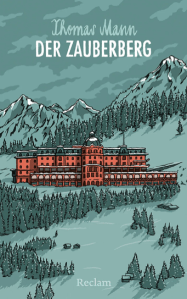
Is The Magic Mountain a difficult book?
We often see these discussions on social media about difficult books. Ulysses is mentioned. Proust’s À la recherche du temps perdu. Some of Henry James’ later novels. And Thomas Mann’s The Magic Mountain. These novels have one thing in common – they are very long. Depending on the font size, the page count of The Magic Mountain varies between 750 and over 1000 pages. If you’re a slow reader, this alone could make it difficult, but that’s usually not what people are referring to.
I personally didn’t find it difficult, but I could imagine a few things might actually be challenging for some readers. Thomas Mann is a highly intellectual writer. A master of language. I don’t know anyone who writes like him, uses language like he does. I always loved it because I find it expressive and funny but he’s not a writer who lets you identify much with his characters. You’re always at arm’s length. At times, the author will intrude. He will make fun of the story, his own writing, his characters. There’s a whole lot of telling instead of showing. For this, he’s often been called a cold writer. We don’t really know how his characters feel and if we do it’s through the lenses of satire and mockery. That’s not to everyone’s taste. The sentences are rather long, and his style is very unique. I’m sure translators didn’t have an easy time. I don’t know how many English translations there are by now, but apparently there was a new one in the 80s that was extremely different from the first translation. I read an article that I found on JSTOR and the author said that the old translation seemed to have stayed close to the original while the new one made it sound more English. In other words, the translator tried to make it more readable. I’m never sure how to feel about these attempts.
What made The Magic Mountain challenging for me is that it slows down considerably from page 500 on. The pace changes completely and only picks up again towards the very last pages. The book has 7 chapters with sub chapters and the first five are about 50% of the book. From book 6 on, the sub chapters get longer and longer. That wouldn’t exactly be a problem but the nature of the chapters change. While there’s a lot going on in the first half, in the second half philosophical and/or theoretical parts become more frequent and far longer. To be honest, those weren’t always that gripping to read. Of course, this change of pace and content has deeper meaning. After all, this is a book about time, the nature of time, the experience of time and about a specific period, the years before World War I.
 Beauty is a Sleeping Cat