Frank Herbert: Dune (1965) Book II Muad’Dib

It’s time for the second Dune readalong post. The readalong is hosted by Carl V from Stainless Steel Droppings,  The Little Red Reviewer and (slight change of the initial three) Grace from Books without any Pictures. This weeks questions have been sent by Redhead (The Little Red Reviewer). Check out the other links here.

I’m happy to report that I liked part II much better. There is far less dialogue and if there is, it is an exchange between two people and not purely an instruction of the reader.

Was Liet’s identity a surprise?  Who do you think he really works for?

I’m not totally sure about this question. I thought he died? I thought since he was a Fremen he also secretly worked for them.

What do you think of the Fremen culture?  Is this a culture you think you’d enjoy spending some time with?

They sound like a very proud and interesting people and reminded me a bit of the Tuareg or any other desert dwelling nomads. A lot of Dune is inspired by North African culture. But since I like rain and plants more than anything else in the world and as appealing as I think some of it sounds, thanks but no thanks, I wouldn’t want to live with them. Furthermore I’m not into duelling. A fierce fighting people isn’t the kind I would want to spend time with. One aspect that I liked is their patient attempt to re-green the desert. Their elaborate plans sounded very convincing.

What do you think of Count Fenring’s unusual verbal mannerisms?  

I found it quite annoying and was trying to imagine how it would sound. I’m not sure what Herbert wants to tell us with this?

This is a far future empire with very little in the way of computerization. Information is often passed down orally, and schools (such as the Mentats and the Bene Gesserit) have formed to train young people in memorization and information processing.  What are you thoughts on a scifi story that is very “low-tech”?  Does that sound like a feasible future? A ridiculous one?

This is precisely the reason why I thought from the beginning that it really is a bit of a sci-fi/fantasy blend. Considering the fact that resources are limited on earth, and very likely on other planets as well, low-tech seems a more viable way to go. These people are advanced in other ways. The mental faculties are far more developed and this would be something to wish for. Unfortunately, humans stay humans, and will, even with low-tech support only , try to exploit others. At least that’s how it is on Dune.

If you found the beginning of the book tough to get into, do you find that you’re having an easier time with the middle portion, now that all the “set-up” is complete?

Yes, it is far easier, as I said in the intro, there is much less dialogue in this part and finally people seem to talk to each other. At least to a certain extent. In part I the dialogue was meant for the reader to understand life on Dune, which is a highly artificial way of getting information across. Since a lot is “set-up” now, he did let go of this. The reading was more fluent and there was quite a bit of action. I liked the part when Paul and his mother are on their own. That part was quite gripping.

The center portion of the book is still pretty dialog heavy, but what I’ve noticed is the subtlety of the dialog. Things left unsaid are often more important than things that are said.  What do you think of that as a stylistic choice? does it make the dialog more interesting? less interesting? 

Any change in the dialogue form was a welcome change for me. I appreciate it much more the way it is handled here but it is still far from realistic. And whenever the parts are centered on the Baron, the dialogue is still heavy (meaning too much and artificial).

Dune was written in the 60’s. Does it feel dated to you? How does it compare, writing style-wise, to more contemporary science fiction you’ve read?

I don’t know any new science fiction. It doesn’t feel dated, no. Maybe the strong Arabic element is dated. I have a feeling a contemporary writer wouldn’t use a word like jihad and would try to be more inventive in terms of cultural elements and not just pick from existing cultures.

If you’ve never read this book before, where do you think the storyline is headed?

I’m really not sure. I start to have a feeling that we will be left with a lot of open questions at the end of Part III. It’s epic, so that seems logical. I wonder if we will even get introduced to the Princess Irulan. I would like to read something about her. But – should anyone wonder – I will not go on reading this series. The moment I close part III, that’s it for me.

Quiet Corners of Paris – Paris au Calme by Jean-Christophe Napias (2006)

Quiet Corners of Paris: Unexpected Hideaways, Secret Courtyards, Hidden Gardens

This is one of those books you will appreciate once you know Paris a bit better. When you visit for the first time you want to see the famous places but as soon as you have seen them and get tired of fellow tourists you might enjoy following the tips that you can find in a book like Quiet Corners of Paris – Unexpected Hideaways, Secret Courtyards, Hidden Gardens (you can open it by clicking on the photo).

I think there aren’t many things as magical as being in a big city with all the commotion and traffic, enter a passage, go through a door and find yourself in another world, almost outside of time, like a character in a fantasy novel. Many cities have places like this but they are hard to find.

Quiet Corners of Paris is informative and contains a number of lovely photographs. It’s a small book, rectangular in shape with nice glossy paper.

The book is structured along the different Arrondissements, starting with the first and ending with the 20th. Each arrondissement has other things to offer.

You will find some less well-known museums like the Musée Zadkine, Musée de la Vie Romantique, La Maison Balzac or the Musée Bourdelle, but also a great number of enchanted looking places like the Place Dauphine, the Hôtels du Marais, the Village Saint-Paul.

Parks are also mentioned, you will find the Jardin du Luxembourg and the Parc Monceau as well as the Buttes-Chaumont.

In any case it is a lovely book and will help you discover a hidden side of Paris that is as charming or even more so than the big Boulevards and Avenues.

This is a contribution to Book Bath‘s and Thyme for Tea‘s event Paris In July.

Colette: La Chatte – The Cat (1933)

I’m so pleased that I actually found a picture of the old 60s paperback of La Chatte that I bought second-hand a few years ago. These old Le Livre de Poche editions have such an incredible charm.

The book is available in English as Gigi and The Cat which is very misleading as Gigi is an independent story in its own right as much as The Cat and pairing them like this sounds as if that was the book’s title. I realised this when reading the review of the two books on Literary Relish’s blog.

Reading tastes change, at least mine do, but some authors will always remain favourites. One of those authors who is special to me and has always been is Colette. She is such an accomplished writer, a masterful stylist, a great storyteller and a psychologist of superior order. She can take a story that looks simple and nondescript and turn it into a complex piece of writing, revealing the numerous layers of motives and motivations behind actions. Her descriptions of people and settings are some of the best I have read. Her vocabulary is selected and she tried to find the exact and appropriate expression at any moment. Still there is no superfluous word or unnecessary adornment in her writing.

La Chatte is no exception. It has a subject to which I relate but it is far more than the story of a relationship between a man and his cat. It is a subtle analysis of love versus passion, of marriage versus celibacy, of childhood and growing up, of change and permanence. The story also captures the dynamics of disenchantment following the recognition that one’s object of desire is flawed.

The story is simple and can be told in a few words. Childhood friends Alain and Camille are going to be married. The lively and insensitive Camille is looking forward to her new life but Alain, who has to leave behind his beloved cat and the home of a happy childhood, is not as joyful as the bride. The relationship he has with the Chartreux cat Saha is very intense and emotional. They share rituals and habits and are deeply attached to each other. The cat doesn’t like Camille and the young woman thinks her future husband is slightly silly when it comes to the animal.

The newlyweds are meant to live at the old house with its splendid garden but at first they move to a friend’s apartment while Paul’s old rooms and the family home are being transformed into a bigger apartment for them.

Paul cannot adjust to his new life and sneaks off to his parents’ house frequently. Whenever he returns the cats looks thinner and thinner. She misses him and doesn’t eat anymore. Finally he takes her with him to his new home. To make things easier for the cat and his wife, Alain tries to teach her the cat’s ways but Camille couldn’t care less.

What unfolds is a story of jealousy and hatred between Camille and Saha. It is an uneven fight, shocking at times. Most of it happens behind Alain’s back but in the end, after something horrible has occurred, he notices what is going on. Camille’s reactions to the cat and the way she treats her opens an escape route for Alain and tells him a lot about his wife that he hadn’t seen before.

I really liked Alain who is a dreamer and so unprepared  for married life. He is an only child of very rich parents and the beautiful family home is stately and imposing and so is the old garden. One of Alain’s and the cat’s biggest joys is sitting quietly on a chair, watching birds, smelling the flowers and do nothing else but contemplate their surroundings.

One wonders what motivated Alain to get married in the first place. He was so content before, enjoying a life of leisure.  He shares everything with the cat apart from a sexual relationship which seems the only reason why he let Camille sweep him away into marriage. He realizes that he doesn’t need to be married to get what he needs. He can always have girl-friends.

The deep affection he and the cat have for each other is very touching. Colette loved cats but I think the cat could be replaced by a friend or a brother, a sister, anyone with whom one wouldn’t have a sexual relationship. I think Colette also shows that love in its purest form can come from many sources.

La Chatte is a novel full of beautiful descriptions and the tension that slowly builds up between the two rivals makes this a very engrossing read.

I read Colette’s novel as a contribution to Book Bath‘s and Thyme for Tea‘s event Paris In July.

Daniel Vigne’s Le Retour de Martin Guerre – The Return of Martin Guerre (1982)

I watched a lot of movies with Gérard Depardieu. Not always because I wanted to, often because he was automatically cast in each and every bigger French production. Still, there are a few I haven’t seen yet and The Return of Martin Guerre or Le Retour de MartinGuerre was one of them. I thought it might be a good choice for Book Bath‘s and Thyme for Tea‘s event Paris In July and so I watched it last week.

There are a lot of things I liked about this movie that is based on a true story that happened in France in the 16th century. The cinematography is stunning, the music by Michel Portal is really great, Depardieu is good and the lovely Nathalie Baye is wonderful. Last but not least I found out when watching this that the US movie Sommersby with Richard Gere and Jodie Foster is a remake of The Return of Martin Guerre.

In a medieval little village in France two young people get married. One couldn’t say that they get along well. The boy, Martin Guerre, is not exactly a good or tender husband, on the very contrary. It seems that married life is just too much for him. One day he runs off and doesn’t come back anymore.

Nine years later, a grown man arrives in the village and is enthusiastically greeted as Martin Guerre by everyone. Finally the runaway has returned to wife and family. Everybody recognizes him, welcomes him and he knows them all as well. He knows each and every little detail of their past life. Still they are aware that he has changed a lot. He tells them that he has been at war these past nine years and that he has seen a lot of awful things. Maybe war has made him a better man? He is joyful, easy-going and very gentle with his wife. The relationship they have is completely different from what they had before. They enjoy each other’s company and are very much in love. Others are affected by this happiness as well. It seems that the return of Martin Guerre changed everybody’s life for the better. Soon there will be a second child and things would be perfect if Martin did not decide to ask his uncle for money.

From this moment on, things change drastically. People start to say that he is not Martin Guerre. He is dragged into court but declared innocent. As soon as he is out there are new accusations and new proofs. The movie turns into a court room drama. He is acquitted again and accused once more.

Knowing that this is a true story and seeing the outcome is quite heartbreaking. It is also shown how great the influence of the Church is and how superstitions arise. At one point there is talk of the devil and of black magic. People really do not know whether it is him or not, everybody is confused.

Vigne’s movie is highly watchable and I liked especially how the music, the pictures and the story go hand in hand and complete each other.

I’m sorry for this blurred trailer. On top of that I couldn’t find the one with the English subtitles but the movie is available with English subtitles. At least you can hear a bit of Portal’s music.

Frank Herbert Readalong: Dune (1965) Book I Dune

It’s time for the first Dune readalong post. The readalong is hosted by Carl V from Stainless Steel Droppings, Kailana from The Written World and The Little Red Reviewer.

It’s a bit different from other readalongs I have participated in so far, as we are all sent questions to answer. I like this different approach and will dedicate the whole post to those questions and not summarize anything at all. I think some of the answers should suffice to help potential readers decide whether or not they want to embark on the Dune journey as well. This week’s questions have been sent by Carl V. Don’t forget to head over to his site and check out the links for the answers of the others.

1.  What, if any, preconceived ideas did you have before you started reading Dune and how has the first section measured up to those preconceptions?

I will keep this answer quite short as part of this question will be answered when I answer question 5.

I had not a lot of preconceived ideas regarding the story. I knew that it was called an epic but I had never read a summary and so pretty much the whole story came as a surprise. I had preconceived ideas regarding the form. I had read that it was compared to Lord of the Rings, I never thought this meant that the story was similar but that I would find engaging, fluent writing. That is not what Dune is like at all. I found it very unwieldy so far.

2.  What did you think about the plot device of the early revelation that Yueh was to be the traitor?

This type of revelation doesn’t always work well but here it added to the feeling of threat. Knowing more than the main protagonists made me feel closer to them. A bit as if you knew friends are in danger and you wanted to warn them. Despite the fact that we know he is a traitor, we do not know everything yet and the outcome of the whole episode remains surprising.

3.  What was your favorite part of this first section?  Which character(s) do you find most interesting and why?

I really liked the description of the planet and the over-importance of water. I couldn’t help and find it prophetic. When Herbert wrote this, our planet wasn’t as polluted as it is now and, if we believe what certain experts say, the importance of water might sooner look like it is described in Dune, than we would like.

Another uncanny element is the use of Arabic sounding or genuinely Arabic names and concepts. There is talk of a jihad and the emperor’s name is Shaddam…

The scene in the wet-plant conservatory was one of my favourite ones. I liked the description a lot and also the way lady Jessica finds a hidden message. It is one of the rare scenes in the book with hardly any dialogue (see answer 5).

I find all the Bene Gesserit characters extremely interesting. The mental training they undergo, how they master themselves and others is fascinating. The Lady Jessica is a favourite but I also like Paul, her son, a great deal.

I also liked the idea of “spice” a lot. Something that enlightens and can make you dependent at the same time.

There were a few almost scary elements which I appreciated as well. Those sandworms could also be used in a horror story to great effect.

4.  Did the revelation about the Harkonnen surprise you? Why or why not? Thoughts.

It did surprise me to a certain extent but I wasn’t sufficiently interested in that part. The conspiracy, the treachery, that was not what interested me the most. I liked other elements better. I am not often reading for suspense, I like well-drawn characters, descriptions, settings and scenes.

5.  Finally, please share some overall thoughts on this first section of the book.  Are you finding it difficult to follow? Easy to understand? Engaging? Boring?  Just share what you are thinking thus far.

The writing in Dune is as dry as the planet Arrakis. I did find the beginning extremely difficult to follow because of the concepts and words that you had to look up constantly in the glossary at the back of the book. It gets easier after a few pages.

The biggest problem I had was the story telling itself. I’m sorry to have to say this but I think Frank Herbert cannot write. I don’t think “show but don’t tell” is something you have to follow religiously when writing literary fiction but it is needed in genre fiction. Dune is probably the most extreme example of genre fiction to disregard this advice. This is all tell and hardly any show. The first part consist to 80% of dialogue. And even the thoughts are rendered in “direct speech mode”. Whenever he described something, I came up for air and also enjoyed parts of it. More scenes and less dialogue would have made me like it more.

I am very honestly, disappointed in this book so far. If the story telling was half as good as the concepts, ideas and characters, this could have been terrific. I will still go on reading, hoping for a change of style in part II. So far… It’s a bit of a chore.

What Ever Happened to Josipovici’s Editor? or How the Disenchantment of the World Became the Divestment of the World

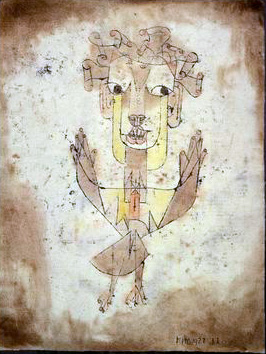
Datei:Klee, Angelus novus.png

A monolingual proofreader or editor isn’t always the best solution as the example of What Ever Happened to Modernism? nicely illustrates.

Let me put one thing straight right away, I have, so far, only read 16 pages of Josipovici’s What Ever Happened to Modernism? and had to frown already more than once. I think that someone who, in the early pages, mentions fellow critic’s books, labelling them as “dreadful”, should be a bit more careful when exposing his own train of thought and how he chooses to underline his theory.

To quote or not to quote? is not the key question. Crucial is how you do it.  In the original language and offering a translation? Or the translation only?

I did not understand why Josipovici does in some cases quote the English translation followed by the original or in other cases followed only by bits of the original and sometimes only the translation. Let’s presume he has his reasons, that I didn’t get and let’s leave it at that but when I come upon a key expression like Max Weber’s “disenchantment of the world” and find the German original expression – in brackets – rendered as Die Entziehung der Welt and not, as it should say correctly, Die Entzauberung der Welt (p. 11), then something must have gone really wrong. There are only two explanations. Josipovicis’ editor doesn’t speak German or he himself doesn’t speak German. If the latter is the case, I have a few additional problems.

How could that happen? How could die “Entzauberung” become die “Entziehung”? The first means “disenchantment” and is the correct term used by Max Weber while the other signifies “divestment”. I think, this is embarrassing. Maybe Josipovici’s book is not dreadful but his German sure is. Entziehung isn’t even a proper noun but a noun that has been built by adding the affix -ung to a verb (entziehen – Entziehung), unlike Entzug. “Entziehen” also signifies “to withdraw”.

Additionally I’m still thinking about his definition of modernism. Modernism, as he writes, should neither be seen as a period nor a style but rather as art that makes its production one of its key themes (yes, I do simplify), self-conscious art that reflects itself, so-called metafiction.  I thought that was the definition of postmodernism. To make something clear here, the term metafiction isn’t used (he is talking about art in general anyway), Josipovici is very accessible, not a complicated writer at all. He is neither a Blanchot, Derrida nor a Barthes. No, the way he writes is very Anglo-Saxon. Funny that.

To be honest, I am,  among other things, a linguist with a fondness of Freudian slips and that is why I will finish Josipovici’s book. I appreciate things that make me laugh.

On a more generous note, I would say that, early on, Josipovici has, unconsciously and through a lapse, revealed what he really wanted to write about which isn’t the disenchantment but the divestment of the world. Or rather the divestment of literature. I do agree with his subconscious. I think, literature doesn’t suffer so much from being too modernist or not modernist enough but because it buys too much into consumerism.

By the way, I’m not a native English speaker and I didn’t have a proofreader. Mistakes and lapses are entirely my own.

Datei:Ohne Titel, um 1892.jpg

Sarah Gardner Borden: Games to Play After Dark (2011)

An unsparingly honest portrait of one marriage’s devolution into train wreck. Borden covers it all—from the resentments that build over childcare to the sex that’s no longer fun. Reading Games to Play After Dark is as intimate an experience as reading someone’s diary.

It is hard to believe that Games to Play After Dark is Sarah Gardner Borden’s first novel. The topic, a marriage that falls apart, may not be the most original, the young mother who tries to combine the demands of her children and her husband and her personal needs, isn’t new but how she describes it, the details she evokes, the way she looks at what has been swept under the carpet and the bed and what is hidden in the closets is extremely well done.

There have been a few similar books in recent years. Rebecca Miller’s The Private Lives of Pippa Lee, Rachel Cusk’s Arlington Park and Ayelet Waldman’s Love and Other Impossible Pursuits (see my review) are a few I have read. Many recent thrillers and crime novels also explore marriage and family life. One of the distiguishing traits of this novel is that Borden looks at sexuality in a detailed way and handles the topic explicitly. The games that are played after dark, are indeed of specifically sexual nature. More than any other recent writer of domestic disasters, Borden shows human beings as sexual beings, initiating with the discovery of sexuality by young people and leading to the sexuality of adults in- and outside of marriage.

Kate and Colin meet at a party, fall in love and get married soon after. The first years are intense and enjoyable but the moment the sexual attraction diminishes, things get complicated.

She became finicky about sex, wanting it only occasionally. Her body began to feel like a recently tidied room that she didn’t want Colin to mess up.

After the first child the marriage gets really awry. Kate has a hard time to cope and Colin, who is on a career path, doesn’t help much. The discussions and disputes that follow are some of the best bits of writing in this novel. A second child seems a good idea at first, after all, they want to be a “real family” and that is, according to Kate and their friends, only possible with a second child. After the second child is born, Kate doesn’t want any physical intimacy from Colin anymore. Her need of tenderness and proximity is covered by her daughters. She loves to lie in bed with them, feel their warm bodies.

But there is also decidedly more house work with a second child and the second daughter, on top of that, is a horrible brat. A child from hell. Scenes like the one below are all too frequent.

How much longer could she continue, could she stand it: the serving, the directing, the resulting absurd sense of abuse, the constant tiny negotiations of space? On the landing as Kate dropped the stuff and bent to collect her keys from her purse, Robin kicked her in the behind.

The older the girls get, the uglier the marriage turns. Although they try hard, they go to see a therapist, they try “date nights” and “family dinner”, things always go wrong. Kate and Colin fight constantly and more than once they both display violent behaviour. It is obvious Kate cannot take it much longer. She desperately tries to find a way out and the first path she chooses, is the well-known one of the affair. This is the only bad story line Borden told, not so much because she chose to have Kate start an affair (after all this seems more than common) but because it doesn’t seem plausible. In any case, the affair doesn’t last very long, and Kate will have to find another way out.

It’s a well-told book, I loved reading it and was captivated. I also appreciated that Borden seems to say, that not every marriage has to turn out like this, having children doesn’t need to be like this but there are combinations of people and circumstances that seem doomed from the start. Kate’s character and her past prepared the ground for this disastrous marriage. And Kate, when thinking back and remembering the beginning when they just got married wonders:

She had no idea if at that point things could have gone one way or the other, or if only one way, this way, had been available.

It is obvious that it isn’t only Colin’s fault, things go wrong, although, during their disputes, we think it is. The reasons lie much deeper and we see some of it in an early passage.

She could see that doing what he wanted was compelling for both of them, and that to interfere would interfere with the sexual chemistry that served as foundation for their bond. “Okay,” she said. “I don’t care where I am, ” she said, “so long as we’re together.” But later that night, doubt moved in her.

Kate doesn’t know herself and has not learned to analyze her feelings which is a bad foundation for a marriage. She had a complicated relationship with her father, which we get to know in flashbacks all through the novel.

Sexual attraction, sexuality and intimacy are core themes in Games to Play After Dark . The way they are described indicates clearly that they are no games but, on the contrary, powerful forces that need to be handled with care or they will constantly influence, interfere and fire back.

I’m very interested to see where Sarah Gardner Borden will go after such a promising debut novel.