Barbara Trapido: Sex & Stravinsky (2010)

This was my first book by Barbara Trapido but I think it will not be the last. It has flaws but I could generously overlook them as there is so much to enjoy in Sex & Stravinsky.

Sex & Stravinsky is told in alternating points of view something I usually  don’t like unless it is done as well as Barbara Trapido does it. What is really impressive is how different those voices sound. The story could be told in a few words as the book is really focussing more on the characters than on the plot.

The Australian Caroline meets Josh, a South African, in London. Josh is fascinated by opera, ballet and pantomime, dedicating his whole live to these topics. They have a daughter Zoe who would love to become a ballet dancer but since money is tight she has to make do with reading ballet books that are written by Hattie whom she doesn’t know.

Hattie is the secret love of Josh’s life. She still lives in South Africa with Hermann, the tall blond of Boer descent. They have a daughter Cat who is highly creative but hates her mother’s guts.

And there is Jack, Jacques or Giacomo, depending on the mood of the day, a young man of modest background who reinvents his own story as he moves from South Africa to Senegal, to Italy and back to South Africa.

There are a lot of coincidences in this book that seem unrealistic and still Barbara Trapido can get away with it as her characters are truly wonderful.

At the beginning of the novel, the couples are in their respective countries, at the end they all meet in South Africa, more or less by chance.

Caroline is by far the most appealing character and I could relate to her story. She was followed to London by her awful mother who exploits and abuses her whenever she can. Although Caroline is strong – she can renovate and redecorate a house like any man could, she is over six feet tall and a stunning blonde beauty, she transforms a bus into a little paradise, she knows how to cook delicious meals out of nothing, sews the most wonderful clothes out of old pieces -she cannot fight her own mother and her horrible sister. Unfortunately the description of her mother, the event of her cerebral hemorrhage including the story of the will and the unhappy discoveries linked to it felt all too familiar…

Each one of them does not live the life they had dreamt of but they will all get their chance in the end.

I really enjoyed this book. It exudes globalization and all the elements of living in a multicultural world. We hear as much about Stravinsky as about the masks of the Dogon. But, and this is my critique, it sort of flies over these cultural elements. It is a bit like standing at an enormous buffet with fingerfood from every corner of the world. A little taste of Moroccan cuisine, morsels of Northern Italian anti-pasti, a sandwich with a Caribbean spread.

Still, I liked it a lot: I loved the descriptions of the characters. Talented Caroline, Hattie the petite dancer, rebellious Cat, adopted Josh, Herman the boorish architect, little Zoe who discovers France on a school trip.

Zoe’s school trip to France is one of the best parts. Poor Zoe lands in a dysfunctional lower class family with unhealthy habits, a lot of shouting, awful driving in a smoke-filled car.

One theme that we find in the whole novel is legitimacy. There are three characters in this book who don’t know who their real parents are.

I believe Barbara Trapido just invented the genre of the  21st century multicultural fairytale.

One thing I would be interested in however, why did she choose this title? Has anyone an idea?
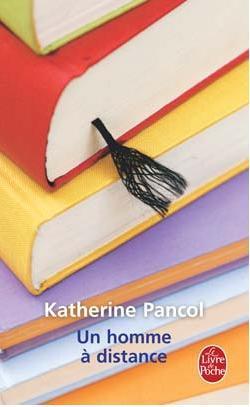
Katherine Pancol: Un homme à distance (2001) An Epistolary Novel about Books

This little book, Un homme à distance, only 160 pages long, is a real gem. I was so enchanted by it. In the evenings I could hardly wait to get back from work and go on reading. Why it has not been translated is a total mystery to me as it would find a multitude of readers in the English-speaking world.  It is also surprising since Katherine Pancol lived in the States where she took creative writing courses at the Columbia University. It is a novel in letters and a novel about books that has been compared to 84, Charing Cross Road by Helene Hanff. We find the same passion for books, the same enchantment. The story is quite simple. A young woman, owner of a book shop in Fécamp (a fishing port with an attractive seafront promenade located between Le Havre and Dieppe, in the French Normandy region), starts a correspondence with a mysterious man. They exchange their thoughts on all sorts of books, some I had never heard of before but, as a true addict, had to buy immediately since I knew the others and they are all outstanding.

The tone of this novel is quite melancholic. The young shopkeeper is heartbroken about the end of an affair which makes her live like a recluse. This correspondence brings her back to life. The end stunned me. It was not what I had expected.

Let’s hope  she will be translated or that the one or the other reader of this post does read  French.

As many of the books mentioned are absolute favourites of mine and the others seem to be must-reads too and for all those who are curious, I made a list.

Contrary to Pancol’s books they are all available as translations.

The Great Meaulnes or The Lost Estate by Henri Alan-Fournier. The Princess de Clèves by Mme de Lafayette. Wuthering Heights by Emily Brontë

The Notebooks of Malte Laurids  Brigge by Rainer Maria Rilke. The Wild Palms by William Faulkner. Three Horses by Erri de Luca

Bakunin’s Son by Sergio d’Atzeni. The House of Others by Silvio d’Arzo. What Maisie Knew by Henry James

Les liaisons dangereuses by Choderlos de Laclos. Letter from an Unknown Woman by Stefan  Zweig. The Letters of a Portuguese Nun.

Cousin Bette by Balzac. Les Diaboliques by Barbey d’Aurevilly. Doomed Love Camilo Castelo Branco. The Letters of Gustave Flaubert.

A Selection of the Chroniques by Guy de Maupassant. The Complete Poems of Emily Dickinson.

Sonnets from the Portuguese by  Elizabeth Browning. The Journal of Delacroix

The only one that has not been translated is Confidence africaine by Roger Martin du Gard.

One that would need to be rediscovered is The Lost Estate. It is probably the novel that influenced Fitzgerald in writing The Great Gatsby. But, as stated before, all the books on this list are excellent and remarkable.

Katherine Pancol has written quite a lot of books. They have all been very successful in France, even more so than this one. The most notable seem to be Les yeux jaunes des crocodiles, La valse lente des tortues and Les écureuils du Central Park sont triste le lundi.

You can visit Katherine´s French/English Homepage.

Lauren Groff: The Monsters of Templeton (2008)


This is quite an unusual, hybrid book. There were passages I enjoyed a lot. The atmosphere and description of Templeton were something to savour. The idea of a monster living in the lake and the ghost in Willie’s bedroom appealed to me a great deal as well. But as much as I loved the beginning and many later parts I lost patience at times. My biggest problem was that I found it too exuberant and too artificial. It is full of great descriptions but totally lacks any psychological depth. The characters, Willie, her mother Vi, Cassandra and many others are charming but they are two-dimensional. Still I can understand that this book found his ardent fans.

At the beginning we see Willie depressed and sad. She is pregnant from her affair with her professor and comes back to Templeton where she grew up looking for refuge. She considers this to be a total failure. She has left Templeton for San Francisco a few years back. Templeton, as we read in the foreword, is actually Cooperstown, Groff’s hometown. It is also the hometown of James Fenimore Cooper. A small town with all the charm of a small town. While away in California Lauren Groff was so homesick that she decided to write about her town.

Apart from being pregnant and desperate, Willie hears from her mother,  that she is actually the daughter of someone from Templeton. After having thought she was the offspring of her mother’s casual encounters with different men during her hippie days, this comes as quite a shock. Willie being an archeologist and trained in research takes this bit of information as a challenge. She starts to investigate the story of her illustrious family, descendants of the great Marmaduke Temple (aka James Fenimore Cooper) in order to find out who her father is. She knows that one of the men in her genealogical tree is illegitimate and this information will lead her to her father.

The story of Willie is interspersed with journal entries, letters, diaries, stories of her ancestors. They are quite different in tone, some are like short stories in their own right and seem to have been written in another century, some were, for me, just tiresome diversions.

In the end, Willie knows the name of her father. She has learnt a great deal about her family and her town. The weak and depressed Willie of the beginning is strong again and able to go out into the world where a brilliant future is waiting for her.

This book deals with some heavy and important themes like illegitimacy / legitimacy / roots /origins /  parenthood/ history. In the beginning there are a lot of  signs of the insecurity of the times we live in but throughout the novel this is more and more abandoned. It is as if the author wanted to say: When you know your origins and where you belong you can never get lost and nothing can really harm you. I am not sure I agree with this.

Be it as it may, this is an original book and some parts are memorable. It’s just somewhat flawed as  a whole.

I would really like to do Lauren Groff justice so maybe I should let her speak for herself:

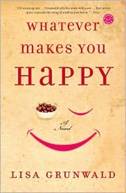
Lisa Grunwald: Whatever Makes You Happy (2005)

Whatever makes you happy is probably a book you either love or hate. It is a blend between fiction and  non-fiction  and very frankly this did not work for me. I found it highly artificial. But it is not boring, so that is one good thing.

Sally Faber, a 40-year-old writer, is trying to write a book about happiness. While struggling with writing she faces a lot of challenging moments in her life. Her little girls leave for the first time for two months to go to summer camp. Her mother leaves her with the challenging task to empty an appartement she owns whose inhabitant, a psychiatrist, has died without leaving any heirs.

Despite all of this Sally seems to have it all. A great live, cute girls, an understanding gentle and successful husband yet she endangers all of this by starting an affair with a megalomaniac self-centered artist who supposedly understands her better than her husband.

The idea to let us dive into Sally’s research was already quite artificial but to sort of test some of the theories by inventing this odd affair was even more so. It just did not make any sense. I did not understand what she did. In the end it felt less like a novel than like an experiment and playing around with the concept of happiness. Sure, there are quite a few insights, views and bits of information that are interesting, which is probably why many readers liked this, but it spoilt the novel for me to have it presented in this way.

Aspiring writers learn to show and not tell, and that is exactly what I would like to tell Lisa Grunwald.

I think it is disappointing because the idea of a novel about happiness appealed to me. The only bit I really liked was the way she described Sally´s feelings for her little girls. That was truly touching.

I should have known what to expect since this novel was recommended by Gretchen Rubin whose Happiness Project I found equally disappointing.  More of that in my next post

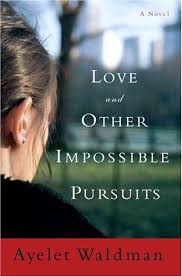
Ayelet Waldman: Love and Other Impossible Pursuits (2006)

I was so curious to read this. I had heard such a lot about Ayelet Waldman and most of it was fuelled by hate. I still do not understand this at all. Just because she questions motherhood? Because she admits, it is no picnic? Be it as it may, I really liked this book. It just swipes you away.

Emilia is married to the love of her life, Jack, but she is not his first wife. And there is also William, his son from his first marriage. A precocious and at times obnoxious child. Emilia cannot handle him and cannot handle her guilt either. Guilt that she was the reason Jack broke up with his wife Caroline, and guilt because she feels responsible for the death of her daughter Isabel who died on her first day home from the hospital just after she was born. This grief and her guilt overshadows everything. And the fact that her father left her mother for a young Russian prostitute.

A lot of heavy stuff but the prose is very light and funny enough this book is never depressing. I found it extremely interesting. It is also a portrait of the city of New York and a description of what it is like to be a mother in New York. Many things that probably only a New Yorker knows, like urbanbaby.com, the running moms of Central Park, A Walk to Remember. Movies and books about New York hold a special appeal for me. This one is no exception. I loved to read these insider descriptions of  walks and places that you would visit with a kid or on your own.

Love and Other Impossible Pursuits is a book that will engage you, make you think, make you wanna discuss it. It is courageous and tackles topics that are of great importance to everybody. Even to women like me who have no children.

It is really worth reading and I do also feel tempted to watch the movie.

Some questions that would be interesting to discuss:

How difficult is it to be a stepmother?

Can there ever be a conflict-free patchwork family?

How do you survive the death of your child?

Is it easier to lose a child when it is a bit older?

Is it better to share your feelings with people who have been through the same or should you see a counselor?

Would you want to replace your dead child?

Should you give him/her a name?

There are many, many more… A lot of food for thought as you can see.

Gerard Donovan: Julius Winsome (2007)

What a sad read and yet how true it felt.

If anyone has ever truly loved an animal, this book will get to him or her since the main character finds  his best friend, his dog, shot dead by some unknown person at the very beginning of this novel. Hardly ever have I been so moved by the description of someone´s mourning. But even before this tragic incident Julius Winsome has been grieving for a lot of other reasons.

He´s a loner living in a cabin deep in a forest in Maine, his only companions are the 3000 and some more books his father has left behind. They cover the cabin walls and Julius reads them one by one. He is still not over the loss of his father and is sad about having been left by the girlfriend he had for a few months who, all of a sudden, didn´t turn up any more. Apart from these two facts we hear nothing about his biography. It´s as if his memories were  solely composed of his grandfather´s stories of WWI and his father´s tales from WWII and some odd remembrances linked to his memorizing words found in Shakespeare´s plays and sonnets.

Julius has always been a defender of animals and to find his beloved dog senselessly shot dead triggers something  very dark in him.

In the chapters following the opening scenes we see him take revenge.

Gerard Donovan is also a poet so it is only natural his style should be very poetic and picturesque. You can almost hear the snow fall when it starts to cover  the dog´s grave. You can hear the gunshots from the hunters that so infuriate Julius and you feel the utter loneliness of this gentle man turning into an avenger.

Julius Winsome American edition amazon.com

Julius Winsome American edition barnes and noble

Julius Winsome (engl.) European Edition amazon.de

amazon.co. uk

Reviews

Review guardian co uk