Siri Hustvedt: The Shaking Woman or A History of My Nerves (2010)

While speaking at a memorial event for her father, the novelist Siri Hustvedt suffered a violent seizure from the neck down. Was it triggered by nerves, emotion – or something else entirely? In this profoundly thought-provoking and revealing book, Hustvedt takes the reader on her journey through psychiatry, philosophy, neuroscience and medical history in search of a diagnosis. Conveying the often frightening mysteries of illness, she illuminates the perenially mysterious connection between mind and body and what we mean by ‘I’

Siri Hustvedt is one of my favourite writers. Whenever she has a new novel out I’m likely to buy and read it. I’m a bit behind as I haven’t read Sorrows of an American and The Summer Without Men yet. Until now I haven’t read any of her essays but was planning on doing it and when I saw The Shaking Woman or The History of my Nerves in a bookshop I bought and read it immediately.

Whether someone likes this book or not depends a lot on the expectations. Many readers where disappointed to find a blend. The Shaking Woman is halfway between essay and memoir, very dense, hardly anecdotal but highly informative and thought-provoking.

“Nerves” is such an interesting term and topic. I recently watched the movie Housewife, 49 based on the diaries that a 49-year-old housewife wrote during WWII. She is  depressed and, as she says, “nervous” or has problems with her “nerves”. I also seem to remember distinctly Mrs Bennett in Pride and Prejudice exclaiming on and on “My poor nerves”. By using the word we may mean quite a lot of things and this is precisely what Siri Hustvedt hints at too.

During a speech for her late father Siri Hustvedt started to shake violently from chin down. She continued to speak and the shaking wasn’t in any way audible, it didn’t affect her capability to speak in any way. She says she didn’t even feel nervous or anxious before the speech. If this had happened only once she might not have felt tempted to undergo so many tests and read such a lot about various topics. But it did happen again and from what I understood still happens to this day.

Everybody with a chronic disease can feel with Siri Hustvedt and her struggle to make sense of what happens. It’s the nature of many chronic diseases that are somewhere on the borderline between physical and psychological to be hard to diagnose and even harder to treat.  These are some of the topics she writes about. But she doesn’t only write about the different tests and treatments she undergoes, she looks for a deeper meaning. What does it mean when you say “I’m ill”? Who is this “I”? What does it mean when you say you are physically ill? Is your mind not part of your body?

Who are we anyway? What do I actually know about myself? My symptom has taken me from the Greeks to the present day, in and out of theories and thoughts that are built on various ways of seeing the world. What is body and what is mind? Is each of us a singular being or a plural one? How do we remember things and how do we forget them? Tracking my pathology turns out to be an adventure in the history of experience and perception.

She thinks for a long time that what she has is a convulsion disorder and therefore we hear a lot about the history of hysteria, its early treatment and what has become of it now. She parallels hysteria and shell-shock and wonders why both terms are now out of fashion.

One of the doctors she consults tells her she has a panic disorder and she also reads a lot about this.

But it wouldn’t be Siri Hustvedt if she stopped there. She goes far beyond her illness and so, in the end, this book is less about a symptom than about the mind as a whole. She also writes at length about migraine and different ways of perceiving the world. About memory and imagination.

When I read a novel, I see it, and later, I remember the images I invented for the book. Some of these images are borrowed from intimate places in my own life. Others, I suspect, are taken from movies or pictures in books and paintings I’ve seen.

She also writes about mysticism, Merleau-Ponty, Simone de Beauvoir, Freud and mixes all kind of views and theories.

At the end she has explored numerous things but still doesn’t know what she really has.

The Shaking Woman describes one woman’s intellectual journey that starts with a symptom and ends with an exploration of all sorts of disciplines, theories and views on consciousness. It seems as if the inconspicuous sounding word “nerves” was a little door that Hustvedt opened to enter a huge, huge landscape. I’m glad I took the journey with her.
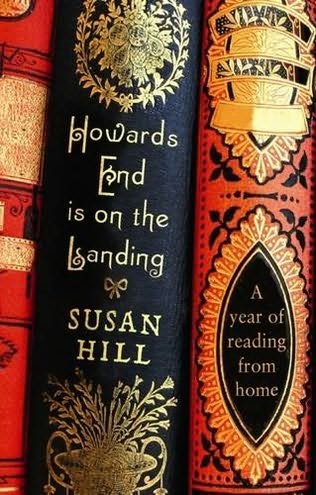
Susan Hill: Howards End is on the Landing (2009) A Bookish Memoir

Early one autumn afternoon in pursuit of an elusive book on her shelves, Susan Hill encountered dozens of others that she had never read, or forgotten she owned, or wanted to read for a second time. The discovery inspired her to embark on a year-long voyage through her books, forsaking new purchases in order to get to know her own collection again. A book which is left on a shelf for a decade is a dead thing, but it is also a chrysalis, packed with the potential to burst into new life. Wandering through her house that day, Hill’s eyes were opened to how much of that life was stored in her home, neglected for years. Howard’s End is on the Landing charts the journey of one of the nation’s most accomplished authors as she revisits the conversations, libraries and bookshelves of the past that have informed a lifetime of reading and writing.

I can’t tell you exactly how long it took to read this book. An evening? Two? Certainly not longer. I devoured it. What is more fascinating to read than a bookish memoir? And written by a writer. On top of that Howards End is on the Landing also contains some information on Strange Meeting, the first book I chose for my Literature and War Readalong.

Shouldn’t we all stop buying books from time to time and first read what is at hand, on our own shelves? This is exactly what Susan Hill did for a whole year. During this year she discovered and rediscovered a lot of books and writers, was reminded of many memories that are linked to books and writing and chose her own personal canon of 40 books.

It is an extremely interesting and entertaining and at times frankly puzzling book. Susan Hill doesn’t read Canadian or Australian literature. Why not? Too foreign. She thinks Joyce, Proust and a few others are unreadable. Are they? There were bits and pieces of information like this that did surprise me. But she is honest. She isn’t pretending for one second. It is obvious that this is the book of a reader, it is nothing like Francine Prose’s outstanding Reading Like a Writer, it is only about personal choices and tastes. There are whole chapters dedicated to her favourite female writers: Barbara Pym, Anita Brookner, Virginia Woolf, Penelope Fitzgerald and Iris Murdoch.  She has met quite many of the writers she mentions and tells anecdotes that are interesting too.

One whole chapter is dedicated to diaries, another one to picture books, one to things that fall out of books, another one is dedicated to annotations in books and  she muses over short stories (not her favourite form).

Sebald gets a whole chapter which surprised me after what she said about Proust and Joyce and others. I’m glad I am already reading his Austerlitz or I would have to rush and get one of his books. She really makes him sound appealing. I agree with her, there is no writer like Sebald.

His subject matter is extraordinary, unpredictable and odd – he seems to collect the unusual and be interested in the outlandish, but, through his eyes, even the ordinary and prosaic becomes somehow strange. Everything he sees, everywhere he goes, every person he meets, all are filtered through some curious lens of his own devising.

Something that I liked is her evaluating some of the classics and giving advice with which one of their novels one should start. One should read Hardy’s The Mayor of Casterbridge and not start with Tess of the d’Urbervilles or Jude the Obscure. Sounds sensible.

If she had two choose among the ghost stories she knows, she would choose M.R. James’ O Whistle and I’ll Come to You and Edith Wharton’s  Mr Jones. Given that it’s a genre in which she excels, I take her word for it.

When it comes to short stories in general she likes John McGahern, William Trevor and Katherine Mansfield.

Travel books are also covered and here it is Patrick Leigh Fermor who gets a special mention. He is also mentioned in her chapter on editing books, something she has also been doing for quite a while. Fermor is one of her authors.

One chapter I enjoyed particularly was the one on diaries. I would have liked to start all the books mentioned right away and have never heard of some the authors she loves to read and reread. Namely the Reverend Francis Kilvert and Frances Partridge. But she also loves Virginia Woolf’s A Writer’s Diary and, surprisingly (as she doesn’t like his novels at all), The Journal of Sir Walter Scott.

All in all I highly recommend this book. It’s very colloquial and reading it feels like talking to a good friend about the books and stories he or she likes. I found a lot of books I’m looking forward to reading now, especially those that are waiting on my shelves. In this sense it is an inspiring book that put me in the mood to concentrate more on the books I already have and not acquire so many news ones.

Out of the list of 40 novels she indicates, I chose to reproduce a list of the novels written by women that she thinks to be among the best. I chose only the women because a) they are not as numerous and b) I would like to read more female authors this year and c) you should still have a reason to read her memoir.

I read and reviewed Carson McCullers and read To the Lighthouse as I have read all the novels by Virginia Woolf (except Voyage Out). The Rector’s Daughter and The Blue Flower are those I am most curious about.

Which ones of these novels do you know and like?

The Ballad of the Sad Café by Carson McCullers

The Last September by Elizabeth Bowen

Middlemarch by George Eliott

The Blue Flower by Penelope Fitzgerald

To the Lightouse by Virginia Woolf

The House of Mirth by Edith Wharton

The Rector’s Daughter by F.M Mayor

The Pursuit of Love by Nancy Mitford

The Bell by Iris Murdoch

Family and Friends by Anita Brookner

The Finn Family Moomintroll by Tove Jansson

David Gilmour: The Film Club (2007) A Touching Memoir of a Father and His Teenage Son Watching Their Way Through Cinema History

It was an unconventional deal: Jesse could leave school, sleep all day, not work, not pay rent – but he had to watch three films a week … of his father’s choosing. Week by week, side by side, father and son watch the world’s best (and occasionally worst) films – from True Romance to Chungking Express, A Hard Day’s Night to Rosemary’s Baby, Showgirls to La Dolce Vita. The films get them talking – about girls, music, heartbreak, work, drugs, money, love, friendship – and they open doors to a young man’s interior life at a time when parents are normally shut out. Gradually, the son develops from a chaotic teenager into a self-assured young adult, but as the film club moves towards its bittersweet and inevitable conclusion, Jesse makes a decision which surprises even his father… The Film Club is a book that goes straight to the heart. Honest, unsparing and poignant, it is the true story of one man’s attempt to chart a course for his beloved son’s rocky passage into adulthood.

David Gilmour’s The Film Club was one of the few books that I bought following a recommendation in a book shop. You know those corners where the staff piles up the books they read during the year and liked a lot? Well, this was on one of them. It is not only a memoir – the non fiction genre I like best – but a book that speaks extensively about movies. It isn’t a literary masterpiece, it is no The Liar’s Club or The Glass Castle, but it is very, very entertaining and quite touching. Gilmour is very outspoken when it comes to feelings. He writes as easily about joy as about anxieties.

Picking movies for people is a risky business. In a way it is as revealing as writing someone a letter. It shows how you think, it shows what moves you, sometimes it can even show how you think the world sees you.

When Gilmour’s teenage son starts to show an alarming disinterest in school, Gilmour decides to let him leave school under one condition, namely watching three movies per week with his father. Three movies that his father chooses, of course. It’s an experiment and when they start Gilmour is as uncertain about the outcome as the reader.

Gilmour, a novelist and journalist, has come to a major turning point in his own life. He is out of work and desperately trying to get little TV assignments here and there. Being out of work, panics him, on the other hand it gives him a lot of time to spend with his son. Knowing very well that the boy isn’t going to stay with him forever he cherishes every moment. No wonder the book is full of nostalgia and has a very bitter-sweet tone.

I return to old movies not just to watch them again but in the hope that I’ll feel the way I did when I first saw them; not just about movies either, but about everything

During the three years that follow Gilmour’s idea of letting his son drop out of school, he shows him the greatest of filmmaking there is. They watch movies by periods, by schools, by themes, by countries. I think he lists at least some 80 movies including some from the French nouvelle vague, the New Hollywood movement, Japanese film making, Western, Horror, Comedies… The first few choices are far from succesful as Jesse, Gilmour’s son, finds them unbearably boring. He has no clue how to watch a French movie for example, doesn’t know which are crucial scenes to look out for in a Hitchcock film. Normally before showing the movie to his son, Gilmour will give some background information, a lot of it was very enlightening. He explains to him why certain actors are better than others, that the best of them are even great when they don’t even say a word, he shows him special camera angles, indicates pieces of dialogue. It takes a year until Jesse starts to see and enjoy the movies they are watching and develops a taste of his own. He loves Chungking Express.

True Romance has a eight- or nine minute encounter between Dennis Hopper and Christopher Walken that may well be, for me, the best stand-alone scene in film. (….) Christopher Walken announcing “I am the Antichrist”.

But this book isn’t only about movies. The movies also serve as basis for discussions about everything. And life goes on. Gilmour struggles to find a job, Jesse falls in love twice and both times end in disaster. The second heart-break is so intense, you have to be really hardened to not be reminded of something similar in your own life.

Showgirls,” I said to Jesse, “is something of a cinematic oddity, a guilty pleasure without a single good performance.”

It is obvious that the experiment described in the book helps them both. Jesse finds perspective. After living as a rap musician for a while, he takes a completely new direction and David Gilmour writes this book. The relationship between these two is unique. So much honesty, trust and friendship between a father and a son is wonderful. Not every parent has the chance to spend as much time with his kid, that is for sure, but every parent has certainly spent enchanted moments with his/her child and will be touched by this story. For us film lovers it’s a great way to remind us how many movies there are still to discover, how many to watch again and in how many different ways we can watch them.

Here’s a video in which they talk about the book.

David and Jesse Gilmour talk about The Film Club

Nora Murphy: Knitting the Threads of Time Casting Back to the Heart of our Craft (2009) A Memoir

You don’t need to be a knitter to enjoy this book. I am not. Still I liked this book for many reasons. It is a memoir in which Nora Murphy takes us on a personal journey on which she starts and finishes a difficult sweater for her son and explores the manifold meanings of knitting, yarn and clothes.  Now is the perfect time to read it as the memoir starts in October and ends three months after All Soul’s Day. Her style is very evocative.

A woman sits in her comfy chair. Two needles and a ball of yarn keep her company. She is knitting away at something. Maybe a scarf? Socks? She enjoys the sound of her needles beating like a soft drum. She inhales the smell of the waxy yarn. She exhales the satisfaction of watching a single strand transform into an object of beauty. She is perfectly present, in perfect bliss. (Epilogue, Darkness Falls p. 3)

And another teaser:

October is a bit like the last dance in Minnesota. We know it’s the first month of darkness, but we don’t want to acknowledge it. We’d prefer to keep our attention on the sunlight dancing off the red and orange and yellow and gold and brown mosaic in the trees overhead. But we know better – a long winter awaits us. (Leaves p. 13)

Nora introduces us to herself, her family and her friends and the people she meets on her journey. She opens up her house and her heart for us. We are allowed to catch a glimpse of her cozy little home and the life she lives with her two sons and Diego her friend and lover. Through her we meet a woman who owns a yarn shop, an owner of a sheep farm and all of her animals, and many other people. We get to know Minnesota through several seasons. And we learn a lot about yarn. Nora Murphy combines history and cultural anthrolpogy. I did not know, for example, that King George’s Wool Act of 1699 might have been responsible for the American Revolution. England felt its wool industry was threatened by the colonies and forbid to export sheep to America. But some animals had been smuggled in and where already quite numerous by 1665. At some time, anyone found guilty of trading in wool faced severe punishment. The cutting-off of hands is mentioned. However, unlike Ireland, America was too far away from England to be threatened for long and the way to independence could not be blocked forever.

Nora’s book is also a lesson in values. Cherish the moment. Learn from the past. Try something new. Remember the simple things. In a world that spins in confusion she tries to build stability and conveys this to those around her and her readers. I felt very comforted, enchanted and energized by this book.

Nora Murphy’s Homepage